
To the Editor,
Significant tricuspid regurgitation (TR) is common in the setting of advanced heart failure and is associated with a poor prognosis. In patients supported with a left ventricular assist device (LVAD), TR may persist or worsen because of right ventricular (RV) remodeling and mechanical interaction with intracardiac devices. Transcatheter tricuspid valve replacement (TTVR) has expanded the therapeutic options available to patients at high surgical risk; however, experience in patients with both an LVAD and transvalvular leads remains limited.1-3
The prevalence of significant TR among patients with an LVAD is estimated to affect approximately 40%.4 We describe 2 patients with an LVAD and intracardiac devices with transvalvular leads who underwent orthotopic TTVR with an EVOQUE prosthesis (Edwards Lifesciences, United States). To our knowledge, these are the first such procedures performed in Europe, and no previous reports have described the use of the EVOQUE prosthesis in this highly complex anatomical and hemodynamic setting.
The first patient was a 74-year-old man with nonischemic dilated cardiomyopathy diagnosed in 2015 and persistent severe left ventricular dysfunction, with a left ventricular ejection fraction of 27%. In 2016, an implantable cardioverter-defibrillator (ICD) was implanted for primary prevention. From 2022 onward, the patient’s clinical condition deteriorated, with advanced heart failure and N-terminal pro–B-type natriuretic peptide (NT-proBNP) levels > 35 000 pg/mL. Therefore, he underwent implantation of a HeartMate 3 LVAD (Abbott, Belgium) as destination therapy. Preoperative echocardiography showed mild RV dilatation (45 mm), preserved longitudinal RV function, with a tricuspid annular plane systolic excursion of 17 mm, and mild TR. After LVAD implantation, the RV progressively dilated to 58-60 mm, and TR worsened to grade III/IV. Eleven months after implantation, the patient was readmitted with predominantly right-sided heart failure decompensation. Echocardiography showed massive TR caused by RV dilatation and interference from the ICD lead. NT-proBNP, which had decreased to 5000 pg/mL after LVAD implantation, subsequently increased to 17 569 pg/mL. Right heart catheterization showed a central venous pressure of 10 mmHg and pulmonary artery systolic/diastolic pressure of 30/12 mmHg. Because torrential TR persisted, TTVR was indicated.
The second patient was a 72-year-old man with longstanding ischemic heart disease and persistent severe left ventricular dysfunction, with a left ventricular ejection fraction of 19%. An ICD had been implanted in 2005 and upgraded to cardiac resynchronization therapy in 2019. During the assessment before LVAD implantation, echocardiography showed RV dilatation (> 60 mm), a tricuspid annular plane systolic excursion of 15 mm, and massive TR predominantly involving the posterior leaflet and related to interference from the device lead. Estimated pulmonary artery systolic pressure was 47 mmHg, and NT-proBNP was 6597 pg/mL. Despite the presence of massive TR at the time of LVAD implantation, concomitant correction was not performed because of the high surgical risk and the expectation of improvement after left ventricular unloading, a strategy supported in selected clinical scenarios described in the literature. After LVAD implantation and restoration of euvolemia, torrential TR persisted, with RV dilatation but preserved RV function. Before TTVR, NT-proBNP had decreased to 2008 pg/mL, and the LVAD was operating at 5100 revolutions per minute, providing flows of 3.5-4.2 L/min.
In both patients, TR had a mixed mechanism, combining annular dilatation due to RV remodeling and mechanical interference from the device lead. Preprocedural computed tomography was performed in both patients to select prosthesis size and assess the implantation trajectory and depth. The procedures were guided by real-time transesophageal echocardiography, which confirmed adequate coaxial alignment and leaflet capture before final prosthesis deployment. No significant interference in the echocardiographic window was observed when proper anchoring of the prosthesis was confirmed. A 56-mm EVOQUE prosthesis was selected in both cases. There was no significant lead entrapment or changes in ICD parameters after implantation (video S1).2,3
The mean transprosthetic gradients were 2.0 mmHg and 2.2 mmHg, respectively. Residual TR was nonsignificant (figure 1). Hemodynamic interactions with the LVAD were limited and required only temporary adjustments to the number of revolutions per minute, which were reduced during the procedure and for the first few hours afterward. Oral anticoagulation with vitamin K antagonists was continued after TTVR, with no relevant changes to the remainder of the medical treatment or to LVAD management. The clinical and hemodynamic characteristics are summarized in table 1.
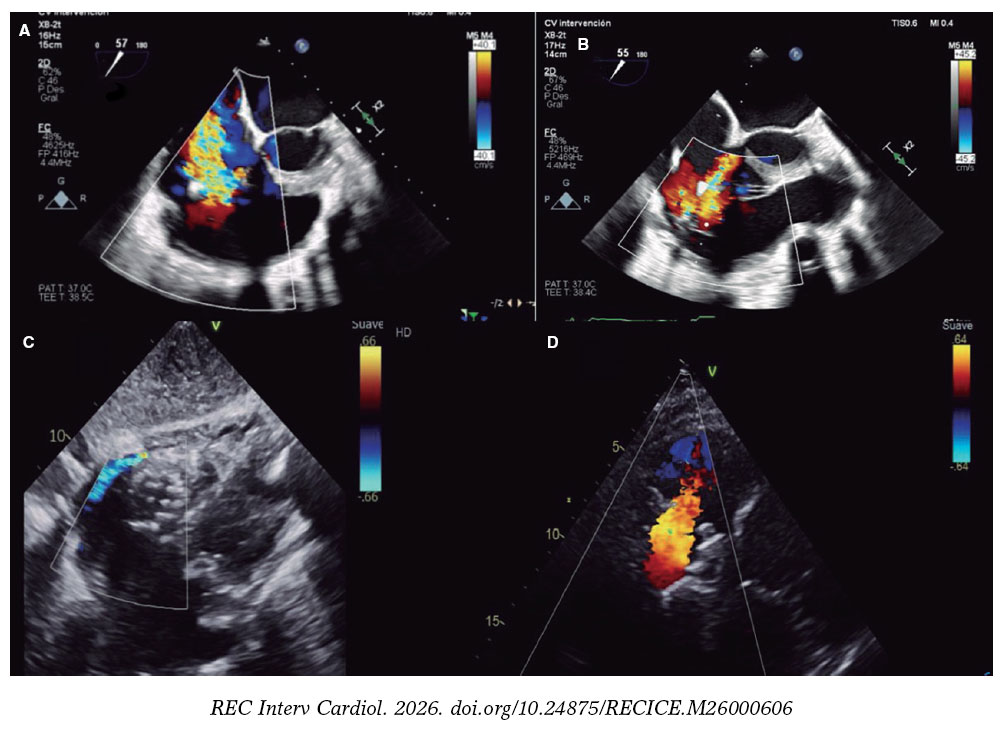
Figure 1. Initial transesophageal echocardiograms of patient 1 (A) and patient 2 (B), and transthoracic color Doppler echocardiograms obtained after implantation in patient 1 (C) and patient 2 (D).
Table 1. Baseline patient and device characteristics and procedural outcomes
| Variable | Patient 1 | Patient 2 |
|---|---|---|
| Age, years | 74 | 72 |
| LVAD type | HeartMate 3 | HeartMate 3 |
| Time from LVAD implantation to EVOQUE implantation, months | 17 | 10 |
| ICD type | Medtronic Evera SVR (dual-chamber ICD) | Medtronic Claria MRI (dual-chamber CRT-D) |
| Number of transvalvular leads | 1 | 1 |
| Additional epicardial devices | No | Yes (AtriClip) |
| EVOQUE prosthesis size, mm | 56 | 56 |
| Mean postimplantation gradient, mmHg | 2 | 2.2 |
| Residual TR | Mild | Mild |
| Inferior vena cava diameter before EVOQUE implantation, mm | 33 | 30 |
| Inferior vena cava diameter 3 months after EVOQUE implantation, mm | 15, without respiratory variation | 17, with respiratory variation |
| Vascular complications | No | No |
| Significant lead entrapment | No | No |
| Changes in pacing thresholds, sensing, or impedance | No | No |
| Available follow-up | 3 months | 3 months |
| NYHA functional class before EVOQUE implantation | IV | III-IV |
| NYHA functional class after EVOQUE implantation | II-III | II |
|
ICD, implantable cardioverter-defibrillator; LVAD, left ventricular assist device; NYHA, New York Heart Association; TR, tricuspid regurgitation. |
||
These cases illustrate 2 distinct patterns of TR in patients with an LVAD: progression after implantation in a patient with nonischemic cardiomyopathy and persistence of massive TR in a patient with ischemic heart disease. Although transcatheter edge-to-edge repair is a less complex option, in these patients, the valve anatomy, gap size, and severity of regurgitation made an optimal outcome more predictable with complete valve replacement. The main technical challenges were interaction with the transvalvular leads, optimization of delivery-system coaxiality, and adjustment of mechanical circulatory support during implantation to maintain hemodynamic stability.
TTVR was technically feasible in both patients, with low transprosthetic gradients and no clinically relevant compromise of the intracardiac leads or mechanical support function.1-3
The TRISCEND II trial demonstrated that TTVR effectively reduces TR and improves clinical status, although patients with this degree of complexity were underrepresented.1
From a pathophysiological perspective, TR in patients receiving LVAD support may result from both progressive RV remodeling and mechanical interaction between intracardiac leads and the tricuspid valve apparatus.2-4 The feasibility of orthotopic transcatheter valve replacement in this setting expands the therapeutic options for patients previously considered eligible only for conservative or palliative management.1
Both patients had a favorable cardiovascular course during hospitalization after the procedure, with improvement in heart failure symptoms.
This experience provides preliminary evidence supporting the feasibility of TTVR with the EVOQUE system in patients with an LVAD and transvalvular leads, an increasingly relevant clinical scenario.1-4
FUNDING
No funding was received for this study.
ETHICAL CONSIDERATIONS
The study was conducted in full compliance with the principles outlined in the Declaration of Helsinki. Informed consent was obtained from the patients for the procedures and publication of their data. The study was reviewed by the research ethics committee of the Complejo Hospitalario Universitario de Santiago de Compostela (A Coruña, Spain), which determined that specific approval was not required because this was a case series. The SAGER guidelines were followed when considering potential sex- or gender-related biases.
STATEMENT ON THE USE OF ARTIFICIAL INTELLIGENCE
During preparation of the manuscript, generative artificial intelligence tools were used exclusively to assist with the linguistic and structural review of the text. The authors critically reviewed the final content and accept full responsibility for it.
AUTHORS’ CONTRIBUTIONS
I. Toribio-García and A. Redondo Diéguez contributed to the conception of the study and drafting of the manuscript. I. Gómez Otero, O. Otero García, A. Martínez Monzonís, and A.B. Cid Álvarez contributed to the critical revision of the content and approval of the final version. All authors read and approved the final version of the manuscript.
CONFLICTS OF INTEREST
The authors declared no conflicts of interest.
SUPPLEMENTARY DATA
Video 1. Toribio-García I. DOI: 10.24875/RECICE.M26000606.24875/RECIC.M25000543
REFERENCES
1. Hahn RT, Makkar R, Thourani VH, et al. Transcatheter tricuspid valve replacement in severe tricuspid regurgitation. N Engl J Med. 2024;391:105-115.
2. Abbasi M, Killu AM, Van Niekerk C, et al. Lead function and abnormalities after transcatheter tricuspid valve replacement with the EVOQUE system. Europace. 2025;27:45-53.
3. Genske F, Marquetand C, Eitel I, Frerker C. Successful implantation of an EVOQUE-Tricuspid Valve Replacement System in a patient with two right ventricular ICD leads: a case report. Eur Heart J Case Rep. 2025;9:ytaf066.
4. Mendiola Pla M, Russell SD, Milano CA, et al. Late follow-up for a randomized trial of surgical treatment of tricuspid valve regurgitation in patients undergoing left ventricular assist device implantation. J Thorac Cardiovasc Surg. 2025;170:244-253.