Drug-coated balloons: from evidence to practice and a proposed antithrombotic therapy algorithm
Balones farmacoactivos: de la evidencia a la práctica y propuesta de un algoritmo de tratamiento antitrombótico
Rigoberto R. Hernández Caballero,Stefano Siliano andJosé M. de la Torre-Hernández
Servicio de Cardiología, Hospital Universitario Marqués de Valdecilla, Instituto de Investigación Valdecilla (IDIVAL), Santander, Cantabria, Spain
ABSTRACT
Drug-coated balloons (DCBs) have emerged as an effective “leave-nothing-behind” strategy in percutaneous coronary intervention, offering the potential to reduce the permanent metallic burden, preserve vasomotion, and shorten the duration of antithrombotic therapy. Current DCB technologies include paclitaxel-coated and sirolimus-coated balloons, which differ in drug delivery, tissue retention, and clinical performance. Evidence from randomized clinical trials and meta-analyses supports the use of DCBs in several coronary settings, particularly in-stent restenosis, small-vessel disease, bifurcation lesions, and patients at high bleeding risk. Optimal lesion preparation is essential to maximize procedural success. Antithrombotic management after DCB-only percutaneous coronary intervention remains insufficiently standardized. Based on the available evidence, abbreviated dual antiplatelet therapy, or even single antiplatelet therapy in selected patients at high bleeding risk, appears feasible and safe. DCBs and drug-eluting stents should therefore be regarded as complementary technologies, with their use tailored to lesion complexity, bleeding risk, and individual patient characteristics.
Los balones farmacoactivos (BFA) se han consolidado como una estrategia eficaz «sin implante» en la intervención coronaria percutánea, ya que ofrecen la posibilidad de reducir la carga metálica, preservar la vasomotricidad y acortar el tratamiento antitrombótico. Las tecnologías actuales de BFA incluyen balones liberadores de paclitaxel y de sirolimus, que difieren en la liberación del fármaco, la retención tisular y el rendimiento clínico. La evidencia procedente de ensayos aleatorizados y metanálisis respalda el uso de los BFA en varios escenarios coronarios, en particular la reestenosis en el interior del stent, la enfermedad de pequeños vasos, las lesiones de bifurcación y los pacientes con alto riesgo hemorrágico. Una preparación óptima de la lesión es esencial para maximizar el éxito del procedimiento. El tratamiento antitrombótico tras una intervención coronaria percutánea únicamente con BFA sigue sin estar suficientemente estandarizado. Según la evidencia disponible, las estrategias abreviadas de tratamiento antiagregante plaquetario doble, o incluso simple en determinados pacientes con alto riesgo hemorrágico, parecen viables y seguras. Por lo tanto, los BFA y los stents farmacoactivos deben considerarse tecnologías complementarias, cuya selección debe adaptarse a la complejidad de la lesión, el riesgo hemorrágico y las características individuales del paciente.
In contemporary interventional cardiology, drug-coated balloons (DCBs) have emerged as a viable, safe, and effective option for percutaneous coronary intervention (PCI) in selected clinical settings involving coronary artery disease.1
The appeal of the “leave-nothing-behind” strategy lies in its potential to reduce the thrombotic and bleeding risks associated with permanent metallic implants and prolonged dual antiplatelet therapy (DAPT), preserve coronary vasomotion, and maintain future revascularization options. These advantages are among the reasons why DCBs have gained an established role in the interventional cardiologist’s armamentarium.
DCB TECHNOLOGY AND MECHANISM OF ACTION
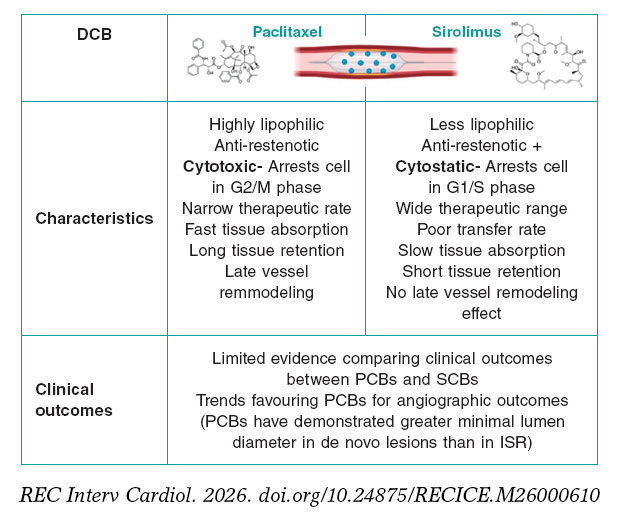
The antiproliferative agents used in DCBs can be divided into 2 main classes: paclitaxel and sirolimus.2 Paclitaxel, a well-established antineoplastic agent, is highly lipophilic, which facilitates rapid cellular uptake and enables a sustained biological effect at low doses. Sirolimus, also known as rapamycin, has potent antiproliferative and immunosuppressive properties. Because sirolimus is less well absorbed than paclitaxel, innovative excipients and delivery systems have been developed to enhance drug transfer, tissue retention, and bioavailability. To overcome these issues, microcarriers are therefore used to facilitate the gradual release and dissolution of sirolimus over time.2
In a recent large meta-analysis, paclitaxel-coated balloons (PCBs) were associated with significantly lower late lumen loss (LLL) than sirolimus-coated balloons (SCBs), although no significant difference in TLF was observed.3
Because DCBs differ in drug type, formulation, transfer kinetics, excipients, and bioavailability, they are not considered to have a class effect.1-3 The main differences between the antiproliferative drugs used in DCBs are shown in figure 1.
Future DCB technologies may incorporate novel drugs or combinations of 2 drugs within the same balloon platform.4 Consequently, different DCBs may be more appropriate for specific lesion types or patient profiles, in accordance with the current precision-medicine paradigm.
LESION PREPARATION AND PROCEDURAL TECHNIQUE
The principal goal of balloon angioplasty is to achieve adequate luminal gain in a stenotic coronary segment. Plaque fracture and vessel dissection caused by stretching of the vessel wall are the main mechanisms responsible for luminal gain, although the risk of acute vessel closure increases with the severity of the dissection.5
Dissection may be independently associated with late lumen gain and a lower risk of target lesion failure (TLF) after DCB-only PCI. In a retrospective cohort of 328 de novo coronary lesions treated with DCB-only PCI, the absence of dissection was associated with a significantly higher rate of TLF.6
Cortese et al.7 evaluated a cohort of 156 patients treated with DCBs for native coronary artery disease. Final type A-C dissections without impaired distal flow were observed in 52 patients. No significant differences in MACE rates were found between patients with and without dissection.
In the TRANSFORM trial, 109 patients were randomized to treatment with an SCB or PCB to demonstrate noninferiority in clinical and angiographic outcomes. Although acute dissection volume showed a slight inverse association with LLL among patients treated with a PCB, this association was not observed among those treated with an SCB.8 Although no differences in clinical outcomes were found, the greater late lumen loss observed with SCBs, particularly in complex lesions, highlights the importance of adequate lesion preparation when using the less lipophilic sirolimus platform.9
The ULTIMATE III trial randomized 260 patients with de novo coronary lesions and high bleeding risk to intravascular ultrasound- guided or angiography-guided DCB-only PCI. The primary endpoint of LLL at 7 months was significantly lower with intravascular ultrasound guidance, whereas target vessel revascularization (TVR) did not differ between groups.10 Further studies are required to establish the role of intravascular ultrasound and optical coherence tomography (OCT) in DCB-guided PCI.
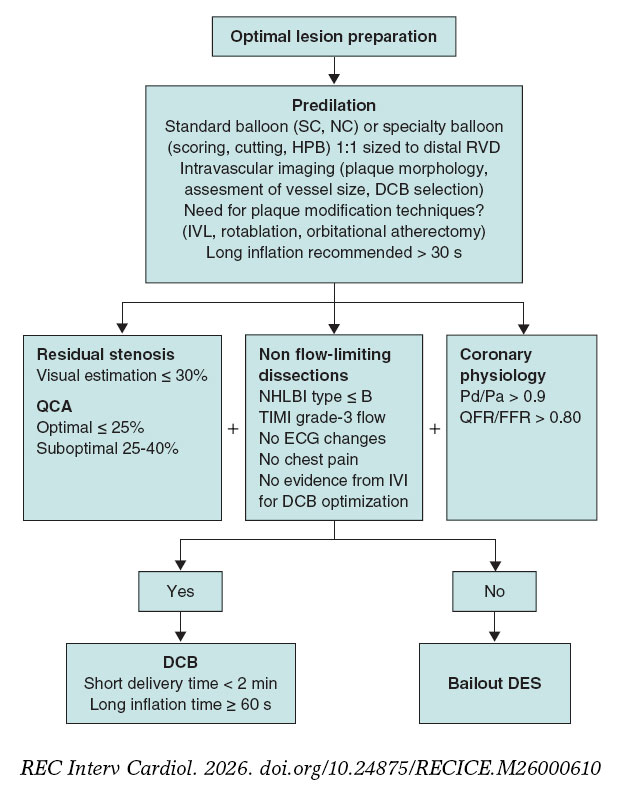
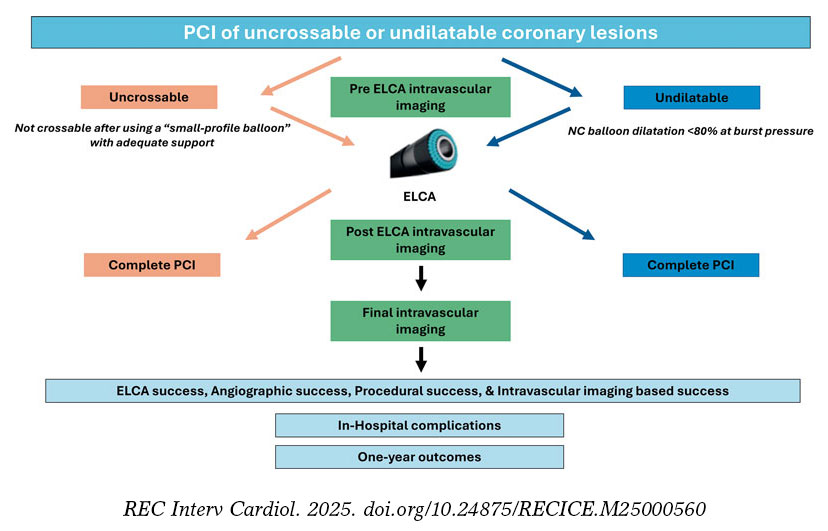
Lesion preparation may involve semicompliant (SC) or noncompliant (NC) balloons, specialized cutting or scoring balloons, using a 1:1 balloon-to-artery ratio based on the distal reference vessel diameter, or calcium-modification techniques, as recommended by the Academic Research Consortium.11 An adequate angiographic result should be confirmed before DCB delivery (figure 2).
In the presence of residual dissection or angiographically limited acute luminal gain after predilation, fractional flow reserve has been proposed to provide a more accurate assessment of the functional result. Historical data indicate that a fractional flow reserve > 0.90 after balloon angioplasty is a strong predictor of immediate functional improvement and is associated with low restenosis rates at the 2-year follow-up.12,13
Patients with residual percent diameter stenosis > 30% or a National Heart, Lung, and Blood Institute coronary dissection of type C or higher have systematically been excluded from clinical trials because of ethical concerns regarding the risk of procedural failure and subsequent complications.11
CORONARY LESION SUBSETS
In-stent restenosis
Several randomized studies have compared DCBs with plain old balloon angioplasty (POBA) or drug-eluting stents (DESs) for the treatment of in-stent restenosis (ISR), as well as PCBs with SCBs (table 1).14-25
The ISAR-DESIRE 3 trial randomized 402 patients with DES-ISR to treatment with POBA, PCB, or paclitaxel-eluting stents (PES). At 10 years, the primary endpoint and major secondary endpoints did not differ significantly between the PCB and PES groups.18,25
In the RIBS V trial, the primary endpoint of minimum lumen diameter at 9 months was significantly greater with everolimus- eluting stents than with PCBs (P < .001), although clinical outcomes were similar.15
In the RIBS IV trial, 309 patients with DES-ISR were randomly assigned to treatment with a PCB or an everolimus-eluting stent. Target lesion revascularization (TLR) rates were significantly lower in the everolimus-eluting stent group at the 1-year (P = .007) and 3-year (P = .015) follow-up.20
In the DARE trial, 278 patients with DES-ISR involving ostial lesions, the left main coronary artery, or bifurcations were randomized to treatment with a PCB or an everolimus-eluting stent. For the primary endpoint of in-segment minimum lumen diameter at 6 months, PCB treatment was noninferior to DES implantation (P for noninferiority < .0001). TLR rates were similar at 12-month follow-up.23
DAEDALUS was a patient-level meta-analysis of 710 patients from 10 randomized clinical trials comparing DCB angioplasty with repeat DES implantation for ISR. Among patients with bare-metal stent ISR (BMS-ISR), no significant differences were observed between treatments in the primary efficacy or safety endpoints. Among patients with DES-ISR, the risk of the primary efficacy endpoint was significantly higher with DCB angioplasty, whereas the risk of the primary safety endpoint was numerically lower.26
In a recent cohort of 160 patients with ISR treated with SCB-based PCI and followed for a median of 1 year, no cardiac deaths were reported. The rates of myocardial infarction (MI), TLR, and TVR were 3.4%, 2.5%, and 6.3%, respectively, which were lower than the 11.1% event rate reported in the DAEDALUS meta-analysis at 1 year.27
According to the European clinical practice guidelines on chronic coronary syndromes (CCS), DES implantation is preferred over DCB angioplasty for the treatment of DES-ISR.28 However, an initial DCB strategy may be preferable in selected cases, reserving implantation of an additional DES layer for DCB treatment failure. A DCB-first approach is particularly appealing for patients with BMS-ISR, multiple pre-existing stent layers, ISR in small vessels, or ISR involving bifurcations. The recommended duration of DAPT after DCB-PCI for ISR is 4 weeks.29
All available evidence should be considered when selecting a treatment strategy for ISR. The theoretical advantages of DCBs—avoiding additional metallic layers and shortening antithrombotic therapy—must be balanced against their potentially lower long-term efficacy in this setting.
De novo lesions
Small-vessel de novo disease
The first randomized trials comparing DCBs with DESs for de novo coronary lesions focused on small-vessel disease (table 2).30-34
Table 2. Randomized controlled trials evaluating drug-coated balloons for de-novo small vessel disease
MACE at 12 months: PCB (7.3%) vs EES (7.5%); P = .92
PCB (3.4%) vs EES (4.5%); P = .43
DCB, drug-coated balloon; DES, drug-eluting stent; DS, diameter stenosis; EES, everolimus-eluting stent; LLL, late lumen loss; MACE, major cardiovascular adverse events; PCB, paclitaxel-coated balloon; PES, paclitaxel-eluting stent; SVD, small vessel disease; TLR, target lesion revascularization; ZES, zotarolimus-eluting stent.
A recent meta-analysis included 4 randomized clinical trials that assigned 1414 participants with vessels < 3 mm to treatment with either a PCB or a DES. No significant differences in MACE rates were observed at 1- or 2-year follow-up.35 Furthermore, the BASKET-SMALL 2 trial reported no significant differences at 3 years. TVR rates at the 3-year follow-up were likewise similar between groups. Major bleeding was evaluated only in BASKET-SMALL 2 and was significantly less frequent with the PCB strategy at the 2-year follow-up (P = .03).35
In all trials except RESTORE SVD, antiplatelet therapy consisted of 1 month of DAPT for patients with CCS undergoing PCB-PCI, 3 months for patients undergoing BMS implantation, and 6-12 months for those undergoing DES implantation. All patients with acute coronary syndrome (ACS) received 12 months of DAPT.
Although different DAPT regimens were used after PCI with BMSs or DESs, 3 randomized clinical trials (RCT) used 1 month of DAPT after DCB-PCI in patients with CCS. None showed a statistically significant difference in MACE or TLR between treatment groups, supporting the safety of abbreviated DAPT after DCB-PCI.
Large-vessel de novo disease
Evidence regarding DCB use in large-vessel disease is derived from several trials conducted in different clinical settings (table 3).36-42
Table 3. Randomized controlled trials evaluating drug-coated balloons for de-novo large vessel disease
The REC-CAGEFREE I trial investigated the efficacy of PCB angioplasty compared with sirolimus-eluting stent (SES) implantation in 2272 patients with de novo, noncomplex coronary lesions without restrictions on vessel size.35 At the 3-year follow-up, no significant differences were observed between the PCB and SES groups in cardiovascular death or target vessel myocardial infarction (TVMI). However, clinically driven TLR was significantly more frequent after PCB treatment at 1 year (P = .002) and 3 years (P < .001). Notably, subgroup analysis according to small- vs nonsmall-vessel disease showed a significant interaction. Among patients with nonsmall-vessel disease, SESs were associated with fewer device-oriented composite endpoint events (P < .0001). Among patients with small-vessel disease, PCB and SES strategies produced similar device-oriented composite endpoint rates through 3 years. Major bleeding was numerically less frequent in the PCB group but did not differ significantly between groups.37
The SELUTION trial, recently presented at a major scientific conference, randomized 3341 patients eligible for PCI to an SCB strategy using the SELUTION SLR device or a DES strategy, with randomization performed before lesion preparation.38 All participants had a de novo lesion in a vessel measuring between 2.0 mm and 5.0 mm. Crossover to DES implantation occurred in 20% of patients assigned to the SCB strategy.
The primary composite endpoint of target vessel failure (TVF) at 1 year comprised cardiac death, TVMI, and clinically driven TVR. Noninferiority was demonstrated in the intention-to-treat analysis. Although the trial had broad inclusion criteria, patients with ST-segment elevation myocardial infarction, chronic total occlusions, ISR, or left main coronary lesions were excluded. Significant interactions were observed according to sex, with worse outcomes for SCB treatment in women; moderate-to-severe calcification, with better outcomes for SCB treatment in calcified lesions; and high bleeding risk, with better outcomes for the SCB strategy.
A recent systematic review and meta-analysis of randomized clinical trials comparing DCBs with DESs in 2961 patients with de novo large-vessel disease found that DCB treatment was associated with risks of TLR, all-cause mortality, cardiac death, MI, and MACE similar to those observed with DES implantation. However, DCB treatment was associated with a higher risk of TVR.43
All studies included in this meta-analysis evaluated PCB-based PCI, and the criteria for adequate lesion preparation, balloon inflation time, and angiographic and clinical outcomes varied across studies. Target vessel thrombosis was not reported in these trials and is considered one of the most important safety considerations when deciding whether to use DCB-PCI for large-vessel disease. These methodological differences highlight important areas for future randomized clinical trials.44
Bifurcation lesions
DCBs offer several theoretical advantages in bifurcation lesions, particularly when used within a provisional stenting strategy. These advantages include targeted delivery of antiproliferative therapy to the side branch (SB), a lower risk of carina shift and stent thrombosis, and avoidance of stent malapposition and polymer deformation.
Regarding the benefit of DCB treatment of the SB during provisional stenting, the PEPCAD-BIF trial randomized 64 patients with bifurcation lesions and a SB reference diameter of 2.0 mm to 3.5 mm to DCB angioplasty or POBA of the SB. The primary endpoint of LLL and the binary restenosis rate were significantly lower in the DCB group.45
Gao et al. conducted the DCB-BIF trial, which compared DCBs with NC balloons for SB treatment in 784 patients with true bifurcation lesions undergoing main-vessel stenting and presenting with a severely compromised SB. The primary composite endpoint of cardiac death, TVMI, or clinically driven TLR was significantly less frequent in the DCB group (P = .013), primarily because of a lower rate of TVMI.46
In the SPACIOUS trial, Zhou et al. enrolled 230 patients with de novo, non-left-main true bifurcation lesions and randomized them to SCB or PCB angioplasty of the SB. LLL did not differ significantly between groups, whereas binary restenosis was significantly less frequent in the sirolimus group (P = .043). Clinical outcomes, including death, MI, and revascularization, were similar between groups.47
A meta-analysis by Zheng et al., which included 934 patients from 10 studies, showed that DCB treatment of the SB was associated with lower LLL and a lower rate of binary restenosis than POBA. The rate of MACE at 12 months was also significantly lower in the DCB group.48 Notably, the DCB-BIF trial was not included in this meta-analysis.
Chronic total coronary occlusions
The treatment of chronic total coronary occlusions has gained increasing clinical importance over the past decade, with growing evidence suggesting that successful PCI may improve symptoms and reduce ischemic burden.49 DES implantation has potential limitations, and alternative strategies that avoid permanent coronary implants have therefore attracted increasing interest.50
In a retrospective analysis of the PROGRESS-CTO Registry, DCBs were used in 454 patients (3.7%). A DCB-only strategy was used in 48.4% of cases. Patients in the DCB-only group had more favorable angiographic characteristics and a technical success rate similar to that of patients treated with a hybrid DES-DCB strategy. During a median follow-up of 323 days, the DCB-only group had a lower rate of MACE (P = .032).51
Yan et al.52 conducted a retrospective analysis of patients with successfully revascularized chronic total coronary occlusions and diffuse distal disease who were treated with either a DES-only or a hybrid DES-DCB strategy. At 24 months, the DES-DCB group had significantly lower MACE rates (P = .008) and greater improvement in anginal symptoms (P < .001).
In the PICCOLETO X study, Cortese et al.53 conducted a multicenter registry including 938 patients and compared DCB-only and DCB plus DES strategies. At 12 months, the primary endpoint of TVF occurred in 9.5% of the overall population, with no significant differences between groups.
Panuccio et al.54 conducted a meta-analysis of 6 observational studies including 2221 patients undergoing PCI for chronic total coronary occlusions and compared DCB-only and hybrid strategies. The primary endpoint of TLR at a mean follow-up of 2.8 years did not differ between groups. Secondary endpoints, including MACE, cardiovascular mortality, TVR, and TVMI, were also similar.
Several RCTs evaluating the use of DCBs in chronic total coronary occlusions are ongoing and should provide more robust evidence in this setting.55,56
CLINICAL SCENARIOS
Acute coronary syndrome
Patients with acute coronary syndrome (ACS) have a higher ischemic risk, and concerns remain regarding the feasibility of DCB-PCI in lesions with a high thrombus burden. However, adequate lesion preparation and restoration of Thrombolysis in Myocardial Infarction grade-3 flow may facilitate DCB use in this setting.
The PEPCAD NSTEMI trial evaluated 210 patients with non–ST-segment elevation MI. The PCB-only strategy was noninferior to BMSs and DESs for TLF at 9 months. The overall MACE rate was 6.7% with PCB treatment vs 14.2% with DES implantation. TLR and LLL did not differ significantly between groups. All patients received DAPT for 1 year.42
The REVELATION study randomized 120 patients presenting with ST-segment elevation MI and < 50% residual percent diameter stenosis after thrombus aspiration to treatment of the culprit lesion with either a PCB or a SES. During 2-year follow-up, MACE rates did not differ significantly between groups. All patients received DAPT for 1 year.36
The REC-CAGEFREE II trial specifically evaluated DAPT duration in patients with ACS treated with PCB-only PCI.39 Conducted at 41 centers in China, the trial randomized 1948 patients with ACS to either stepwise DAPT de-escalation DAPT, consisting of DAPT for 1 month with ticagrelor, followed by 5 months on ticagrelor monotherapy, and then 6 months of aspirin monotherapy or a standard 12-month regimen of DAPT consisting of aspirin plus ticagrelor. Stepwise DAPT de-escalation was noninferior to 12-month DAPT for the primary composite endpoint of Bleeding Academic Research Consortium (BARC) type 3 or 5 bleeding, all-cause mortality, stroke, MI, and revascularization at 12 months (P for noninferiority = .01). The composite of all-cause mortality, stroke, MI, and revascularization was similar between groups, whereas BARC type 3 or 5 bleeding was less frequent in the de-escalation group.
Notably, only 44% of patients presented with ST-segment elevation or non–ST-segment elevation MI; the remaining patients had unstable angina. The mean PCB diameter was 2.72 mm, placing most treated lesions within the small-vessel category. In addition, only 1 lesion was treated in most patients. These findings suggest that the trial population was highly selected and that the results should not be generalized to the broader ACS population. Nevertheless, this was one of the first RCTs to evaluate DAPT duration in patients treated with DCBs and supports the hypothesis that an abbreviated antiplatelet regimen may be appropriate in selected patients with ACS.
Regarding future perspectives, the ongoing COPERNICAN trial is a Spanish study enrolling patients with ST-segment elevation MI who are randomized to PCB or SES treatment of culprit and suitable nonculprit lesions, either during the index PCI or as part of a staged strategy. The primary endpoint is a 12-month composite of TLF. The antithrombotic regimen is left to the operator’s discretion; therefore, prespecified subgroup analyses of the different treatment strategies should provide additional insights. The trial is intended to support the expanding use of DCB-PCI in ACS by evaluating the safety and efficacy profile of this metal-sparing strategy.57
Currently, the generally recommended duration of DAPT after either DES implantation or DCB-PCI in patients with ACS remains 12 months.58
Patients at high bleeding risk
High bleeding risk (HBR) is an increasingly common clinical scenario among patients undergoing PCI. Increased life expectancy has resulted in a proportional rise in PCI procedures among older patients and those requiring long-term oral anticoagulation.
Patients who experience bleeding after PCI have significantly higher rates of all-cause mortality and adverse outcomes, including nonfatal MI, stroke, and prolonged hospitalization, compared with patients without bleeding.59
In the DEBUT trial, 220 patients at HBR were randomized to treatment with a PCB or BMS.40 At 9 months, the primary endpoint occurred in 14% of patients in the BMS group and 1% of those in the PCB group (P for superiority = .00034). Both groups received only 1 month of DAPT, regardless of whether the clinical presentation was CCS or ACS.
A subgroup analysis of the HBR population in the BASKET-SMALL 2 trial included 758 patients who were randomized to PCB or DES treatment of de novo lesions in small native coronary vessels.60 MACE rates did not differ significantly between PCB and DES treatment, irrespective of bleeding risk. Although the differences were not statistically significant, major bleeding was less frequent with PCB than with DES treatment among patients without HBR (0.9% vs 3.8%), whereas the corresponding rates among patients with HBR were 4.5% and 3.4%. The numerical increase in bleeding among DES-treated patients without HBR was probably related to the longer duration of DAPT.
In the REC-CAGEFREE II trial described above, 20.6% of patients met HBR criteria. In the stepwise de-escalation group, BARC type 3 or 5 bleeding was significantly less frequent than in the standard-treatment group, while noninferiority was maintained for the primary endpoint. These findings suggest that abbreviated DAPT in patients at HBR may reduce bleeding without increasing ischemic events.39
In addition, single antiplatelet therapy (SAPT) has been evaluated in patients at HBR. In a Finnish study, 172 patients, 87% of whom met HBR criteria, underwent DCB-only PCI and were discharged on SAPT.61 At 1 year, MACE and all-cause mortality rates were 1.4% and 4.1%, respectively, among patients with CCS and 7.1% and 12.1%, respectively, among those with ACS. The rate of clinically relevant bleeding, defined as BARC type 2-5 bleeding, was 10.5% despite the advanced age and high comorbidity burden of the population.
Cortese et al.62 evaluated 107 patients at HBR who underwent DCB-only PCI and were discharged on SAPT, comparing them with patients treated with DAPT for 6 months. At 1 year, MACE rates did not differ significantly between groups, whereas the cumulative incidence of BARC type 2-5 bleeding was significantly lower in the SAPT group (P = .04).
In the EASTBOURNE registry, 2123 patients underwent DCB-PCI for de novo lesions (56.3%) or ISR (47.7%). A subgroup of 113 patients (5.8%) received SAPT.63 No TLR or abrupt vessel closure occurred in the SAPT group. At 1 year, MACE and TLR rates did not differ between SAPT and DAPT regimens.
Additional details of these 3 studies are shown in table S1.
In conclusion, in patients at HBR undergoing DCB-only PCI, an abbreviated 1-month DAPT regimen may be considered. SAPT may also be considered in selected patients at very high bleeding risk.
The main findings from randomized clinical trials evaluating DCB angioplasty in patients with large-vessel disease, ACS, or HBR are summarized in table 3.
Patients with diabetes and diffuse or multivessel disease
Patients with diabetes often present with complex, diffuse coronary artery disease and a higher risk of restenosis, particularly in small vessels and bifurcation lesions. The stent-sparing nature of DCBs, together with their favorable outcomes in small-vessel disease, suggests that they may be beneficial in this high-risk population. DCBs and DESs should therefore be regarded as complementary devices that can be combined in hybrid strategies to reduce total stent length.
In a retrospective study, 254 patients with multivessel disease successfully treated with DCBs alone or in combination with DESs were included in a DCB-based treatment group and compared with 254 propensity score-matched patients treated with second-generation DESs. The DCB-based strategy was associated with a lower rate of MACE.64
In a 3-year subgroup analysis of the BASKET-SMALL 2 trial, TVR rates were significantly lower among patients with diabetes mellitus treated with PCBs (P = .036), whereas no significant difference was observed among patients without diabetes.65 The DAPT strategy used in this study consisted of 1 month of DAPT after PCB-PCI. However, patients with insulin-dependent diabetes mellitus represented only 12.6% of the study population; therefore, no firm recommendation can be made because of the limited sample size.
CURRENT INDICATIONS FOR DCB USE
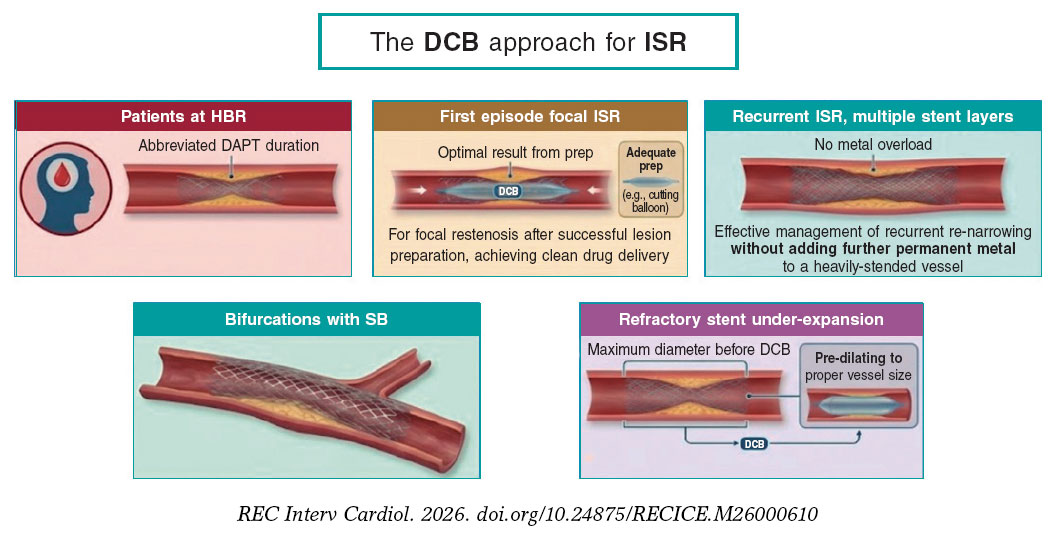
Based on the evidence and knowledge accumulated in recent years, our recommendations for DCB use are summarized below (figure 3 and figure 4).66
Figure 3. Recommended indications for DCB treatment of ISR. DAPT, dual antiplatelet therapy; DCB, drug-coated balloon; HBR, high bleeding risk; ISR, in-stent restenosis; SB, side branch.
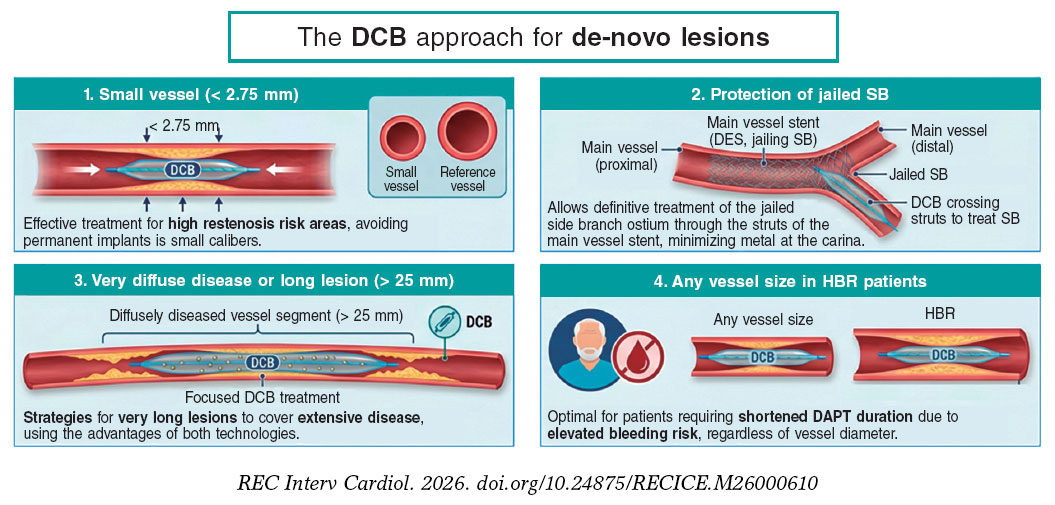
Figure 4. Recommended indications for DCB treatment of de novo lesions. DAPT, dual antiplatelet therapy; DCB, drug-coated balloon; DES, drug-eluting stent; HBR, high bleeding risk; SB, side branch.
In-stent restenosis
We recommend considering DCB treatment in the following settings: a) a first episode of focal in-stent restenosis (ISR) with an optimal result after adequate lesion preparation; b) recurrent ISR with multiple stent layers; c) refractory stent underexpansion; d) bifurcation lesions with side-branch involvement. e) patients at HBR.
De novo lesions
We recommend considering DCB treatment in the following settings: a) small vessels with a reference diameter of < 2.75 mm; b) ostial or proximal SB treatment during provisional stenting; c) very diffuse disease or long lesions > 25 mm, using a hybrid DCB-DES strategy when appropriate; d) lesions in vessels of any size in patients at HBR, particularly those at very HBR.
A PROPOSED ANTITHROMBOTIC THERAPY ALGORITHM AFTER DCB-ONLY PCI
The Third Report of the International DCB Consensus Group, published in 2020, was developed in response to the lack of standardization and comparability among DCB studies.10 The group proposed 4 weeks of DAPT for ISR and de novo lesions in patients with CCS treated with DCB-only PCI. The authors also noted that DAPT duration after DCB treatment could potentially be shortened further in patients at HBR and that oral anticoagulation could be combined with SAPT in selected patients.10
According to current European clinical practice guidelines, DAPT after DCB angioplasty is recommended for 6 months in patients with CCS and 12 months in those with ACS. In patients at HBR, 3 months of DAPT is considered appropriate, whereas a 1-month regimen may be considered as an alternative.28,58
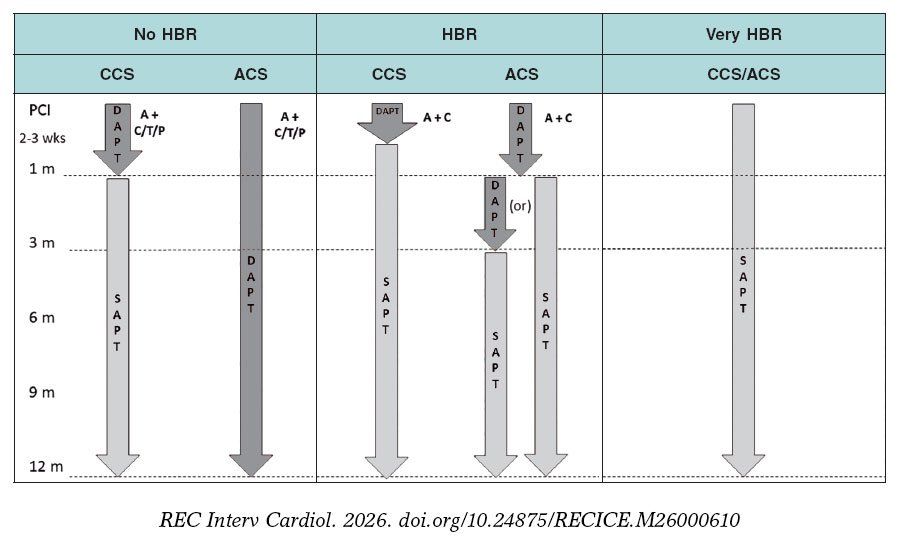
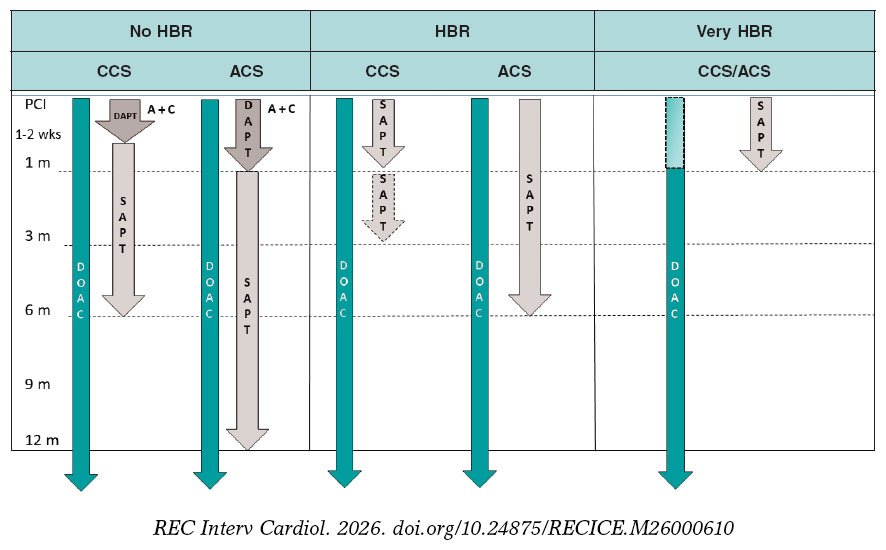
Our proposed antiplatelet strategy for patients treated with DCB-only PCI is based on a personal interpretation of the reviewed evidence and acknowledges the lack of robust randomized clinical trial data (figure 5 and figure 6).
Figure 5. Antiplatelet therapy during the first year after DCB-only PCI in patients without an indication for oral anticoagulation. A, aspirin; ACS, acute coronary syndrome; C, clopidogrel; CCS, chronic coronary syndrome; DAPT, dual antiplatelet therapy; DCB, drug-coated balloon; HBR, high bleeding risk; M, months; P, prasugrel; PCI, percutaneous coronary intervention; SAPT, single antiplatelet therapy; SB, side branch; T, ticagrelor; wk, weeks.
Figure 6. Antithrombotic therapy during the first year after DCB-only PCI in patients with an indication for oral anticoagulation. A, aspirin; ACS, acute coronary syndrome; C, clopidogrel; CCS, chronic coronary syndrome; DAPT, dual antiplatelet therapy; DCB, drug-coated balloon; DOAC, direct oral anticoagulant; HBR, high bleeding risk; M, months; PCI, percutaneous coronary intervention; SAPT, single antiplatelet therapy; wk, weeks.
Bleeding risk is not dichotomous but exists along a continuum and may be divided into at least 3 categories. The PRECISE-HBR score stratifies bleeding risk as follows: very high bleeding risk, defined by a 1-year Bleeding Academic Research Consortium (BARC) type 3 or 5 bleeding rate of ≥ 6% and a score of ≥ 27; HBR, defined by a 1-year rate of ≥ 4% but < 6% and a score of 23-26; and non-HBR, defined by a 1-year rate of < 4% and a score of ≤ 22.67
The first consideration is whether the patient requires oral anticoagulation and the degree of bleeding risk, classified as low bleeding risk, HBR, or very HBR. The second consideration is the clinical presentation, namely CCS or ACS.
Recommendations when oral anticoagulation is not required
In patients without HBR, DAPT should be administered for 1 month after DCB-only PCI for CCS and for 12 months after ACS. Any oral P2Y12 inhibitor may be used.
Among patients at HBR, those with CCS may receive DAPT for 2-3 weeks followed by SAPT, whereas patients with ACS may receive DAPT for 1-3 months according to individual clinical characteristics. Clopidogrel should be used as the P2Y12 inhibitor. The complex group of patients at very HBR may be treated with SAPT alone from hospital discharge, preferably with clopidogrel (figure 5).
Recommendations when oral anticoagulation is required
In patients without HBR, we propose triple therapy with a direct oral anticoagulant (DOAC + DAPT) for 1-2 weeks after PCI for CCS and for 1 month after ACS. This should be followed by dual therapy (DOAC + clopidogrel) for up to 12 months, after which DOAC monotherapy should be continued.
Among patients at HBR, dual therapy with a DOAC plus clopidogrel may be administered for 1-3 months after PCI for CCS and for up to 6 months after ACS. Thereafter, DOAC monotherapy is recommended.
The very challenging group of patients at very HBR may receive dual therapy for 1 month followed by DOAC monotherapy. Alternatively, SAPT may be considered during the first month, followed by DOAC monotherapy (figure 6).
Because evidence in this area remains extremely limited, these recommendations should be regarded as provisional proposals pending validation in future studies.
CONCLUSIONS
Overall, DCBs and DESs should be considered complementary rather than competing technologies. Reducing the permanent metallic burden in complex multivessel disease is an appealing strategy, and hybrid approaches incorporating DCBs are increasingly used in clinical practice.
Current evidence particularly supports DCB use in ISR, small-vessel disease, bifurcation lesions, and patients at HBR, in whom a “leave-nothing-behind” strategy may reduce the metallic burden and permit shorter antithrombotic regimens. Optimal lesion preparation and careful patient selection remain essential to achieve favorable outcomes.
A class effect should not be assumed because individual DCB platforms differ substantially in design, drug formulation, excipient, and delivery characteristics, all of which may influence clinical performance.68
Although evidence regarding antithrombotic therapy after DCB-only PCI remains limited, emerging data suggest that abbreviated DAPT, and even SAPT in selected patients at HBR, may be feasible and safe. Future randomized trials are needed to better define the role of DCBs in large-vessel disease and to establish individualized antithrombotic strategies.
In conclusion, DCB angioplasty is an alternative when DES implantation is considered problematic because of anatomical or clinical factors.
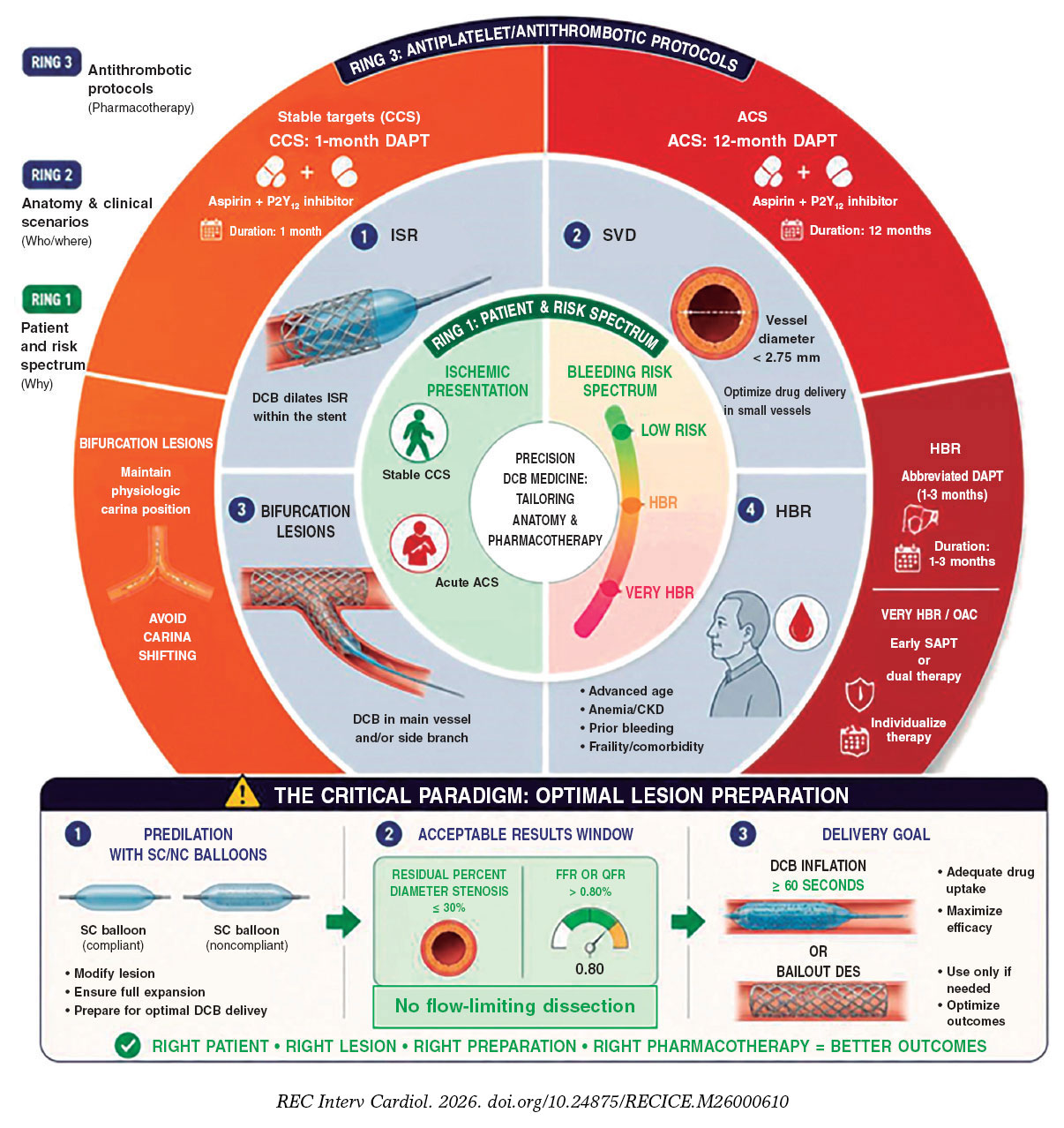
Figure 7 provides a comprehensive visual summary of this review as the central illustration.
Figure 7. Central illustration. The wheel integrates 3 levels of decision-making: the patient and bleeding-risk profile (ring 1), the anatomical target lesion or high bleeding risk (ring 2), and the corresponding antithrombotic strategy (ring 3). The lower panel summarizes the critical lesion-preparation strategy required to optimize outcomes. ACS, acute coronary syndrome; CCS, chronic coronary syndrome; CKD, chronic kidney disease; DAPT, dual antiplatelet therapy; DCB, drug-coated balloon; DES, drug-eluting stent; FFR, fractional flow reserve; HBR, high bleeding risk; ISR, in-stent restenosis; NC, noncompliant balloon; DOAC, direct oral anticoagulation; QFR, quantitative flow ratio; SAPT, single antiplatelet therapy; SC, semicompliant balloon; SVD, small-vessel disease.
DCB therapy is currently receiving substantial attention. Over time, the field is likely to reach a more balanced position, consolidating the most appropriate indications and optimal methods of use.69
FUNDING
The authors received no financial support for the research, authorship, or publication of this article.
STATEMENT ON THE USE OF ARTIFICIAL INTELLIGENCE
The authors used Google Gemini solely to develop representative figures illustrating the different applications of drug-coated balloons in clinical settings involving in-stent restenosis and de novo lesions. Canva was used to assist with the design of the central illustration. After using these tools, the authors reviewed and edited the resulting content as necessary and take full responsibility for all content included in the publication.
AUTHORS’ CONTRIBUTIONS
J.M. de la Torre-Hernández and R.R. Hernández Caballero conceived the topic and designed the structure of the review. J.M. de la Torre-Hernández, R.R. Hernández Caballero, and S. Siliano performed the literature search and extracted data on coronary drug-coated balloons. R.R. Hernández Caballero and S. Siliano drafted the sections on current clinical evidence and compiled the data presented in the tables. R.R. Hernández Caballero and J.M. de la Torre-Hernández developed and organized the figures used for the lesion preparation flowchart and the proposed antithrombotic therapy algorithms. All authors critically reviewed and edited the manuscript and approved the final version.
CONFLICTS OF INTEREST
J.M. de la Torre-Hernández is editor-in-chief of REC: Interventional Cardiology. The journal’s editorial procedure to ensure impartial handling of the manuscript has been followed. J.M. de la Torre-Hernández reports receiving payments from Abbott, Medtronic, Philips, Biotronik, Amgen, Daiichi Sankyo, Boston Scientific, and Novartis for participation as a speaker or advisory board member. R.R. Hernández Caballero and S. Siliano declared no conflicts of interest whatsoever.
SUPPLEMENTARY DATA
REFERENCES
1. Fezzi S, Scheller B, Cortese B, et al. Definitions and standardized endpoints for the use of drug-coated balloon in coronary artery disease: consensus document of the Drug Coated Balloon Academic Research Consortium. EuroIntervention. 2025;21:e1116–1136.
2. Tanaka T, Kawakami R, Shiraki T, et al. Drug-Coated Balloons in Percutaneous Coronary Interventions: Insights into Device Design and Translation to the Clinic. EMJ Int Cardiol. 2025;13:86-100.
3. Shin D, Singh M, Shlofmitz E, et al. Paclitaxel-coated versus sirolimus-coated balloon angioplasty for coronary artery disease: A systematic review and meta-analysis. Catheter Cardiovasc Interv. 2024;104:425-436.
4. Shahrori ZMF, Frazzetto M, Mahmud SH, Alghwyeen W, Cortese B. Drug-Coated Balloons: Recent Evidence and Upcoming Novelties. J Cardiovasc Dev Dis. 2025;12:194.
5. Lim Y, Oh S, Ahn JH, et al. Management of Abrupt Vessel Closure During Percutaneous Coronary Intervention: A Narrative Review. J Cardiovasc Interv. 2026;5:1-10.
6. Lee T, Ashikaga T, Nozato T, et al. Predictors of target lesion failure after percutaneous coronary intervention with a drug-coated balloon for de novo lesions. EuroIntervention. 2024;20:e818-e825.
7. Cortese B, Silva Orrego P, Agostoni P, et al. Effect of Drug-Coated Balloons in Native Coronary Artery Disease Left With a Dissection. JACC Cardiovasc Interv. 2015;8:2003-2009.
8. Ninomiya K, Serruys PW, Colombo A, et al. A Prospective Randomized Trial Comparing Sirolimus-Coated Balloon With Paclitaxel-Coated Balloon in De Novo Small Vessels. JACC Cardiovasc Interv. 2023;16:2884-2896.
9. Wan Ha W, Iwan Czyk S, Cortese B. Drug-coated balloons on the “big stage“: is this technology ready for an all-comer population with de novo lesions? REC Interv Cardiol. 2024;6:266-268.
10. Gao XF, Ge Z, Kong XQ, et al. Intravascular Ultrasound vs Angiography-Guided Drug-Coated Balloon Angioplasty: The ULTIMATE ? Trial. JACC Cardiovasc Interv. 2024;17:1519-1528.
11. Jeger RV, Eccleshall S, Wan Ahmad WA, et al. Drug-Coated Balloons for Coronary Artery Disease: Third Report of the International DCB Consensus Group. JACC Cardiovasc Interv. 2020;13:1391-1402.
12. Poerner TC, Duderstadt C, Goebel B, Kretzschmar D, Figulla HR, Otto S. Fractional flow reserve-guided coronary angioplasty using paclitaxel-coated balloons without stent implantation: feasibility, safety and 6-month results by angiography and optical coherence tomography. Clin Res Cardiol. 2017;106:18-27.
13. Her AY, Shin ES, Lee JM, et al. Paclitaxel-coated balloon treatment for functionally nonsignificant residual coronary lesions after balloon angioplasty. Int J Cardiovasc Imaging. 2018;34:1339-1347.
14. Unverdorben M, Vallbracht C, Cremers B, et al. Paclitaxel-coated balloon catheter versus paclitaxel-coated stent for the treatment of coronary in-stent restenosis. Circulation. 2009;119:2986-2994.
15. Alfonso F, Pérez-Vizcayno MJ, Cárdenas A, et al. A randomized comparison of drug-eluting balloon versus everolimus-eluting stent in patients with bare-metal stent-in-stent restenosis: the RIBS V Clinical Trial (Restenosis Intra-stent of Bare Metal Stents: paclitaxel-eluting balloon vs. everolimus- eluting stent). J Am Coll Cardiol. 2014;63:1378-1386.
16. Pleva L, Kukla P, Kusnierova P, Zapletalova J, Hlinomaz O. Comparison of the Efficacy of Paclitaxel-Eluting Balloon Catheters and Everolimus-Eluting Stents in the Treatment of Coronary In-Stent Restenosis: The Treatment of In-Stent Restenosis Study. Circ Cardiovasc Interv. 2016;9:e003316.
17. Adriaenssens T, Dens J, Ughi G, et al. Optical coherence tomography study of healing characteristics of paclitaxel-eluting balloons vs. everolimus-eluting stents for in-stent restenosis: the SEDUCE (Safety and Efficacy of a Drug elUting balloon in Coronary artery rEstenosis) randomised clinical trial. EuroIntervention. 2014;10:439-448.
18. Kufner S, Cassese S, Valeskini M, et al. Long-Term Efficacy and Safety of Paclitaxel-Eluting Balloon for the Treatment of Drug-Eluting Stent Restenosis: 3-Year Results of a Randomized Controlled Trial. JACC Cardiovasc Interv. 2015;8:877-884.
19. Xu B, Gao R, Wang J, et al; PEPCAD China ISR Trial Investigators. A prospective, multicenter, randomized trial of paclitaxel-coated balloon versus paclitaxel-eluting stent for the treatment of drug-eluting stent in-stent restenosis: results from the PEPCAD China ISR trial. JACC Cardiovasc Interv. 2014;7:204-211.
20. Alfonso F, Pérez-Vizcayno MJ, Cárdenas A, et al. A Prospective Randomized Trial of Drug-Eluting Balloons Versus Everolimus-Eluting Stents in Patients With In-Stent Restenosis of Drug-Eluting Stents: The RIBS IV Randomized Clinical Trial. J Am Coll Cardiol. 2015;66:23-33.
21. Wong YTA, Kang DY, Lee JB, et al. Comparison of drug-eluting stents and drug-coated balloon for the treatment of drug-eluting coronary stent restenosis: A randomized RESTORE trial. Am Heart J. 2018;197:35-42.
22. Cutlip DE, Mehran R, Sharma S, et al. Sirolimus-eluting balloon vs repeat drug-eluting stent or balloon angioplasty for coronary in-stent restenosis: The SELUTION4ISR randomized trial. J Am Coll Cardiol. 2026. https://doi.org/10.1016/j.jacc.2026.03.021.
23. Baan J Jr, Claessen BE, Dijk KB, et al. A Randomized Comparison of Paclitaxel-Eluting Balloon Versus Everolimus-Eluting Stent for the Treatment of Any In-Stent Restenosis: The DARE Trial. JACC Cardiovasc Interv. 2018;11:275-283.
24. Jensen CJ, Richardt G, Tölg R, et al. Angiographic and clinical performance of a paclitaxel-coated balloon compared to a second-generation sirolimus-eluting stent in patients with in-stent restenosis: the BIOLUX randomised controlled trial. EuroIntervention. 2018;14:1096-1103.
25. Giacoppo D, Alvarez-Covarrubias HA, Koch T, et al. Coronary artery restenosis treatment with plain balloon, drug-coated balloon, or drug-eluting stent: 10-year outcomes of the ISAR-DESIRE 3 trial. Eur Heart J. 2023; 44:1343-1357.
26. Giacoppo D, Alfonso F, Xu B, et al. Drug-Coated Balloon Angioplasty Versus Drug-Eluting Stent Implantation in Patients With Coronary Stent Restenosis. J Am Coll Cardiol. 2020;75:2664-2678.
27. Padilla L, Liberman F, Tello J, et al. Safety and efficacy of the Essential Pro paclitaxel drug-eluting balloon for the treatment of coronary in-stent restenosis. REC Interv Cardiol. 2024;6:166-171.
28. Vrints C, Andreotti F, Koskinas KC, et al. 2024 ESC Guidelines for the management of chronic coronary syndromes. Eur Heart J. 2024;45:3415-3537.
29. Kleber FX, Mathey DG, Rittger H, Scheller B. German Drug-eluting Balloon Consensus Group. How to use the drug-eluting balloon: recommendations by the German consensus group. EuroIntervention. 2011;7(Suppl K): K125-K128.
30. Cortese B, Micheli A, Picchi A, et al. Paclitaxel-coated balloon versus drug-eluting stent during PCI of small coronary vessels, a prospective randomised clinical trial. The PICCOLETO study. Heart. 2010;96:1291-1296.
31. Tang Y, Qiao S, Su X, et al. Drug-Coated Balloon Versus Drug-Eluting Stent for Small-Vessel Disease: The RESTORE SVD China Randomized Trial. JACC Cardiovasc Interv. 2018;11:2381-2392.
32. Cortese B, Di Palma G, Guimaraes MG, et al. Drug-Coated Balloon Versus Drug-Eluting Stent for Small Coronary Vessel Disease: PICCOLETO II Randomized Clinical Trial. JACC Cardiovasc Interv. 2020;13:2840-2849.
33. Latib A, Colombo A, Castriota F, et al. A randomized multicenter study comparing a paclitaxel drug-eluting balloon with a paclitaxel-eluting stent in small coronary vessels: the BELLO (Balloon Elution and Late Loss Optimization) study. J Am Coll Cardiol. 2012;60:2473-2480.
34. Jeger RV, Farah A, Ohlow MA, et al. Drug-coated balloons for small coronary artery disease (BASKET-SMALL 2): an open-label randomised non-inferiority trial. Lancet. 2018;392:849-856.
35. Murphy G, Naughton A, Durand R, et al. Long-term Outcomes for Drug-eluting Balloons versus Drug-eluting Stents in the Treatment of Small Vessel Coronary Artery Disease: A Systematic Review and Meta-analysis. Interv Cardiol. 2023;18:e14.
36. Niehe SR, Vos NS, Van Der Schaaf RJ, et al. Two-Year Clinical Outcomes of the REVELATION Study: Sustained Safety and Feasibility of Paclitaxel-Coated Balloon Angioplasty Versus Drug-Eluting Stent in Acute Myocardial Infarction. J Invasive Cardiol. 2022;34:E39-E42.
37. Gao C, He X, Ouyang F, et al. Drug-coated balloon angioplasty with rescue stenting versus intended stenting for the treatment of patients with de novo coronary artery lesions (REC-CAGEFREE I): an open-label, randomised, non-inferiority trial. Lancet. 2024;404:1040-1050.
38. Spaulding C, Krackhardt F, Bogaerts K, et al; SELUTION DeNovo Investigators. Sirolimus-Eluting Balloon With Provisional Stenting Versus Systematic Drug-Eluting Stent Implantation to Treat De Novo Coronary Lesions: A Randomized, Open-Label, Noninferiority Trial. Circulation. 2026 Jun 15. doi: 10.1161/CIRCULATIONAHA.126.079033.
39. Gao C, Zhu B, Ouyang F, et al. Stepwise dual antiplatelet therapy de-escalation in patients after drug coated balloon angioplasty (REC-CAGEFREE II): multicentre, randomised, open label, assessor blind, non-inferiority trial. BMJ. 2025;388:e082945.
40. Rissanen TT, Uskela S, Eränen J, et al. DEBUT trial investigators. Drug-coated balloon for treatment of de-novo coronary artery lesions in patients with high bleeding risk (DEBUT): a single-blind, randomised, non-inferiority trial. Lancet. 2019;394:230-239.
41. Yu X, Wang X, Ji F, et al. A Non-inferiority, Randomized Clinical Trial Comparing Paclitaxel-Coated Balloon Versus New-Generation Drug-Eluting Stents on Angiographic Outcomes for Coronary De Novo Lesions. Cardiovasc Drugs Ther. 2022;36:655-664.
42. Scheller B, Ohlow MA, Ewen S, et al. Bare metal or drug-eluting stent versus drug-coated balloon in non-ST-elevation myocardial infarction: the randomised PEPCAD NSTEMI trial. EuroIntervention. 2020;15:1527-1533.
43. Sorolla Romero JA, Novelli L, Llau García J, et al. Drug-coated balloons vs drug-eluting stents for the treatment of large native coronary artery disease. Meta-analysis of randomized controlled trials. REC Interv Cardiol. 2026;8:8-16
44. Colombo A, Leone PP. Expanding the role of drug-coated balloons in native large coronary artery disease. REC Interv Cardiol. 2025;8:1-4.
45. Kleber FX, Rittger H, Ludwig J, et al. Drug eluting balloons as stand alone procedure for coronary bifurcational lesions: results of the randomized multicenter PEPCAD-BIF trial. Clin Res Cardiol. 2016;105:613-621.
46. Gao X, Tian N, Kan J, et al. Drug-Coated Balloon Angioplasty of the Side Branch During Provisional Stenting: The Multicenter Randomized DCB-BIF Trial. J Am Coll Cardiol. 2025;85:1-15.
47. Zhou Y, Hu Y, Zhao X, et al. Sirolimus-coated versus paclitaxel-coated balloons for bifurcated coronary lesions in the side branch: the SPACIOUS trial. EuroIntervention. 2025;21:e307-e317.
48. Zheng Y, Li J, Wang L, et al. Effect of Drug-Coated Balloon in Side Branch Protection for de novo Coronary Bifurcation Lesions: A Systematic Review and Meta-Analysis. Front Cardiovasc Med. 2021;8:758560.
49. O'Brien JM, Dautov R, Sapontis J. Chronic Total Occlusions: A State-of-the-Art Review. Heart Lung Circ. 2024;33:764-772.
50. Mahadevan K, Cosgrove C, Strange JW. Factors Influencing Stent Failure in Chronic Total Occlusion Coronary Intervention. Interv Cardiol. 2021;16:e27.
51. Mutlu D, Rempakos A, Strepkos D, et al. Drug-Coated Balloons in Chronic Total Occlusion Percutaneous Coronary Intervention: Insights From the PROGRESS-CTO Registry. Catheter Cardiovasc Interv. 2025;106:3783-3795.
52. Yan X, Gao X, Hu Y, et al. PCI for Chronic Total Occlusions with Distal Diffuse Disease: Stent Alone vs. Stent plus Drug Balloon. Int J Cardiol Heart Vasc. 2025;60:101762.
53. Cortese B, Gasparini G, Meunier L, et al. Drug Coated Balloon-based angioplasty for Chronic Total Occlusions: The PICCOLETO X study. J Am Coll Cardiol Intv. 2026;19:1895-1905.
54. Panuccio G, Abdelwahed YS, Werner GS, et al. Drug-coated balloons and hybrid strategies versus drug-eluting stents in chronic total occlusions: a systematic review and meta-analysis. Rev Esp Cardiol. 2026;79:358-368.
55. Gorgulu S. Drug-Coated Balloon Versus Drug-Eluting Stent Angioplasty for Treatment of Chronic Total Occlusion - The DCB-CTO Trial (DCB-CTO). ClinicalTrial.gov Identifier: NCT07369765. Updated 2026-01-27. Available at: https://clinicaltrials.gov/study/NCT07369765?tab=study. Accessed 6 Mar 2026.
56. Somsen YBO, de Winter RW, Wu J, et al. Design and rationale of the drug-coated balloon coronary angioplasty versus stenting for treatment of disease adjacent to a chronic total occlusion (Co-CTO) trial. Am Heart J. 2025;288:65-76.
57. Sanz-Sánchez J, Santos Martínez S, Rumiz González E, et al. Reduced stent strategy versus conventional percutaneous coronary revascularization in patients presenting with STEMI: design of the COPERNICAN trial. Rev Esp Cardiol. 2026;79:100-105.
58. Byrne RA, Rossello X, Coughlan JJ, et al. 2023 ESC Guidelines for the management of acute coronary syndromes. Eur Heart J Acute Cardiovasc Care. 2024;13:55-161.
59. Urban P, Mehran R, Colleran R, et al. Defining High Bleeding Risk in Patients Undergoing Percutaneous Coronary Intervention. Circulation. 2019;140:240-261.
60. Scheller B, Rissanen TT, Farah A, et al. Drug-Coated Balloon for Small Coronary Artery Disease in Patients With and Without High-Bleeding Risk in the BASKET-SMALL 2 Trial. Circ Cardiovasc Interv. 2022;15:e011569.
61. Räsänen A, Kärkkäinen JM, Eranti A, Eränen J, Rissanen TT. Percutaneous coronary intervention with drug-coated balloon-only strategy combined with single antiplatelet treatment in patients at high bleeding risk: Single center experience of a novel concept. Catheter Cardiovasc Interv. 2023;101:569-578.
62. Cortese B, Serruys PW. Single-Antiplatelet Treatment After Coronary Angioplasty With Drug-Coated Balloon. J Am Heart Assoc. 2023;12:e028413.
63. Mangieri A, Testa L, Heang TM, et al. Safety and efficacy of single antiplatelet therapy in a large cohort of patients treated with sirolimus-coated balloon: Post hoc analysis from the prospective EASTBOURNE registry. Cardiovasc Revasc Med. 2025;74:52-56.
64. Her AY, Shin ES, Kim S, et al. Drug-coated balloon-based versus drug-eluting stent-only revascularization in patients with diabetes and multivessel coronary artery disease. Cardiovasc Diabetol. 2023;22:120
65. Jeger RV, Farah A, Ohlow MA, et al. Long-term efficacy and safety of drug-coated balloons versus drug-eluting stents for small coronary artery disease (BASKET-SMALL 2): 3-year follow-up of a randomised, non-inferiority trial. Lancet. 2020;396:1504-1510
66. Fezzi S, Serruys PW, Cortese B, et al. Indications for Use of Drug-Coated Balloons in Coronary Intervention: Academic Research Consortium Position Statement. J Am Coll Cardiol. 2025;86:1170-1202.
67. Gragnano F, van Klaveren D, Heg D, et al. Derivation and Validation of the PRECISE-HBR Score to Predict Bleeding After Percutaneous Coronary Intervention. Circulation. 2025;151:343-355.
68. Natarajan R, Chandrasekharan K, Eccleshalla SC. PCB vs SCB: has the balance begun to shift? REC Interv Cardiol. 2026. https://doi.org/10.24875/RECICE.M26000588.
69. Colombo A, Leone P. Expanding the role of drug-coated balloons in native large coronary artery disease. REC Interv Cardiol. 2026;8:1-4.