
The primary and essential objective of a scientific publication is to disseminate knowledge and serve as a forum for researchers to communicate their studies. Alongside original research, however, scientific journals also publish other content with a more formative aim, such as reviews, consensus documents or recommendations from scientific societies, and case reports of particular interest.
Regardless of its quality, all journal content requires exposure and visibility to reach interested readers anywhere in the world. Therefore indexing in publicly accessible databases is critical for journals to achieve their basic mission. Among all such databases, the most relevant one in the field of biomedical publishing is PubMed. Developed by the US National Library of Medicine and the National Institutes of Health, PubMed is a free, open-access repository containing millions of bibliographic references and abstracts of biomedical research articles. The presence of a biomedical journal in PubMed increases its visibility and dissemination, acting as a showcase for researchers and health professionals worldwide.
Over its 7 years of publication, REC: Interventional Cardiology has achieved several important indexations. Nonetheless, our authors often expressed disappointment at not seeing their articles included in PubMed (figure 1). This limitation may even have discouraged some researchers from submitting their manuscripts since not being indexed in PubMed undoubtedly reduces the likelihood of citation and, consequently, limits the impact factor attainable.
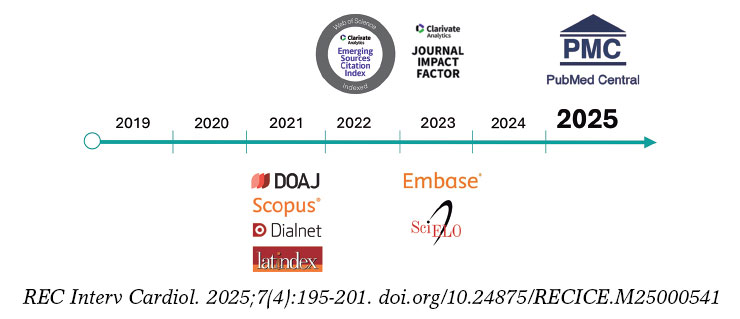
Figure 1. Timeline of the various indexations of REC: Interventional Cardiology.
Indexing in PubMed is a highly demanding process that requires a journal to be established for several years, undergo rigorous external evaluation of content quality, and pass a technical review.
As our readers already know, in 2025, REC: Interventional Cardiology was included in PubMed Central. As a result, the full text of all articles published in the journal since 2024 is now accessible through this repository (figure 1).
Achieving a positive outcome in the final evaluation phase required intense work by both the editorial office and editorial team. However, without question, it was the authors of our content who made this achievement possible, along with the reviewers who helped improve the submitted manuscripts. We also owe much to the successive executive boards of the Interventional Cardiology Association of the Spanish Society of Cardiology (ACI-SEC) over the past 8 years, who have given us independence and unconditional support, as well as to the institutions that generously fund this collective project. Of course, none of this would be possible without being part of the REC Publications journal family, supported and endorsed by the SEC.
Indexation in PubMed Central has major implications for a biomedical journal, such as a) recognition and prestige; b) greater visibility and dissemination; c) increased credibility; d) improved editorial quality; and e) academic and scientific impact.
Articles published in our journal now have the visibility they deserve and can be easily retrieved in bibliographic searches and cited by researchers publishing in other journals. All these advances will progressively enhance the scientific and editorial impact of REC: Interventional Cardiology. Notably, just before the preparation of this Editor’s page, the latest edition of the Journal Citation Reports1 was released. REC: Interventional Cardiology successfully maintained its impact factor—an especially commendable achievement, considering that the reporting period preceded the journal’s inclusion in PubMed Central.
It is gratifying to note that many of our readers and authors already cite the work published in this journal, which undoubtedly increases its visibility and impact. We hope that, with the seal of quality provided by PubMed, this will occur with increasing frequency.
AN ONGOING PROCESS
Although the journal may seem to present an image of stability, many actions, changes, and innovations must be implemented to ensure that the complex editorial process becomes increasingly efficient and of higher quality. Over the past year, as in every year of its trajectory, we have pursued continuous improvement through multiple initiatives. It would take several pages to list all the changes introduced. Many have been aimed at ensuring more rigorous scientific review of manuscripts and requiring that methodology be described in detail. Others have affected translation tasks, since the journal’s bilingual nature demands double scrutiny of content and style. The additional checks implemented in 2023 to ensure strict review of the English version, in our effort to align with the standard set by Revista Española de Cardiología, are now bearing fruit. Other measures have sought to facilitate manuscript submission for authors or streamline the work of the editorial team, all with the aim of making the review process faster and more effective.
We must acknowledge with gratitude that the strict review by the PubMed Central technical team suggested some of these changes as conditions for final acceptance. But there is no room for complacency. The journal must continue to move forward, striving for improvement and pursuing excellence, which invariably lies just a few steps ahead.
EDITORIAL ACTIVITY
The content published since the launch of the journal is shown in figure 2, which illustrates that the number of articles per volume has declined somewhat in recent years, primarily due to the discontinuation, beginning in 2024, of case reports (which had been counted as 3 units: Presentation, How would I approach it?, and Resolution) and the publication in some issues of 2 scientific letters instead of 3, depending on availability.
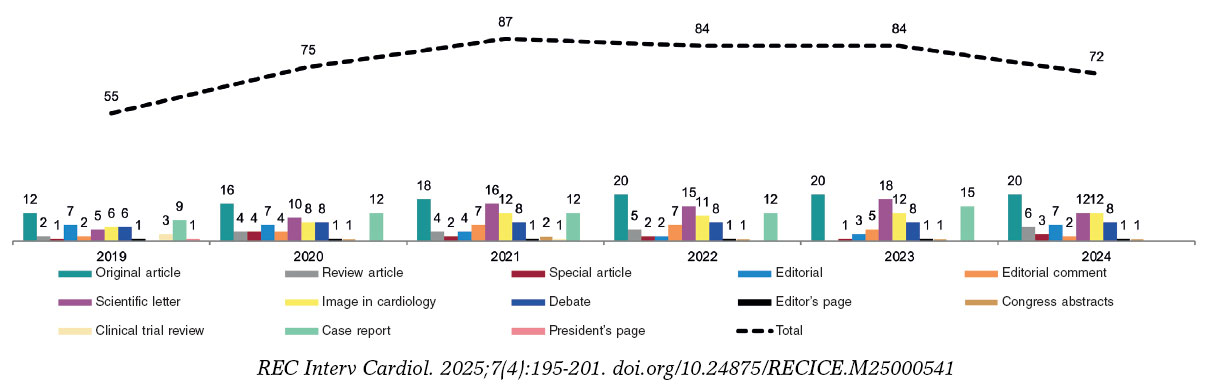
Figure 2. Total content published, 2019-2024.
In the past year, quarterly issues have included original articles, reviews, scientific letters, images, debates, editorial comments, and occasionally consensus documents promoted by the ACI-SEC, as well as the abstracts of communications presented at its annual congress. Since 2024, the journal has been published exclusively in digital format, with the print edition being discontinued for reasons of cost and sustainability.
The following section summarizes statistical data by article type. For 2025, the figures refer only to the first half of the year, as these were the data available at the time of drafting this report.
Original articles
The publication of high-quality original articles is the primary objective of a scientific journal. To safeguard quality, the journal must receive more manuscripts than are needed to fill its issues. Only then is it possible to exercise true selectivity and publish the highest-quality papers.
Figure 3 illustrates that the number of original articles received has increased, with stability in 2023–2024 and a marked upward trend in 2025, when the first semester alone already accounted for 72% of submissions received in the entire previous year.
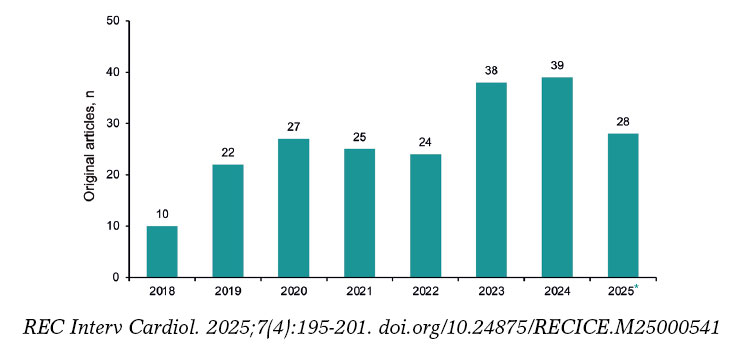
Figure 3. Trends in submissions of original articles.
* Data up to 30 June 2025.
English is by far the predominant language of submission for original articles (figure 4), reflecting in part the growing international interest in our journal, now further reinforced by PubMed Central indexation. Original articles are received from a wide range of countries, notably Portugal, Mexico, Egypt, China, and India. The number of English-language articles submitted from Spain is also increasing, which may indicate that national authors are increasingly choosing to submit to REC: Interventional Cardiology manuscripts that were initially intended for other international journals.
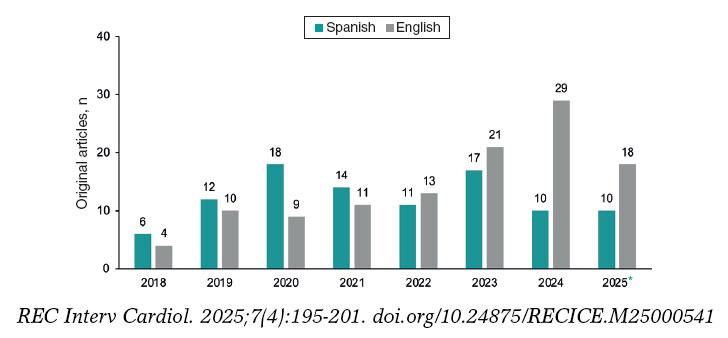
Figure 4. Language of original articles received.
* Data up to 30 June 2025.
Beyond the quality of published content, the speed of editorial decisions is a key value of any scientific journal. In this regard, we can be very satisfied with our editorial turnaround time (figure 5), which remains competitive with that of other leading journals.
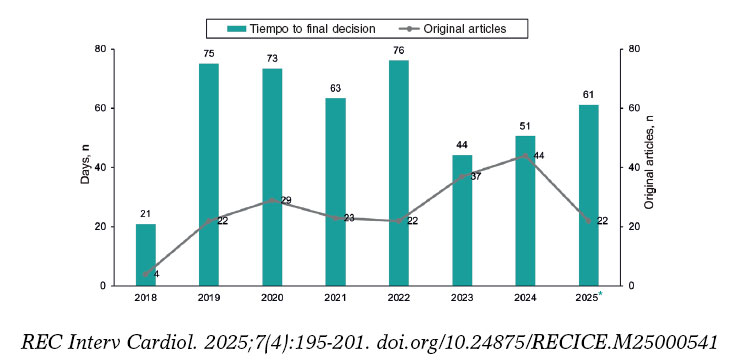
Figure 5. Mean days to reach a final decision on original articles. Bars indicate mean decision time; the grey line indicates the volume of articles decided on each year.
* Data up to 30 June 2025.
As we do every year—and with even greater motivation now that we are indexed in PubMed Central—we invite the interventional cardiology community to submit their research articles to our journal.
Scientific letters
Scientific letters are essentially original studies presented in a shorter format or short case report series of particular interest. Although figure 6 illustrates that 2023 was highly productive, submission volume fell markedly in 2024. This reduction largely reflects the journal’s policy change 2 years ago, when isolated cases were no longer accepted in this format. We are confident that the 2025 submission volume will exceed that of the previous year. We believe this format remains highly attractive, also serving as an alternative for original articles that do not meet the threshold for full publication but are nonetheless of interest.
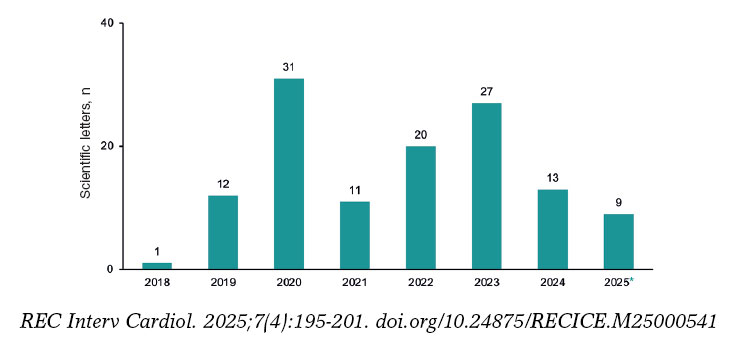
Figure 6. Trends in submissions of scientific letters.
* Data up to 30 June 2025.
Images in cardiology
Interventional cardiology is an image-based specialty, and this type of content is highly popular. Indeed, the excessive backlog of images awaiting inclusion in an issue led us to temporarily suspend submissions during 2023–2024, reactivating them in June 2024 (figure 7). Although many cases yield compelling images and such manuscripts are relatively straightforward to prepare, only a small proportion can be accepted for publication because of editorial space constraints.
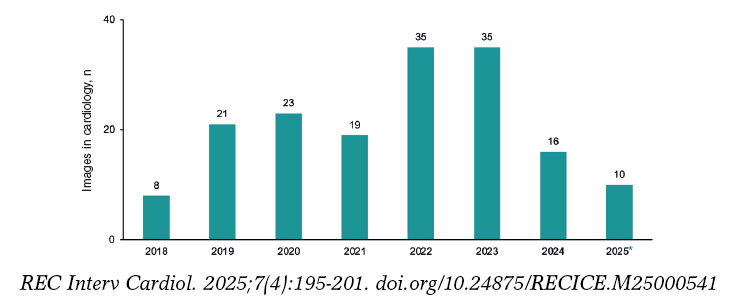
Figure 7. Trends in submissions of images in cardiology.
* Data up to 30 June 2025.
Content transferred from Revista Española de Cardiología
Revista Española de Cardiología is an internationally recognized, high–impact journal with a high rejection rate. Moreover, as a general cardiology journal, it can devote only a limited proportion of its content to interventional cardiology. For this reason, it is relatively common for original articles and other types of manuscripts to be offered the option to be transferred to REC: Interventional Cardiology (figure 8).
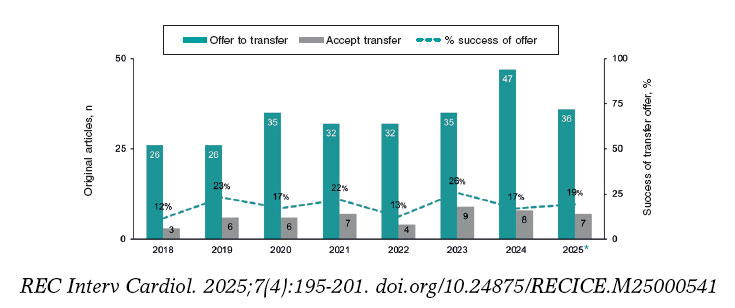
Figure 8. Transfer proposals of original articles rejected at Revista Española de Cardiología and proposals accepted in the same period.
* Data up to 30 June 2025.
Nevertheless, when transfer is offered from a higher-impact to a lower-impact journal, there is always the possibility that authors may decline, as reflected in the number of articles ultimately transferred (figure 8). We are confident that inclusion in PubMed Central and consolidation of our impact factor will make this option increasingly attractive to authors.
Special content
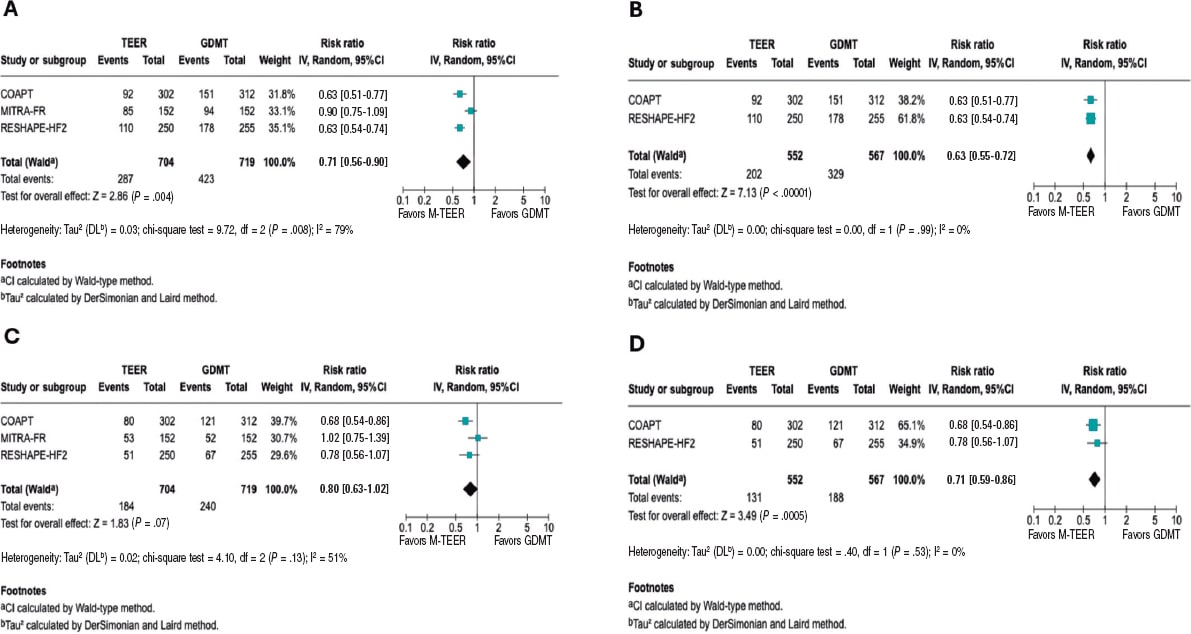
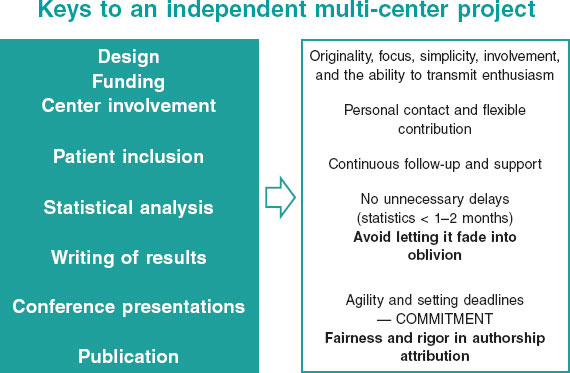
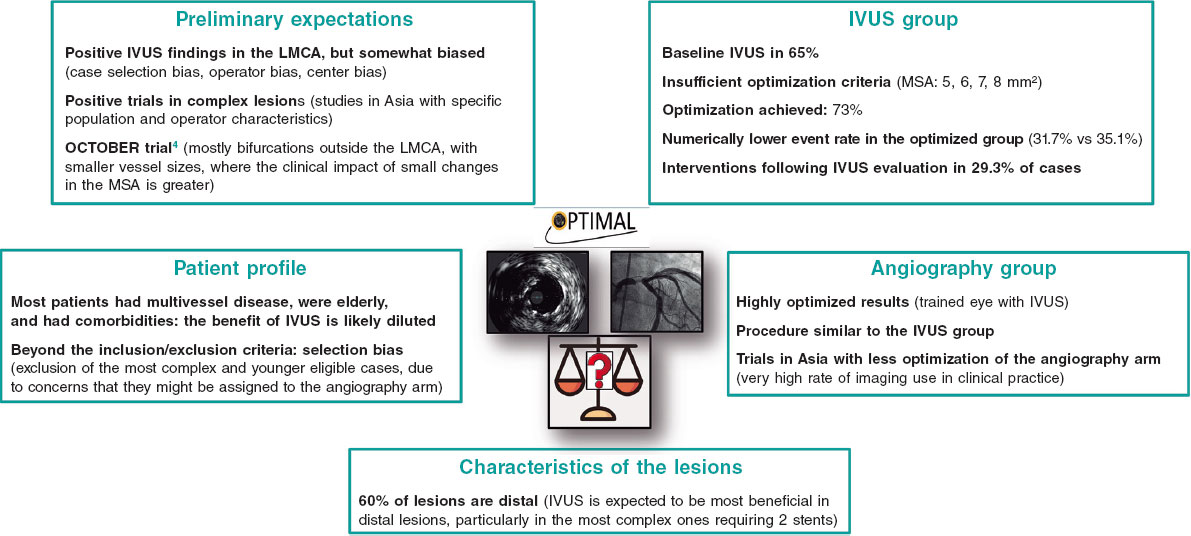
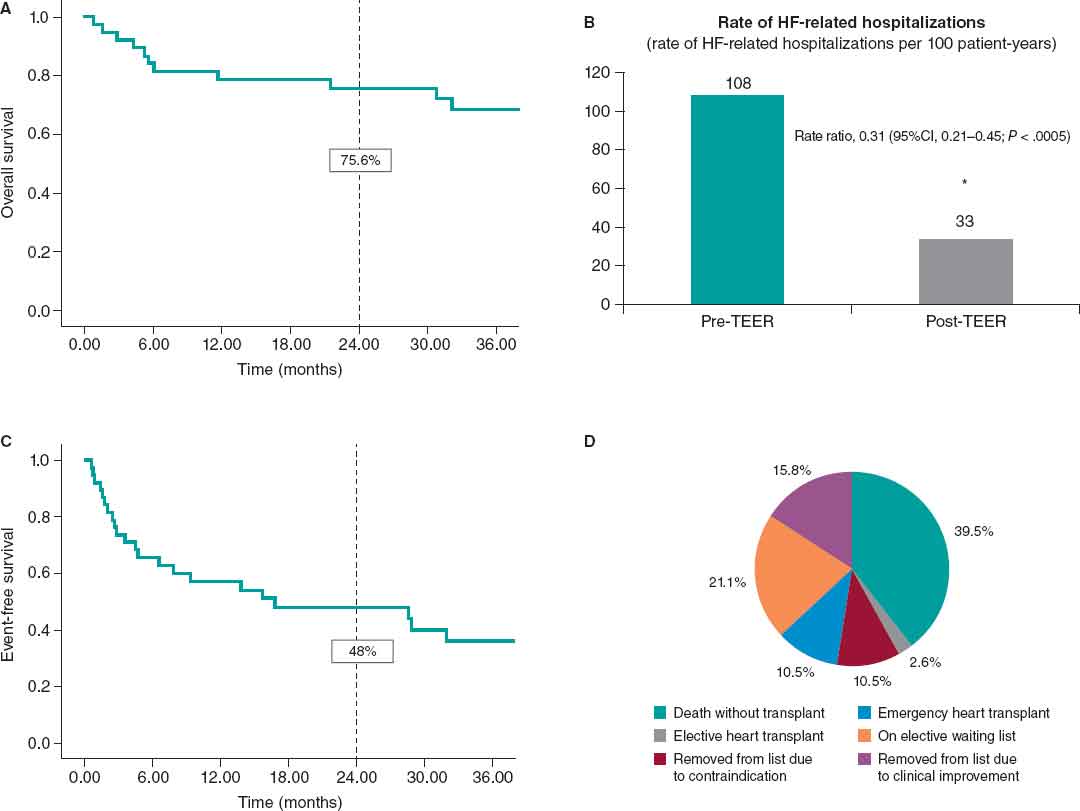
As the official journal of the ACI-SEC, REC: Interventional Cardiology also publishes review articles, position and consensus documents from the association, sometimes in collaboration with others. Figure 9 features 3 special articles, each addressing highly relevant aspects of our field.2-4 Later in this editorial, in the section on dissemination, we devote particular attention to the document on radiation exposure in pregnant professionals.3
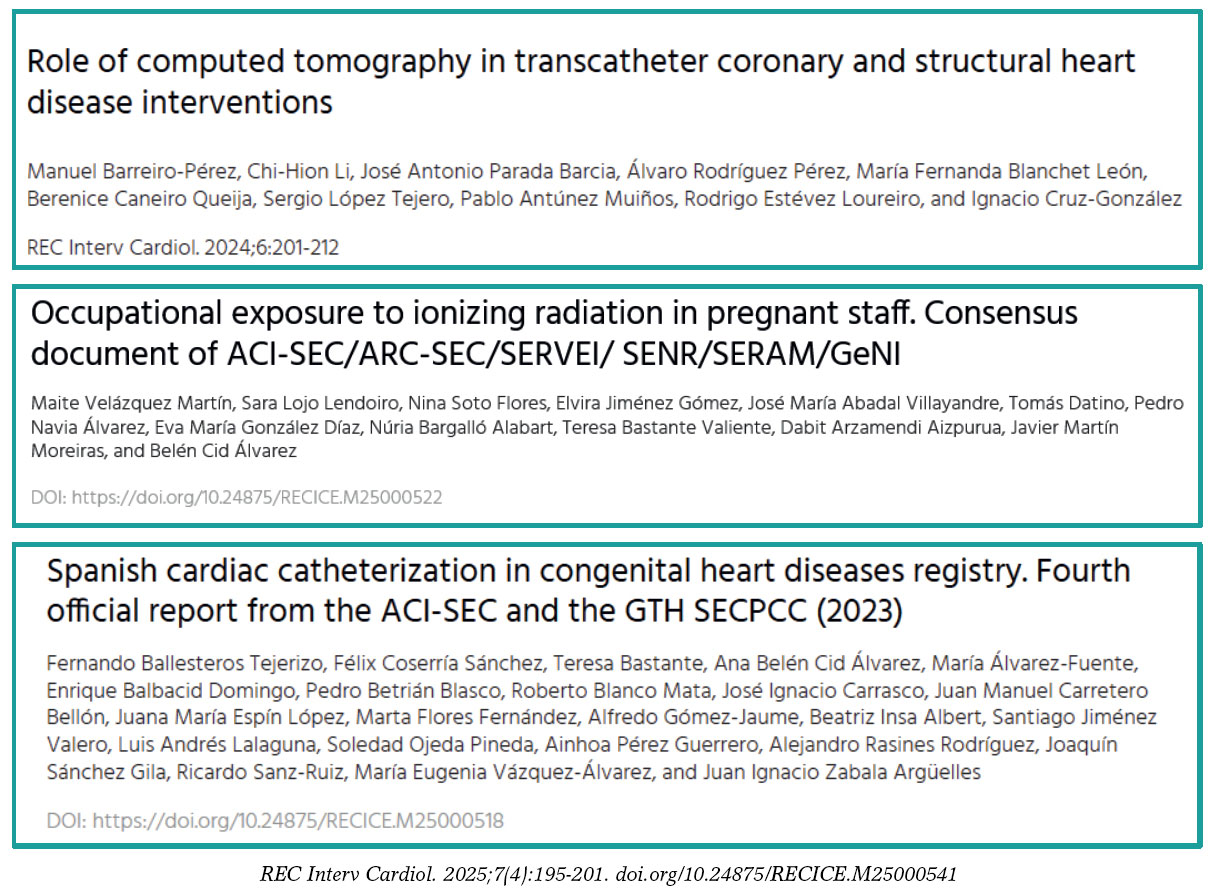
Figure 9. Selected special content published in 2024-2025.2-4
In issue 3 of our journal, as is now customary, we published the abstracts presented at the 2025 ACI-SEC congress, held in Santiago de Compostela (Galicia, Spain). The abstracts were released online a few days before the congress.5 We are confident that many of them will evolve into high-quality original articles. We, therefore, take this opportunity to encourage authors to submit their work to the journal as original articles or scientific letters.
REVIEWERS: AN INVALUABLE CONTRIBUTION
In every Editor’s page we have published, we have highlighted the work of our reviewers. Peer review is indispensable in scientific journals and is largely responsible for their rigor and quality.
Manuscript review is performed anonymously, selflessly, and altruistically, requiring reviewers to devote valuable time that could otherwise be directed to other professional or personal activities.
We are pleased to note that invitations to review for our journal are seldom declined—a particularly meaningful fact given the large number of requests our reviewers receive from other cardiovascular journals. Moreover, reviewers not only tend to accept these invitations but also complete their evaluations within short time frames, enabling us to provide authors with prompt feedback (figure 5 and figure 10).
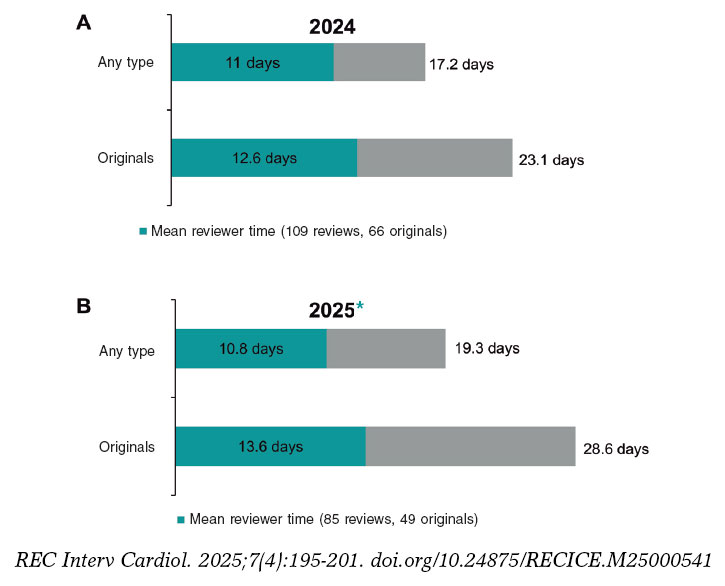
Figure 10. Mean review times in 2024 (A) and within the first half of 2025 (B), overall and for original articles.
* Data up to 30 June 2025.
Although review times have consistently remained within an optimal range throughout the journal’s history, there has been some increase in the past 2 years. We observed this trend last year as well, attributing it in part to reviewer overload. The number of cardiovascular journals has increased substantially, often with shorter publication intervals, and it is likely that we have depended too heavily on the same group of reviewers. For this reason, it is essential to add new reviewers and combine different profiles in the evaluation of each manuscript.
Table 1 lists all reviewers who completed reviews from 1 July 2024 through 30 June 2025. Table 2 identifies those designated elite reviewers in 2024, based on the number, timeliness, and quality of their reviews.
Table 1. Reviewers of REC: Interventional Cardiology who completed reviews from 1 July 2024 through 30 June 2025
| César Abelleira | Francisco Hidalgo |
| Juan H. Alonso-Briales | Pilar Jiménez-Quevedo |
| Ignacio Amat | Santiago Jiménez-Valero |
| Xavier Armario | Alfonso Jurado |
| Eduardo Arroyo | María López-Benito |
| Lluis Asmarats | María T. López-Lluva |
| Pablo Avanzas | José R. López-Mínguez |
| Fernando Ballesteros | Ramón López-Palop |
| Salvatore Brugaletta | Íñigo Lozano |
| Santiago Camacho | Gerard Martí |
| Berenice Caneiro | Javier Martín-Moreiras |
| Pilar Carrillo | Hernán Mejía |
| Xavier Carrillo | Dolores Mesa |
| Almudena Castro | Guillem Muntané |
| Belén Cid | Jorge Palazuelos |
| Félix Coserria | Manuel Pan |
| Ignacio Cruz | Isaac Pascual |
| Javier Cuesta | Eduardo Pinar |
| David del Val | Ander Regueiro |
| Raquel del Valle | Borja Rivero |
| José F. Díaz | Fernando Rivero |
| Alejandro Diego-Nieto | Oriol Rodríguez |
| Mauro Echavarría | Tania Rodríguez-Gabella |
| Agustín Fernández-Cisnal | Sandra Rosillo |
| Ignacio Ferreira | Fernando Rueda |
| José L. Ferreiro | Juan M. Ruiz-Nodar |
| Xavier Freixa | Eva Rumiz |
| Guillermo Galeote | José Ramón Rumoroso |
| Sergio García-Blas | Manel Sabaté |
| Tamara García-Camarero | Pablo Salinas |
| Bruno García del Blanco | Neus Salvatella |
| Carmen Garrote | Ángel Sánchez-Recalde |
| Livia Gheorghe | Juan Sanchis |
| Josep Gómez-Lara | Ricardo Sanz-Ruiz |
| Antonio E. Gómez-Menchero | Jorge Sanz-Sánchez |
| Rafael González-Manzanares | Fernando Sarnago |
| Nieves Gonzalo | Helena Tizón-Marcos |
| Ariana Gonzálvez-García | Ramiro Trillo |
| Enrique Gutiérrez-Ibañes | Beatriz Vaquerizo |
| Felipe Hernández | María E. Vázquez-Álvarez |
| Rosa A. Hernández-Antolín | José M. Vázquez-Rodríguez |
Table 1. Elite reviewers in 2024
| Tamara García-Camarero | Alfonso Jurado |
| Felipe Hernández | Ramón López-Palop |
| Pilar Jiménez-Quevedo | Ángel Sánchez-Recalde |
In addition to the slight increase in review times, figure 10 illustrates a modest rise in editorial management times. Our goal is to implement measures to control, and if possible, shorten, response times, particularly in anticipation of a potential increase in submissions following PubMed Central indexation.
DISSEMINATION
Each Editor’s page must also highlight the awards for the best original articles published in REC: Interventional Cardiology. As in previous years, the awards were presented at the ACI-SEC Annual Congress, which on this occasion held its 36th edition in Santiago de Compostela (Galicia, Spain). The total award of €2500 (€1500 for first prize and €1000 for second) was granted to the article by Real et al.6 on reperfusion therapies in pulmonary embolism and to the article by Sádaba Sagredo et al.7 comparing different intracoronary pressure indices (figure 11).
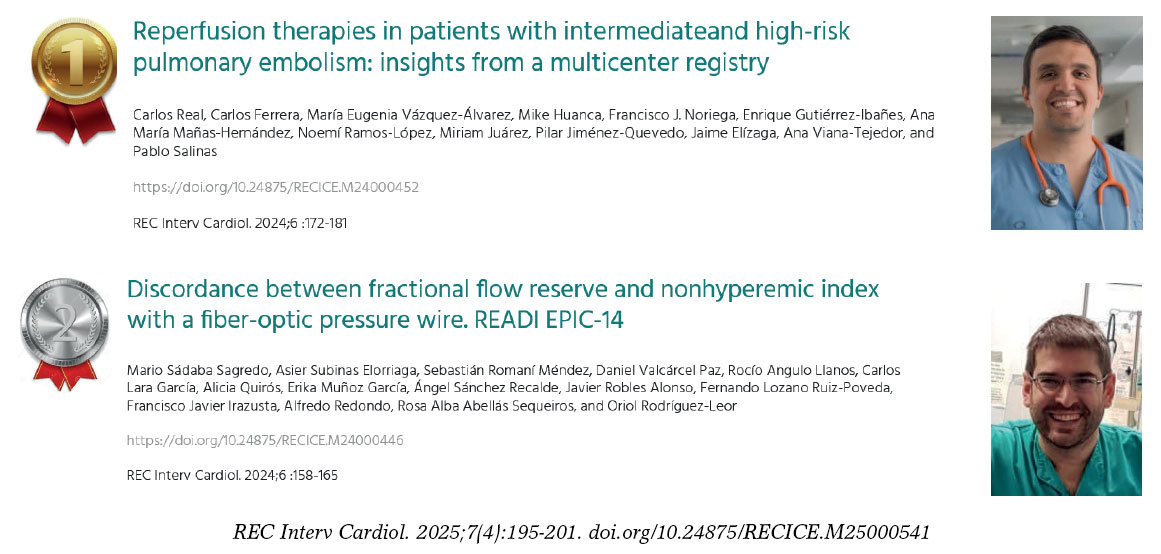
Figure 11. Original articles in REC: Interventional Cardiology awarded at the 2025 annual congress of the Interventional Cardiology Association of the Spanish Society of Cardiology.6,7
For the REC: Interventional Cardiology website, most users access it from Spain, followed by the United States, Mexico, Germany, and Argentina. Access occurs primarily through keyword searches within the field (70%) and, to a lesser extent, through direct searches for the journal (20%).
At the time of writing this Editor’s page, the most widely read publications in the past 12 months include the thematic review “The role of implant projection in optimizing transcatheter aortic valve implantation” by Álvarez-Velasco et al.,8 and original articles “Safety and efficacy of the Essential Pro paclitaxel drug-coated balloon for the treatment of in-stent restenosis” by Padilla et al,9 and “Prognosis of patients with supranormal ejection fraction undergoing percutaneous aortic valve replacement” by Martínez Gómez et al.10
Among special articles, the consensus document “Occupational exposure to ionizing radiation in pregnant staff”3—produced by 5 scientific societies—deserves special attention. This document has significant impact given the growing proportion of women in Spanish interventional cardiology, one of the highest worldwide. Many professionals encounter pregnancy during their careers, which poses challenges to maintaining their professional activity. It is essential that they make informed, autonomous decisions regarding their work during this period. This document provides guidance to support that process.
On social media, the platform X continues to drive the most traffic (3.65% of total) and user engagement, with more than 22 700 followers.11
Furthermore, REC Publications opened a profile this year on BlueSky,12 and we encourage readers active on this emerging platform to follow us there using our usual hashtag: #recintervcardiol.
It is important to emphasize that dissemination is a shared responsibility. Broader dissemination benefits everyone by attracting higher-quality articles, increasing citations, and enhancing the journal’s editorial impact.
ACKNOWLEDGMENTS
As Editor-in-Chief, I wish to thank once again our Associate Editors—Fernando Alfonso, Raúl Moreno, Soledad Ojeda, Armando Pérez de Prado, and Rafael Romaguera (figure 12). My work is greatly facilitated by an editorial team that combines experience, enthusiasm, dedication, and exceptional collegiality.

Figure 12. Editorial team of REC: Interventional Cardiology. Left to right: José M. de la Torre-Hernández, Fernando Alfonso, Armando Pérez de Prado, Soledad Ojeda, Raúl Moreno, and Rafael Romaguera.
Whenever I speak about REC: Interventional Cardiology, especially abroad, I emphasize one particularly relevant feature that explains its exemplary trajectory since inception: it is the official journal of the ACI-SEC. Few journals can claim this, and it represents a unique strength. From the founding ACI-SEC board to the most recently elected, every board has provided unwavering support for this project. ACI-SEC sustains the journal financially with funds obtained through the generous, unconditional support of companies in the field of interventional cardiology, to whom we extend our deepest gratitude. Nonetheless, to further reinforce the journal’s financial sustainability, the SEC has agreed to cover 50% of the editorial office costs.
Last but not least, I wish to recognize the outstanding work and dedication of the REC Publications editorial office staff (Iria del Río, Eva M. Cardenal, Belén Juan, and María González Nogal), who serve as the backbone of this journal, as well as our information technology consultant (Juan Quiles), the other departments of the Casa del Corazón, and the entire team at Permanyer Publications.
As someone has wisely said: “When you think you have reached the highest summit, a greater one always appears on the horizon.”
FUNDING
None declared.
CONFLICTS OF INTEREST
None declared.
REFERENCES
1. Clarivate Analytics. 2024 Journal Impact Factor. Journal Citation Reports (Clarivate 2025). Available at: https://clarivate.com/academia-government/scientific-and-academic-research/research-funding-analytics/journal-citation-reports/infographic/.
2. Barreiro-Pérez M, Li CH, Parada Barcia JA, et al. Role of computed tomography in transcatheter coronary and structural heart disease interventions. REC Interv Cardiol. 2024;6:201-212.
3. Velázquez Martín M, Lojo Lendoiro S, Soto Flores N, et al. Occupational exposure to ionizing radiation in pregnant staff. Consensus document of ACI-SEC/ARC-SEC/SERVEI/SENR/SERAM/GeNI. REC Interv Cardiol. 2025;7:246-254.
4. Ballesteros Tejerizo F, Coserría Sánchez F, Bastante T, et al. Spanish cardiac catheterization in congenital heart diseases registry. Fourth official report from the ACI-SEC and the GTH-SECPCC (2023). REC Interv Cardiol. 2025;7:238-245.
5. Resúmenes presentados al 36 Congreso de la Asociación de Cardiología Intervencionista de la Sociedad Española de Cardiología. Santiago de Compostela, 4-6 de junio de 2025. REC Interv Cardiol. 2025;7:C1-C14.
6. Real C, Ferrera C, Vázquez-Álvarez ME, et al. Reperfusion therapies in patients with intermediate and high-risk pulmonary embolism:insights from a multicenter registry. REC Interv Cardiol. 2024;6:172-181.
7. Sádaba Sagredo M, Subinas Elorriaga A, RomaníMéndez S, et al. Discordance between fractional flow reserve and nonhyperemic index with a fiber-optic pressure wire. READI EPIC-14. REC Interv Cardiol. 2024;6: 158-165.
8. Álvarez-Velasco R, Almendárez M, Alperi A, et al. The role of implant projection in optimizing transcatheter aortic valve implantation. REC Interv Cardiol. 2024;6:332-339.
9. Padilla L, Liberman F, Tello J, et al. Safety and efficacy of the Essential Pro paclitaxel drug-eluting balloon for the treatment of coronary in-stent restenosis. REC Interv Cardiol. 2024;6:166-171.
10. Martínez Gómez E, Solar X, Faria D, et al. Prognosis of patients with supranormal ejection fraction undergoing percutaneous aortic valve replacement. REC Interv Cardiol. 2024;6:271-277.
11. X. @RevEspCardiol. Available at: https://x.com/RevEspCardiol. Accessed 11 Jul 2025.
12. BlueSky. @revespcardiol.bsky.social. Available at: https://bsky.app/profile/revespcardiol.bsky.social.
* Corresponding author.
E-mail address: (J.M. de la Torre-Hernández).
 @RevEspCardiol #recintervcardiol
 @revespcardiol.bsky.social #recintervcardiol