
To the Editor,
Percutaneous closure of patent foramen ovale (PFO) is the treatment of choice for platypnea-orthodeoxia syndrome (POS) due to a right-to-left interatrial shunt. Traditionally, it has been performed using double-disc occluder devices, with a high success rate and good clinical outcomes.1-3 In recent years, the NobleStitch EL system (HeartStitch, Inc., United States) has emerged as an alternative percutaneous, suture-mediated, device-free closure technique that may offer potential advantages in certain anatomical or clinical scenarios.
The available evidence on NobleStitch EL comes primarily from PFO closure for cryptogenic stroke and is limited in POS.4 To the best of our knowledge, this is the first series devoted exclusively to PFO closure using NobleStitch EL in patients with POS. The aim of this study was to analyze the feasibility, efficacy, and safety of this technique.
We conducted a retrospective, observational, single-center study at Hospital Universitari Vall d’Hebron (Barcelona, Spain) involving consecutive patients with POS who underwent PFO closure with NobleStitch EL from January 2018 to January 2025. Classic POS was defined as dyspnea or arterial desaturation while sitting or standing, with improvement in the supine position; in doubtful cases, the oximetric step-up between the pulmonary veins and the left atrium was confirmed. Moreover, pulmonary hypertension was ruled out by right heart catheterization. Right-to-left shunting was graded by transthoracic or transesophageal echocardiography in the supine position using agitated saline (grade 0 = 0 bubbles; grade 1 [mild] = 1–10 bubbles; grade 2 [moderate] = 10–20 bubbles; grade 3 [severe] = > 20 bubbles; and grade 4 [massive] = complete opacification of the left atrium), both at rest and during the Valsalva maneuver. Clinical follow-up, including documentation of arterial oxygen saturation (SaO2), was performed during the first year. Transthoracic echocardiography with agitated saline, both at rest and during the Valsalva maneuver, was performed at the end of the procedure and at 6 months.
Technical success was defined as successful deployment of ≥ 1 sutures in the interatrial septum. Closure efficacy was assessed by the increase in SaO2 and reduction in residual shunting. A nonsignificant residual shunt (less than moderate) and SaO2 ≥ 93% in the absence of pulmonary disease were considered acceptable. The rate of atrial fibrillation and other procedural complications was analyzed as well.
This technique has been previously described in detail.4 (figure 1A and video S1). The procedure is performed via femoral venous access, with administration of unfractionated heparin at a dose of 100 U/kg and a target activated clotting time > 250 seconds. Initially, the PFO is crossed using a 5-Fr pigtail or multipurpose catheter, while a 0.032 in guidewire is placed in the left superior pulmonary vein. After baseline PFO angiography and sizing with a 24-mm compliant balloon, a 0.018 in guidewire is advanced into the distal superior vena cava. A 14-Fr Mullins introducer sheath is used with the NobleStitch EL system. The system consists of 2 dedicated catheters that sequentially suture the septum secundum (NobleStitch S) and septum primum (NobleStitch P). The guidewire placed in the superior vena cava serves as support for the NobleStitch S catheter, whereas the one placed in the left superior pulmonary vein supports the NobleStitch P catheter. Each catheter has an arm carrying a 4-0 polypropylene suture, allowing the septal margins to be encircled. Deployment of the needle perforates the septum and captures the suture. Finally, the KwiKnot system (HeartStitch, Inc.) is used to bring both sutures together, closing the defect with a stitch and cutting the excess suture. Procedure is guided by angiofluoroscopy and intracardiac echocardiography (AcuNav 10 F probe, Biosense Webster, Johnson & Johnson MedTech, United States). No postprocedural antithrombotic therapy is administered unless clinically indicated.
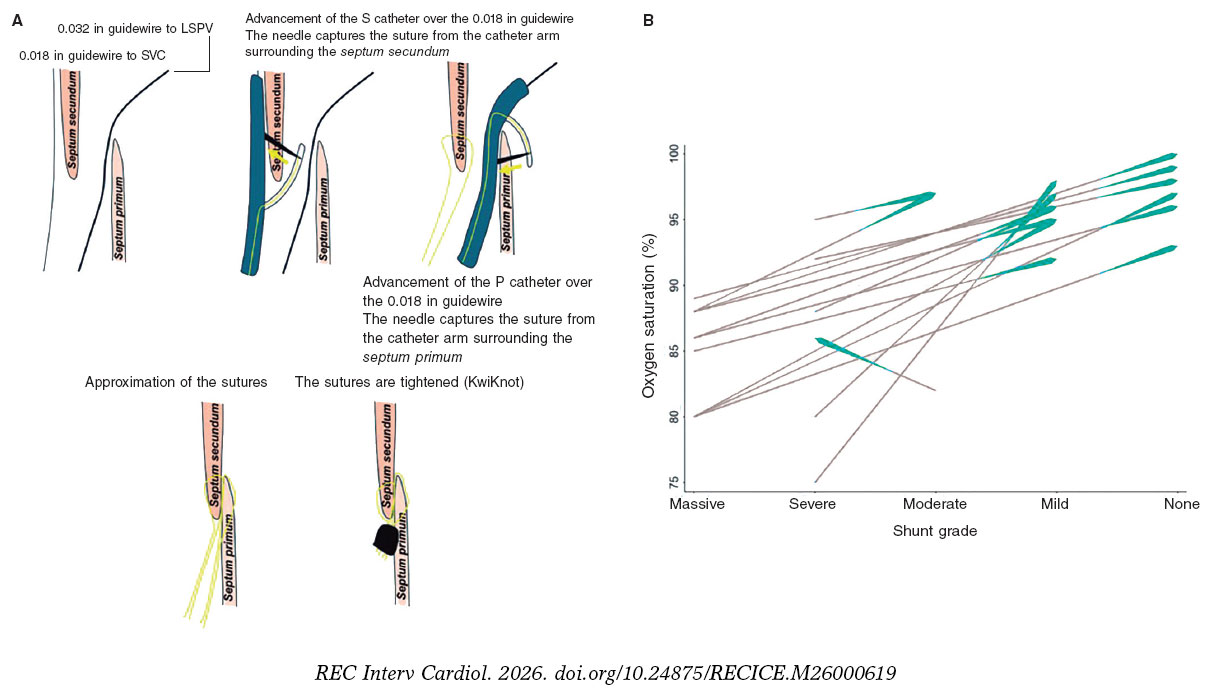
Figure 1. A: Description of the NobleStitch EL percutaneous suture implantation technique. B: Outcomes graph showing the degree of shunting on echocardiography and oxygen saturation (%) before and after (arrowhead) the procedure in each patient. LSPV, left superior pulmonary vein; SVC, superior vena cava.
Sixteen patients were included, 14 with classic POS and 2 with isolated hypoxemia. Median follow-up was 746 days (IQR, 198–1,731 days). Demographic and clinical characteristics are shown in table 1.
Table 1. Patient characteristics
| Variables | Patients |
|---|---|
| General characteristics | |
| Men | 10 (63) |
| Age (years) | 76 [65–83] |
| Smoking | 7 (44) |
| Hypertension | 9 (56) |
| Type 2 diabetes mellitus | 5 (31) |
| Obesity | 3 (19) |
| Ischemic heart disease | 0 (0) |
| Lung disease | 7 (44) |
| Scoliosis | 2 (13) |
| Oxygen saturation while standing (%) | 86 [80–88] |
| Hemoglobin (g/dL) | 14 [12–17] |
| Stroke | 5 (31) |
| Previous bleeding | 5 (31) |
| Atrial fibrillation | 1 (6) |
| Left atrium (area, cm2) | 20 [19–26] |
| Antithrombotic therapy | 8 (50) |
| Anatomical or functional characteristics of the patent foramen ovale | |
| Aortic elongation or aneurysm | 11 (69) |
| Pulmonary thromboembolism | 2 (13) |
| Functional tricuspid stenosis | 2 (25) |
| Diaphragmatic paralysis | 1 (6) |
| Chiari network | 3 (19) |
| Prominent Eustachian valve | 7 (44) |
| Lipomatous interatrial septum | 7 (44) |
| Interatrial septal aneurysm | 14 (88) |
| Fenestration | 2 (13) |
|
Data are expressed as number of patients (percentage prevalence) or median [interquartile range]. |
|
Technical success was achieved in 94% (n = 15); the only failure was due to percutaneous suture dehiscence in a multifenestrated PFO, which required implantation of an umbrella-type device. In 2 patients with massive PFO shunting, a second suture was required due to significant residual shunting: one patient, who had a prominent Eustachian valve and an interatrial septal aneurysm, had no residual shunt, whereas the other, who had a lipomatous and aneurysmal interatrial septum, a Chiari network, and an aortic aneurysm, had persistent mild residual shunting. Median SaO2 increased from 86% (IQR, 80–88) to 96.5% (IQR, 95–97.5; Wilcoxon test; P = .0004). Three patients (19%) had significant residual shunting: the first corresponded to the technical failure described above; the second, who had an aortic aneurysm and a prominent Eustachian valve, improved from a severe baseline shunt to a moderate shunt during the Valsalva maneuver; and the third one, who had a long-tunnel PFO, an aortic aneurysm, and a prominent Eustachian valve, improved from a massive baseline shunt to a moderate shunt during the Valsalva maneuver. Despite persistent moderate residual shunting, the latter 2 patients became asymptomatic, with resolution of hypoxemia and no need for reintervention. No new-onset atrial fibrillation or other complications were observed (figure 1B).
The percutaneous closure of PFO using double-disc occluder devices has demonstrated high occlusion rates. In cryptogenic stroke, efficacy, defined as the absence of residual shunting or only minimal persistent shunting, exceeds 90% at 6–12 months.1 In POS, the Toronto and French groups have reported occlusion efficacy rates close to 100%.2,3 However, these devices have been associated with atrial fibrillation, which usually occurs early, within the first 45 days after implantation, and is more frequent with GORE CARDIOFORM (W. L. Gore & Associates, Inc., United States), with a relative risk of 14.6 and an incidence rate of 6.6%.1,5 Furthermore, serious but rare complications have been reported, including erosion of the atrial wall into the pericardium or aorta, atrioaortic fistula, cardiac perforation, infective endocarditis, device fracture, embolization, and migration.1 Similarly, nickel hypersensitivity is an unusual finding (0.2%) and rarely requires device removal.1 Finally, device thrombosis (1%–2%) and bleeding related to antithrombotic therapy (up to 2.6% in the CLOSURE study) have been reported.1,5,6 In addition, these devices hinder transseptal access. Overall, clinical trials of PFO closure for stroke have reported an incidence rate of procedural complications of 2.6%.1
NobleStitch EL is a device-free alternative based on suture-mediated approximation of the septum primum and septum secundum. In the largest published registry, which included 200 patients treated mainly for cryptogenic stroke and only 1 case of POS, the success rate was 96%, with no significant residual shunt in 89% at 6 months and no system-related complications.4 Extrapolation of evidence from cryptogenic stroke to POS should be approached with caution because patients with POS tend to be older, have more comorbidities, and more complex septal anatomy, including interatrial septal deformation, septal aneurysm, aortic root elongation or distortion, and other abnormalities that favor right-to-left shunting in the upright position. In this setting, a suture-mediated closure strategy could avoid some of the limitations of occluder devices while maintaining good clinical efficacy.
In our series, PFO closure with NobleStitch EL achieved a high technical success rate, with a significant improvement in SaO2 and no relevant procedural complications, including atrial fibrillation. Although anatomical occlusion efficacy was slightly lower than that reported with double-disc devices, clinical efficacy was very high, with resolution of hypoxemia and symptoms in most patients and no need for reintervention. Moreover, in large defects, the possibility of placing additional sutures allowed optimization of final outcomes. However, fenestrated defects may be associated with poorer outcomes, as illustrated by the only technical failure in our series and as previously reported.6 Furthermore, device-free closure made it possible to avoid postprocedural antithrombotic therapy in 50% of patients, with no thrombotic events recorded during follow-up, a potentially relevant aspect in an older population with a higher risk of bleeding and thrombosis.
Despite the small sample size and the observational, retrospective, and uncontrolled nature of the study, PFO closure with NobleStitch EL appears to be a feasible, effective, and safe technique in patients with POS, even in those with complex anatomy, and represents an alternative to double-disc devices. Nevertheless, outcomes could be less favorable in fenestrated defects.
FUNDING
This research received no specific funding.
ETHICAL CONSIDERATIONS
The study protocol was reviewed and approved by the Ethics Committee of Hospital Universitari Vall d’Hebron (Barcelona, Spain). Written informed consent was obtained from all patients. The SAGER recommendations regarding potential sex- and gender- related bias were followed.
STATEMENT ON THE USE OF ARTIFICIAL INTELLIGENCE
Artificial intelligence was not used in the development of this manuscript.
AUTHORS’ CONTRIBUTIONS
K. Rajjoub and Y. Belahnech contributed equally to the conception and design of the study, data collection, analysis and interpretation of the results, and initial drafting of the manuscript. B. García del Blanco, M. Maymí, S. del Fresno, and G. Martí-Aguasca participated in data interpretation and critical revision of the manuscript and made substantial contributions to the final version. All authors have read and approved the final version of the manuscript and agree to be accountable for all aspects of the work.
CONFLICTS OF INTEREST
G. Martí-Aguasca has served as a proctor for the NobleStitch EL system. The remaining authors declared no relevant conflicts of interest whatsoever.
SUPPLEMENTARY DATA
Vídeo 1. Rajjoub K. DOI: 10.24875/RECICE.M26000619
REFERENCES
1. Pristipino C, Sievert H, D'Ascenzo F, et al. European position paper on the management of patients with patent foramen ovale. General approach and left circulation thromboembolism. EuroIntervention. 2019;14:1389-1402.
2. Shah AH, Osten M, Leventhal A, et al. Percutaneous Intervention to Treat Platypnea–Orthodeoxia Syndrome. JACC Cardiovasc Interv. 2016;9:1928-1938.
3. Guérin P, Lambert V, Godart F, et al. Transcatheter Closure of Patent Foramen Ovale in Patients with Platypnea-Orthodeoxia: Results of a Multicentric French Registry. Cardiovasc Intervent Radiol. 2005;28:164-168.
4. Mojadidi MK, Zaman MO, Elgendy IY, et al. Cryptogenic Stroke and Patent Foramen Ovale. J Am Coll Cardiol. 2018;71:1035-1043.
5. Furlan AJ, Reisman M, Massaro J, et al. Closure or Medical Therapy for Cryptogenic Stroke with Patent Foramen Ovale. N Engl J Med. 2012;366:991-999.
6. Gaspardone A, De Marco F, Sgueglia GA, et al. Novel percutaneous suture-mediated patent foramen ovale closure technique: early results of the NobleStitch EL Italian Registry. EuroIntervention. 2018;14:e272-279.