
ABSTRACT
Introduction and objectives: Hospital presentation timing in patients with non–ST-segment elevation acute coronary syndrome (NSTEACS) may influence the initial therapeutic strategy. The aim of this study was to evaluate its association with therapeutic management and clinical outcomes.
Methods: This was an observational, prospective, multicenter study including patients with NSTEACS and culprit atherosclerotic disease identified on nonemergent coronary angiography. Patients were classified according to admission during working hours (WH) or non-working hours (NWH), and on working days (WD) or nonworking days (NWD). Clinical characteristics, invasive management and the incidence rate of in-hospital and 3-year follow-up events were analyzed.
Results: A total of 982 patients were analyzed (66.3 ± 12.7 years; 23.5% women). Most patients were admitted on WD (68.2%), although most admissions occurred during NWH (65.3%). The median time to coronary angiography was 41 hours (20–74), with a longer delay in patients admitted on NWD (59 [32-78] vs 29 [17-71] hours; P < .001). Differences were observed in initial antithrombotic management according to hospital presentation timing, with higher rates of pretreatment with dual antiplatelet therapy and anticoagulation in patients admitted during NWH (P < .001 and P = .036, repectively) and NWD (P = .047 and P = .016, respectively). After multivariable adjustment, admission during NWH was not independently associated with worse in-hospital outcomes (adjusted OR, 0.95; 95%CI, 0.58–1.56; P = .858] or 3-year outcomes [adjusted HR, 1.22; 95%CI, 0.83–1.81; P = .313], with consistent findings for the comparison between WD and NWD.
Conclusions: Hospital presentation timing was not associated with worse in-hospital or follow-up outcomes, although differences were observed in initial clinical management.
Keywords: Acute coronary syndrome. NSTEACS. Myocardial infarction. Ischemic heart disease.
RESUMEN
Introducción y objetivos: El momento de presentación hospitalaria en pacientes con síndrome coronario agudo sin elevación del segmento ST (SCASEST) podría influir en la estrategia terapéutica inicial. El objetivo fue evaluar su relación con el manejo terapéutico y los resultados clínicos.
Métodos: Estudio observacional, prospectivo y multicéntrico que incluyó a pacientes con SCASEST y enfermedad cardiovascular aterosclerótica culpable en la coronariografía no inmediata. Se clasificó a los pacientes según ingreso en horario laboral (HL) o no laboral (HNL), y día laborable (DL) o no laborable (DNL). Se analizaron las características clínicas, el manejo invasivo y la incidencia de episodios intrahospitalarios y en el seguimiento a 3 años.
Resultados: Se analizó a 982 pacientes (66,3 ± 12,7 años; 23,5% mujeres). Aunque la mayoría ingresaron en DL (68,2%), muchos lo hicieron en HNL (65,3%). La mediana hasta la coronariografía fue de 41 (20-74) horas, con mayor retraso en DNL (59 [32-78] frente a 29 [17-71]; p < 0,001). Se observaron diferencias en el tratamiento antitrombótico inicial según el momento de presentación hospitalaria, con mayores tasas de pretratamiento antiagregante plaquetario doble y anticoagulación en HNL (p < 0,001 y p = 0,036) y DNL (p = 0,047 y p = 0,016, respectivamente). Tras el ajuste multivariable, el ingreso en HNL no se asoció de forma independiente con un peor pronóstico intrahospitalario (OR ajustada = 0,95; IC95%, 0,58-1,56; p = 0,858) ni durante el seguimiento a 3 años (HR ajustada = 1,22; IC95%, 0,83-1,81; p = 0,313), con resultados concordantes al comparar DL y DNL.
Conclusiones: El momento de presentación hospitalaria no se relacionó con un peor pronóstico intrahospitalario ni durante el seguimiento, aunque se observaron diferencias en el manejo clínico inicial.
Palabras clave: Síndrome coronario agudo. SCASEST. Infarto de miocardio. Cardiopatía isquémica.
Abreviaturas
NSTEACS: non-ST-segment elevation acute coronary syndrome. NWD: nonworking day. NWH: nonworking hours. WD: working day. WH: working hours.
INTRODUCTION
Ischemic heart disease is one of the leading causes of morbidity and mortality worldwide and the leading cause of death in developed countries. One of its most common clinical presentations is non–ST-segment elevation acute coronary syndrome (NSTEACS), whose incidence has increased in recent years,1,2 partly because of population aging.3
Regarding the management of NSTEACS, current clinical practice guidelines recommend an early invasive strategy with coronary angiography to improve prognosis and reduce adverse events, particularly in patients with high-risk ischemic features.4,5 Nevertheless, the optimal timing of intervention remains controversial, partly because logistical factors hinder the systematic implementation of early reperfusion strategies in everyday practice.6,7
Unlike ST-segment elevation acute coronary syndrome, for which reperfusion pathways are well established, the timing of an early invasive strategy for the management of NSTEACS varies widely.6,7 This is relevant because early coronary angiography (< 24 hours) presents organizational and logistical challenges arising from staff and resource availability, geographical disparities, and increased health care costs.
The timing of hospital presentation, during working hours (WH), at night, or on weekends, is fundamental to the organization of care and may substantially affect the therapeutic management of NSTEACS, including time to cardiac catheterization. Some studies have suggested that admission outside the usual operating hours of cath labs is a determinant of delayed coronary angiography.8 However, evidence on this specific issue remains limited and heterogeneous, particularly in our health care system.
Accordingly, this study aimed to assess the impact of hospital presentation timing on management and clinical outcomes among patients with NSTEACS.
METHODS
Study design and patient selection
The IMPACT-TIMING-GO registry is an observational, prospective, multicenter study involving 23 centers with cath lab availability 24 hours a day, throughout the year. Its design has been published previously.9 It enrolled patients aged ≥ 18 years diagnosed with NSTEACS and culprit atherosclerotic disease confirmed by invasive coronary angiography. Patients with type 2 acute myocardial infarction, spontaneous coronary artery dissection, stress cardiomyopathy, myocarditis, or vasospasm were excluded. Moreover, this substudy excluded emergency coronary angiography, that is, procedures performed immediately according to clinical practice guideline indications.1
Clinical management, including the timing of coronary angiography, followed standard practice at each center. Follow-up visits were conducted at 12 and 36 months after hospital discharge.
The study protocol was developed in full compliance with the principles outlined in the Declaration of Helsinki and approved by the ethics committees of the participating institutions. All patients gave their prior written informed consent.
Endpoints
The primary endpoint was to analyze differences in clinical management and prognosis according to the timing of hospital presentation.
The principal investigator at each center reported institutional care characteristics, including the usual WH of the cath lab.
Patients presenting during the usual cath lab WH, allowing a ± 1-hour margin to account for transfer times, delays in computerized administrative registration, or deviations from operating hours commonly encountered in clinical practice, were classified as presenting during WH. Admissions outside this margin were classified as nonworking hours (NWH). Working day (WD) and nonworking day (NWD) were defined according to the official calendar of each autonomous community and municipality (figure 1).
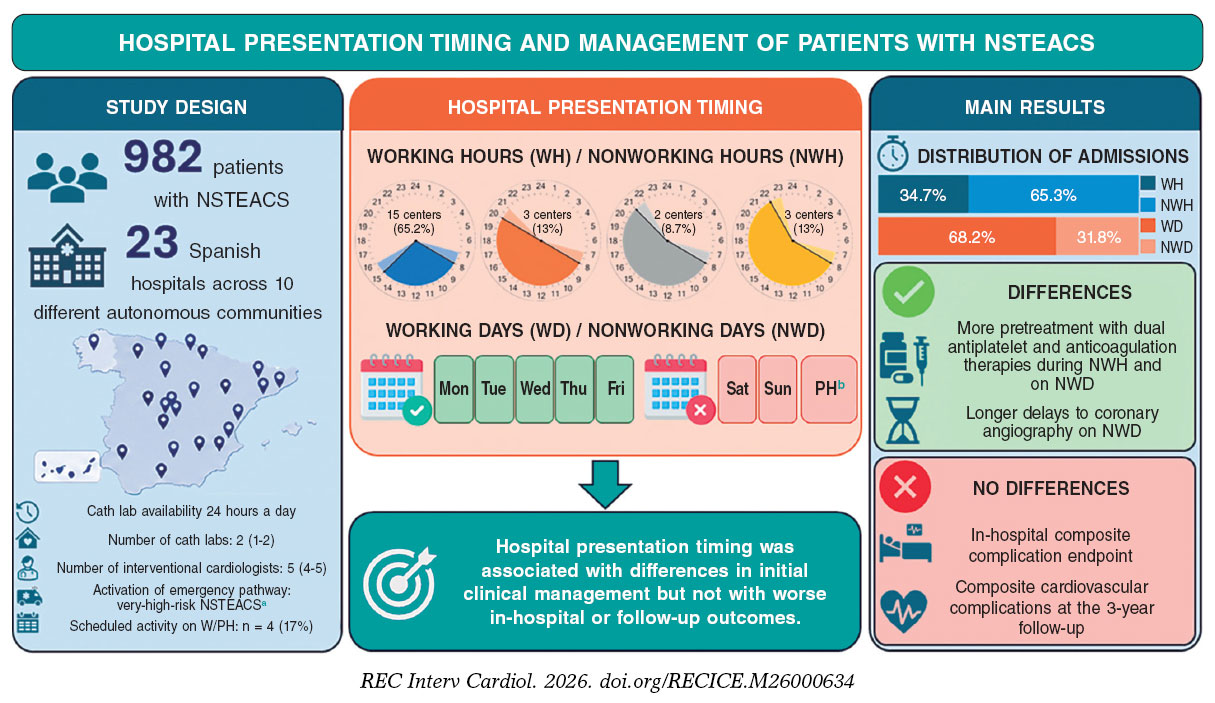
Figure 1. Central illustration. Study design and main findings on the association between hospital presentation timing and management of patients with non–ST-segment elevation acute coronary syndrome (NSTEACS). Left panel: characteristics of the 23 participant hospitals (median and interquartile range). Middle panel: classification of presentation by time (working/nonworking hours) and type of day (working/nonworking day), according to the characteristics of each center. Right panel: distribution of admissions and main differences in clinical management and prognosis. CV, cardiovascular; DAPT, dual antiplatelet therapy; NWD, nonworking day; NWH, nonworking hours; PH, public holiday; WD, working day; WH, working hours; W, weekends. a Only a few centers performed selected procedures in high-risk NSTEACS patients under the myocardial infarction code/alert protocol. b Local, regional, and national public holidays according to the location of each center.
Clinical characteristics, invasive management during hospitalization, and clinical events during hospitalization and after discharge were analyzed. The study flowchart is shown in figure 2.
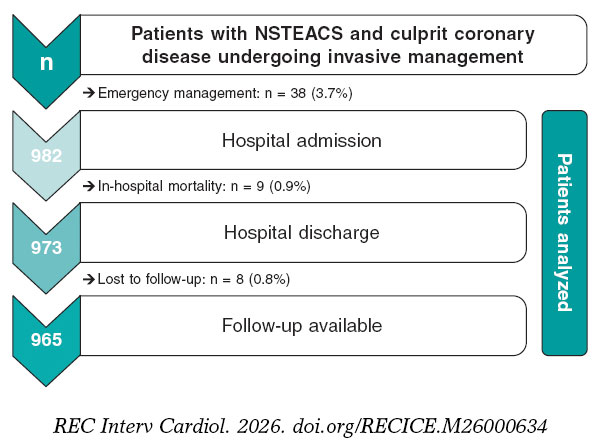
Figure 2. Flowchart of patients included in the study. NSTEACS, non-ST-segment elevation acute coronary syndrome.
The primary in-hospital endpoint was a composite of sustained ventricular arrhythmias, stent thrombosis or reinfarction, mechanical complications of myocardial infarction, renal failure (a > 2.5-fold increase in creatinine levels or need for renal replacement therapy), circulatory support device implantation or heart transplantation, pacemaker implantation, major bleeding (Bleeding Academic Research Consortium grade ≥ 3),10 and death.
The primary endpoint after discharge was a composite of emergency cardiovascular hospitalization or cardiac death.
Statistical analysis
Quantitative variables are expressed as mean and standard deviation or median (interquartile range), and categorical variables as absolute numbers and percentages. The Kolmogorov–Smirnov test was used to assess normality. Categorical variables were compared using the chi-square or Fisher’s exact test, and quantitative variables between groups using the Student t test.
In-hospital events were analyzed as binary outcomes; postdischarge events were additionally assessed using Kaplan–Meier survival analysis. Patients with < 12 months of follow-up were excluded from the analysis. Multivariable adjustment was performed using binary logistic regression for the in-hospital endpoint and Cox regression for the postdischarge endpoint. Covariates with heterogeneous distributions (P < .1) and those relevant to care organization (such as scheduled afternoon activity) were included. A maximum ratio of 1 covariate per 10 events was maintained. Collinearity was assessed using the variance inflation factor. Associations were expressed as odds ratios (ORs) for binary outcomes and hazard ratios (HRs) for survival analysis. 2-sided P values < .05 were considered statistically significant. Analyses were performed using SPSS version 25.0 (IBM, United States).
RESULTS
Of the initial 1020 patients, 38 (3.7%) underwent emergency coronary angiography, more frequently among those admitted during WH than NWH (5.8% vs 2.6%; P = .009), with similar frequencies on WD and NWD (4.0% vs 2.9%; P = .290).
After excluding emergency cases, a total of 982 patients were included (mean age, 66.3 ± 12.7 years; 23.5% women), whose baseline characteristics are shown in table 1. Although most (65.3%) were admitted outside the cath lab WH, most admissions occurred on WD (68.2%), as shown in figure 1. The patients’ baseline characteristics were similar for WH and NWH admissions, as well as for WD and NWD admissions, except for a higher proportion of women admitted on NWD (28.8% vs 20.9%; P = .006).
Table 1. Baseline characteristics, clinical presentation, and treatment at admission
| Variables | Total (n = 982) | Admission WH (n = 341) | Admission NWH (n = 641) | P | Admission WD (n = 670) | Admission NWD (n = 312) | P |
|---|---|---|---|---|---|---|---|
| Age (years) | 66.3 ± 12.7 | 66.2 ± 12.0 | 66.4 ± 13.2 | .801 | 66.7 ± 12.8 | 65.5 ± 12.5 | .173 |
| Female sex (%) | 230 (23.4) | 84 (24.6) | 146 (22.8) | .513 | 140 (20.9) | 90 (28.8) | .006a |
| Body mass index (kg/m²) | 27.7 ± 5.8 | 27.7 ± 5.0 | 27.8 ± 4.6 | .646 | 27.7 ± 4.8 | 27.9 ± 4.5 | .701 |
| Baseline characteristics, n (%) | |||||||
| Hypertension | 677 (68.9) | 234 (68.6) | 443 (69.1) | .875 | 458 (68.4) | 219 (70.2) | .563 |
| Diabetes mellitus | 336 (34.2) | 124 (36.4) | 212 (33.1) | .301 | 230 (34.3) | 106 (34.0) | .913 |
| Smoking | 294 (30.5) | 97 (29.1) | 197 (31.3) | .517 | 187 (28.6) | 107 (34.5) | .175 |
| Cerebrovascular disease | 69 (7.0) | 19 (5.6) | 50 (7.8) | .193 | 42 (6.3) | 27 (8.7) | .173 |
| Chronic kidney disease | 114 (11.6) | 42 (12.3) | 72 (11.2) | .614 | 84 (12.5) | 30 (9.6) | .283 |
| COPD | 100 (10.2) | 32 (9.4) | 68 (10.6) | .546 | 69 (10.3) | 31 (9.9) | .861 |
| Atrial fibrillation/flutter | 75 (7.6) | 28 (8.2) | 47 (7.3) | .622 | 52 (7.8) | 23 (7.4) | .831 |
| Heart failure | 42 (4.3) | 17 (5.0) | 25 (3.9) | .424 | 27 (4.0) | 15 (4.8) | .575 |
| Previous myocardial infarction | 225 (22.9) | 75 (22.0) | 150 (23.4) | .617 | 159 (23.7) | 66 (21.2) | .371 |
| Status at admission, n (%) | |||||||
| NSTEMI at admission | 754 (76.8) | 248 (72.7) | 506 (78.9) | .028a | 500 (74.6) | 254 (81.4) | .019a |
| New ECG changes | 600 (61.1) | 197 (57.8) | 403 (62.9) | .466 | 414 (61.8) | 186 (59.6) | .515 |
| Killip–Kimball | |||||||
| I | 878 (89.4) | 305 (89.4) | 573 (89.4) | .868 | 593 (88.5) | 285 (91.3) | .275 |
| II | 82 (8.4) | 30 (8.8) | 52 (8.2) | 62 (9.3) | 20 (6.4) | ||
| III-IV | 22 (2.1) | 6 (1.8) | 16 (2.4) | 15 (2.2) | 7 (2.3) | ||
| Previous cardiac arrest | 3 (0.3) | 1 (0.3) | 2 (0.3) | .959 | 2 (0.3) | 1 (0.3) | .999 |
| Previous ventricular arrhythmias | 5 (0.5) | 1 (0.3) | 4 (0.6) | .487 | 4 (0.6) | 1 (0.3) | .989 |
| Antithrombotic therapy before coronary angiography, n (%) | |||||||
| Acetylsalicylic acid | 969 (98.7) | 337 (98.8) | 632 (98.6) | .763 | 661 (98.7) | 308 (98.7) | .938 |
| Pretreatment with dual antiplatelet therapy | 683 (69.6) | 206 (60.4) | 477 (74.4) | < .001a | 450 (67.2) | 233 (74.7) | .047a |
| Clopidogrel | 319 (46.7) | 95 (46.1) | 224 (46.9) | .144 | 218 (48.4) | 101 (43.3) | .103 |
| Prasugrel | 18 (2.6) | 8 (3.9) | 10 (2.2) | 13 (2.9) | 5 (2.1) | ||
| Ticagrelor | 346 (50.7) | 103 (50.0) | 243 (50.9) | 219 (48.7) | 127 (54.5) | ||
| Pretreatment with anticoagulant therapy | 746 (76.5) | 245 (72.1) | 501 (78.9) | .036a | 499 (66.9) | 247 (79.9) | .016a |
| LMWH | 317 (42.3) | 97 (40.0) | 220 (43.9) | .070 | 213 (42.7) | 104 (42.1) | .283 |
| Unfractionated heparin | 16 (2.1) | 5 (2.0) | 11 (2.2) | 9 (1.8) | 7 (2.8) | ||
| Fondaparinux | 413 (55.3) | 143 (58.3) | 270 (53.9) | 277 (55.5) | 136 (55.1) | ||
| Coronary angiography, n (%) | |||||||
| Time to coronary angiography | 41 (20-74) | 31 (23-75) | 42 (18-73) | .284 | 29 (17-71) | 59 (32-78) | < .001a |
| < 24 h | 325 (33.1) | 95 (27.9) | 230 (35.9) | .037a | 267 (39.9) | 58 (18.6) | < .001a |
| 24-72 h | 398 (40.5) | 151 (44.2) | 247 (38.5) | 239 (35.7) | 159 (51.0) | ||
| > 72 h | 259 (26.4) | 95 (27.9) | 164 (25.6) | 164 (24.5) | 95 (30.4) | ||
| < 12 h | 102 (10.4) | 45 (13.2) | 57 (8.9) | .035a | 92 (13.7) | 10 (3.2) | < .001a |
| < 72 h | 723 (73.6) | 246 (72.1) | 477 (74.4) | .441 | 506 (75.5) | 217 (69.6) | .058 |
| Previous noninvasive testing | 79 (8.0) | 36 (10.6) | 43 (6.7) | .035a | 57 (8.5) | 22 (7.1) | .435 |
|
COPD, chronic obstructive pulmonary disease; ECG, electrocardiogram; LMWH, low-molecular-weight heparin; NSTEMI, non–ST-segment elevation myocardial infarction; NWD, nonworking day; NWH, nonworking hours; WD, working day; WH, working hours. a P < .05. |
|||||||
Clinical presentation and acute management of the patients
Risk-related characteristics at admission (electrocardiographic changes, hemodynamic status, and ventricular arrhythmias) were similar between groups, except for a higher proportion of patients meeting criteria for NSTEMI among NWH admissions (78.9% vs 72.7%; P = .028) and NWD admissions (81.4% vs 74.6%; P = .019).
Initial antithrombotic therapy differed by presentation timing. Patients admitted during NWH or on NWD more frequently received pretreatment with dual antiplatelet therapy before coronary angiography (74.4% vs 60.4%; P < .001; and 74.7% vs 67.2%; P = .047, respectively). There were no differences in the type of antiplatelet drug; ticagrelor was most widely used in all groups. Anticoagulant pretreatment was more frequent in NWH (78.9% vs 72.1%; P = .036) and NWD admissions (79.9% vs 66.9%; P = .016); fondaparinux was the most widely used agent (55.3%), similarly across subgroups.
The median time from admission to coronary angiography was 41 (20-74) hours. Although it was longer for NWH admissions, the difference was not statistically significant (42 [18-73] vs 31 [23-75] hours; P = .2849). However, the delay was longer for NWD admissions (59 [32-78] vs 29 [17-71] hours; P < .001). Very early coronary angiography (< 12 hours) was more common among patients admitted during WH and on WD (13.2% vs 8.9%; P = .035; and 13.7% vs 3.2%; P < .001, respectively).
Angiographic and procedural characteristics are shown in table S1. Overall, there were no significant differences in underlying coronary anatomy or type of revascularization, which were similar across all subgroups.
In-hospital adverse events
The median length of stay was 5 (3–8) days, with no between-group differences. A total of 96 patients (9.8%) experienced the composite in-hospital endpoint; renal failure was the most common event (5.8%). The characteristics of these patients are shown in table S2. The in-hospital mortality rate was low (0.9%). Complication rates did not differ between WH and NWH or WD and NWD admissions (table 2). Presentation timing was not associated with the composite endpoint in the univariable analysis (figure 3A,B), nor was the timing of coronary angiography.
Table 2. In-hospital and postdischarge adverse clinical events
| In-hospital events, n (%) | Total (n = 982) | WH (n = 341) | NWH (n = 641) | P | Crude OR NWH vs WH (95%CI) | Adjusted ORa NWH vs WH (95%CI) | WD (n = 670) | NWD (n = 312) | P | Crude OR NWD vs WD (95%CI) | Adjusted ORa NWD vs WD (95%CI) |
|---|---|---|---|---|---|---|---|---|---|---|---|
| Length of stay, days | 5 (3-8) | 5 (3-8) | 5 (3-9) | .445 | 5 (3-8) | 5 (4-8) | .117 | ||||
| Composite in-hospital complications | 96 (9.8) | 34 (10.0) | 62 (9.7) | .881 | 0.97 (0.62-1.50) | 0.95 (0.58-1.56) | 72 (10.7) | 24 (7.7) | .134 | 0.69 (0.43-1.23) | 0.76 (0.45-1.25) |
| Stent thrombosis or reinfarction | 7 (0.7) | 1 (0.3) | 6 (0.9) | .432 | 4 (0.6) | 3 (1.0) | .686 | ||||
| Mechanical complication | 0 (0.0) | 0 (0.0) | 0 (0.0) | NA | 0 (0.0) | 0 (0.0) | NA | ||||
| Circulatory support or heart transplantation | 16 (1.6) | 6 (1.8) | 10 (1.6) | .814 | 13 (1.9) | 3 (1.0) | .416 | ||||
| Renal failure | 57 (5.8) | 19 (5.6) | 38 (5.9) | .820 | 43 (6.4) | 14 (4.5) | .228 | ||||
| Ventricular arrhythmias | 6 (0.6) | 3 (0.9) | 3 (0.5) | .424 | 5 (0.7) | 1 (0.3) | .671 | ||||
| Pacemaker implantation | 15 (1.5) | 8 (2.3) | 7 (1.1) | .127 | 12 (1.8) | 3 (1.0) | .411 | ||||
| Major hemorrhage | 18 (1.8) | 6 (1.8) | 12 (1.9) | .900 | 12 (1.8) | 6 (1.9) | .886 | ||||
| Mortality | 9 (0.9) | 3 (0.9) | 6 (0.9) | .930 | 7 (0.9) | 2 (0.6) | .727 | ||||
| Postdischarge events, n (%) | Total (n = 973) | WH (n = 338) | NWH (n = 635) | P | Crude HR NWH vs WH (95%CI) | Adjusted HRa NWH vs WH (95%CI) | WD (n = 663) | NWD (n = 310) | P | Crude HR NWD vs WD (95%CI) | Adjusted HRa NWD vs WD (95%CI) |
| Composite events during follow-up | 141 (14.5) | 45 (13.3) | 96 (15.1) | .446 | 1.21 (0.84-1.74) | 1.22 (0.83-1.81) | 94 (14.2) | 47 (15.1) | .685 | 1.06 (0.74-1.52) | 1.04 (0.71-1.52) |
| Cardiovascular hospitalization | 130 (13.4) | 43 (12.7) | 87 (13.7) | .686 | 87 (13.1) | 43 (13.9) | .373 | ||||
| Cardiac death | 26 (2.7) | 9 (2.7) | 17 (2.7) | .989 | 18 (2.7) | 8 (2.6) | .904 | ||||
| All-cause mortality | 76 (7.8) | 24 (7.1) | 52 (8.2) | .547 | 51 (7.7) | 25 (8.1) | .840 | ||||
| Myocardial infarction | 77 (8.0) | 23 (6.9) | 54 (8.6) | .355 | 47 (7.2) | 30 (9.7) | .171 | ||||
| Repeat coronary revascularization | 114 (11.8) | 40 (11.9) | 74 (11.7) | .922 | 74 (11.2) | 40 (12.9) | .450 | ||||
| Stroke | 12 (1.2) | 3 (0.9) | 9 (1.4) | .559 | 9 (1.4) | 3 (1.0) | .761 | ||||
| Major hemorrhage | 24 (2.5) | 7 (2.1) | 17 (2.7) | .562 | 18 (2.7) | 6 (1.9) | .465 | ||||
|
HR, hazard ratio; NA, not applicable; NWD, nonworking day; NWH, nonworking hours; OR, odds ratio; WD, working day; WH, working hours. a Adjusted multivariable models; included variables are detailed in tables S3 and S5. |
|||||||||||
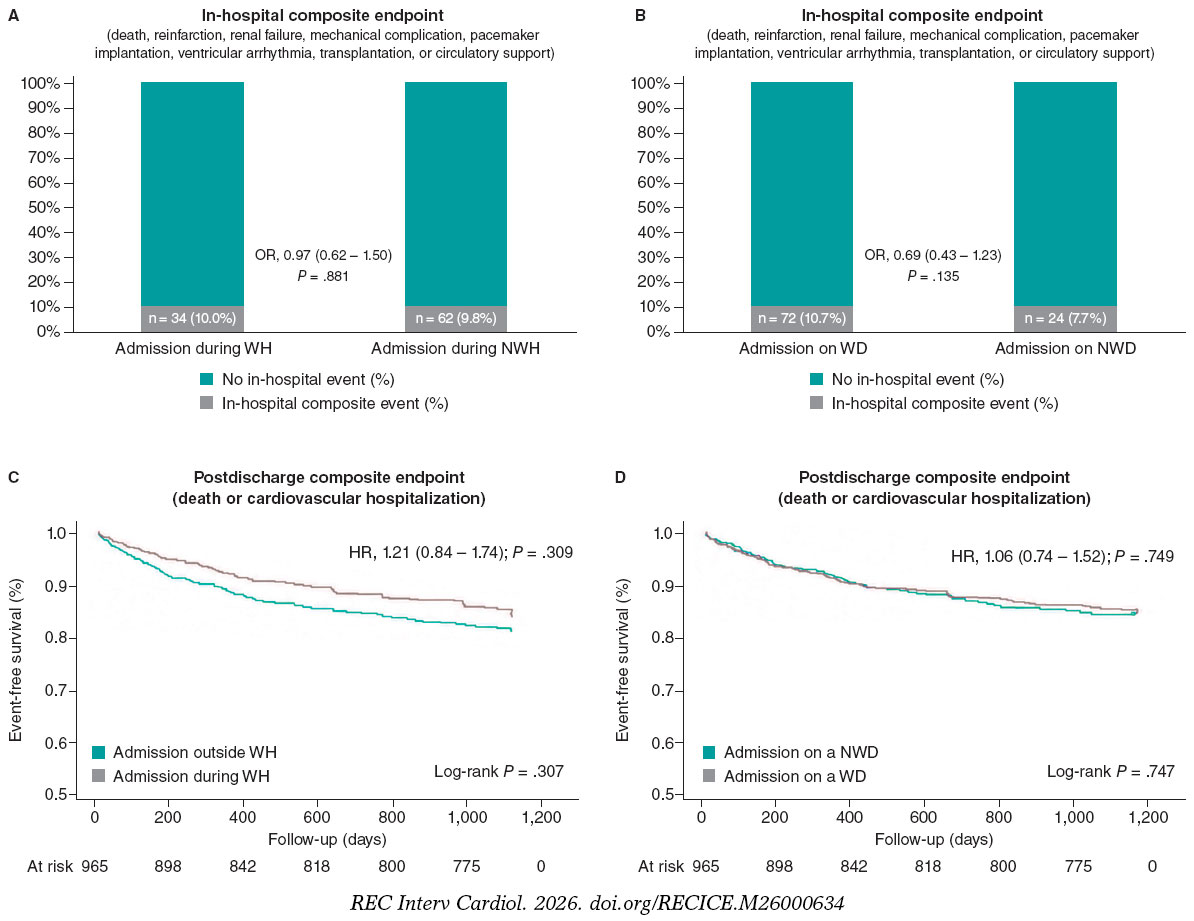
Figure 3. In-hospital (A and B) and postdischarge (C and D) adverse events according to admission during working (WH) or nonworking hours (NWH), and on working (WD) or nonworking days (NWD). HR, hazard ratio; OR, odds ratio.
After multivariable adjustment for clinical presentation (NSTEMI, electrocardiographic changes, and Killip–Kimball hemodynamic status) and care-related characteristics (afternoon activity), neither NWH vs WH admission (adjusted OR, 0.95; 95%CI, 0.58–1.56; P = .858) nor NWD vs WD admission (adjusted OR, 0.76; 95%CI, 0.45–1.25; P = .279) was associated with the in-hospital composite endpoint. The multivariable model is shown in table S3.
Stratified analyses by age, sex, high-risk NSTEACS criteria, pretreatment with antiplatelet or anticoagulant therapy, Killip–Kimball class > I, and timing of coronary angiography were consistent with the overall cohort, with no association with the in-hospital endpoint in any subgroup.
Events after hospitalization
Follow-up data > 12 months were available for 965 patients (99.2% of those discharged), and complete 3-year follow-up for 942 (96.8%); the median follow-up was 1097 (1092-1100) days. During this period, a total of 141 patients (14.5%) experienced the composite postdischarge endpoint, with similar proportions for WH vs NWH and WD vs NWD admissions. Characteristics of patients with the postdischarge endpoint are shown in table S4. The rate of cardiac death was low (2.7%) and similar across all presentation groups (table 2; figure 3C,D; figure S1). Stratified analyses are shown in figures S2 and S3.
After adjustment for outcome-related variables (age, sex, hypertension, renal disease, previous myocardial infarction, heart failure, and frailty) and scheduled afternoon activity, neither NWH vs WH presentation (adjusted HR, 1.22; 95%CI, 0.83–1.81; P = .313) nor NWD vs WD presentation (adjusted HR, 1.04; 95%CI, 0.71–1.52; P = .821) was associated with the postdischarge composite endpoint (table 2; table S5).
Center-level care factors and their impact on care
The main characteristics of participant centers are shown in table 3. Centers with afternoon activity (n = 8; 34.8%) had fewer NWH admissions (68.5% vs 31.1%; P < .001) and shorter times to coronary angiography (31 [19-69] vs 45 [20-85] hours; P = .001), without any differences being reported in the length of stay (5 [3-9] vs 5 [4-8] days; P = .245) compared with centers without afternoon activity. There were no differences in the in-hospital composite endpoint either (4.5% vs 5.0%; P = .523).
Table 3. Care organization at participant centers
| Care organization | Centers (n = 23) |
|---|---|
| Usual working hours | |
| 08:00–15:00 hours | 15 (65.2) |
| 08:00–20:00 hours | 3 (13.0) |
| 08:00–21:00 hours | 2 (8.7) |
| 08:00–22:00 hours | 3 (13.0) |
| Selected nonemergency activity on NWD | 4 (17.4) |
| Cath labs | |
| 1 | 8 (34.8) |
| 2 | 11 (47.8) |
| ≥ 3 | 4 (17.4) |
| Physicians dedicated to interventional cardiology per center | 4.9 ± 1.3 |
|
NWD, nonworking day. Categorical data are expressed as n (%) and continuous variables as mean and standard deviation. |
|
Although 4 centers (17.4%) reported performing nonemergency coronary angiography in selected patients on NWD at the discretion of the on-call team, only 17 procedures (1.7%) were performed under these circumstances.
DISCUSSION
The main findings, summarized in figure 1, were as follows: a) almost two thirds of patients with NSTEACS in our setting were admitted outside usual cath lab WH; b) clinical management differed by presentation timing, particularly time to coronary angiography and antithrombotic therapy; and c) despite these differences, presentation timing was not associated with longer hospitalization or worse in-hospital or postdischarge outcomes at the 3-year follow-up.
The impact of presentation timing on the management of NSTEACS remains controversial. Although earlier registries have associated NWH admissions with longer delays prior to coronary angiography and a lower likelihood of implementing early invasive strategies, the prognostic effect of these delays remains unclear.6-8
In our study, emergency coronary angiographies were excluded to avoid possible bias from higher-risk cases whose management differs substantially. Interestingly, most such patients were admitted during WH, potentially suggesting an association with organizational or care-related factors.
Although the patients’ baseline characteristics were homogeneous, women were more frequently admitted on NWD, which is consistent with former studies.11 Atypical symptoms, more common in women, have been associated with delayed presentation after acute myocardial infarction and could explain this observation.12,13
Of note, a higher proportion of patients met NSTEMI criteria at admission during NWH or on NWD, because clinical practice guidelines emphasize the benefits of emergency coronary angiography (< 24 hours) in these patients.4,5 Taking into account similar risk profiles between groups, off-hours admission might be associated with unmeasured factors, such as longer prehospital delays or more time needed for serial biomarker testing.
Although clinical practice guidelines recommend an early invasive strategy for the management of high-risk NSTEACS,1,2,4,5 its overall prognostic benefit remains debated, as suggested by TIMACS,14 ISAR-COOL,15 OPTIMA-2,16 and SWEDEHEART.7 In our cohort, time to coronary angiography differed by presentation timing, especially between WD and NWD (median, 29 vs 59 hours). Delays > 72 hours were uncommon (26.4%), with no difference by admission timing. Furthermore, although very early cardiac catheterization (< 12 hours) was rare (10.4%), it was more frequent during WH and on WD.
Moreover, antithrombotic therapy differed according to admission timing, which remains controversial because current recommendations continue to evolve in light of evidence from ACCOAST17 and ISAR-REACT 5.18 Our registry showed greater use of pretreatment with antiplatelet and anticoagulant therapy in patients admitted during NWH and on NWD, which may reflect clinical differences between groups (such as the proportion of NSTEMI) or clinicians’ expectation of a longer delay to coronary angiography.
Despite these clinical differences, we found no prognostic differences during hospitalization or follow-up, which reinforces the principal finding from the full IMPACT-TIMING-GO cohort, which reported no prognostic benefit of an early invasive strategy or pretreatment with antithrombotic therapy.19
Comparing care organization is challenging because health systems differ. This heterogeneity was apparent across our 23 centers in 10 autonomous communities. About two thirds defined WH as the morning shift, whereas one third continued activity into the afternoon. Centers with afternoon activity had fewer NWH admissions and shorter times to coronary angiography, but neither shorter stays nor lower event rates.
Overall, our findings reaffirm the complexity of optimal NSTEACS management and the need to individualize therapeutic decisions rather than follow rigid time-based protocols.4,20 The lack of prognostic differences may at least partly reflect the individualized selection of patients by clinical teams in a setting where invasive strategies were available relatively promptly.
From a practical perspective, the findings support flexible care models that adapt coronary angiography timing to patient risk rather than exclusively to predetermined time targets. Nevertheless, consistent with other registries,6-8,21 this interpretation remains hypothetical and cannot establish causality.
Limitations
The main limitation is the observational design of the study, which precludes causal inference. Variability in the timing of patients’ clinical presentation and the complexity of assessing care organization are additional potential sources of bias. Furthermore, no specific multivariable analyses were conducted to identify factors independently associated with antithrombotic therapy or time to coronary angiography; therefore, these findings should be interpreted with caution. Moreover, center-specific care variability and geographical differences within Spain might not be fully captured by the data.
CONCLUSIONS
Two thirds of patients with NSTEACS in our setting were admitted outside WH. Although certain aspects of initial clinical management differed according to admission timing, no association was found with worse in-hospital or 3-year follow-up outcomes.
PRINCIPAL INVESTIGATORS AND PARTICIPANT CENTERS
The authors confirm that the following investigators are responsible for the data reported in this study: F. Diez-Delhoyo and S. Aranda Martínez (Hospital General Universitario Gregorio Marañón, Madrid), M.T. López-Lluva (Hospital Universitario de León), P. Cepas-Guillén (Hospital Clínic de Barcelona), A. Jurado-Román (Hospital Universitario La Paz, Madrid), P. Bazal-Chacón (Complejo Hospitalario de Navarra, Pamplona), M. Negreira-Caamaño and E. Blanco-López (Hospital General Universitario de Ciudad Real), I. Olavarri-Miguel (Hospital Universitario de Valdecilla, Santander), A. Elorriaga (Hos- pital de Basurto, Bilbao), R. Rivera-López (Hospital Virgen de las Nieves, Granada), D. Escribano (Hospital de San Juan de Alicante), P. Salinas (Hospital Clínico San Carlos, Madrid), J. Vaquero-Luna (Hospital Txagorritxu, Vitoria), A. Prieto-Lobato (Hospital Universitario de Albacete), L. Pérez-Cebey (Complexo Hospitalario Univer- sitario de A Coruña), A. Carrasquer (Hospital Joan XXIII, Tarragona), I. Llaó (Hospital Universitario de Bellvitge, L’Hospitalet de Llobregat, Barcelona), F.J. Torres-Mezcúa (Hospital Universitario de Alicante Doctor Balmis), T. Giralt-Borrell (Hospital del Mar, Barcelona), M. Abellas (Hospital Universitario Ramón y Cajal, Madrid), S. García-Blas (Hospital Clínico Universitario de Valencia), L. Matute-Blanco (Hospital Universitario Arnau de Vilanova, Lleida), C. Robles-Gamboa (Hospital Universitario de Toledo), and P. Díez-Villanueva (Hospital Universitario de La Princesa, Madrid).
FUNDING
None declared.
ETHICAL CONSIDERATIONS
The study protocol was approved by the ethics committee of each participant center and was prepared in full compliance with the principles outlined in the Declaration of Helsinki. All patients gave their prior written informed consent. Potential sex- and gender- related biases were considered in accordance with the SAGER guidelines.
STATEMENT ON THE USE OF ARTIFICIAL INTELLIGENCE
Artificial intelligence was not used in the preparation of this article.
AUTHORS’ CONTRIBUTIONS
F. Diez-Delhoyo, M. Thiscal López-Lluva, and P. Díez-Villanueva contributed to the study design. All authors contributed to data collection. E. Blanco López and M. Negreira-Caamaño conducted the literature review and drafted the initial manuscript. All authors critically reviewed and approved the final manuscript.
CONFLICTS OF INTEREST
None declared.
WHAT IS KNOWN ABOUT THE TOPIC?
- NSTEACS requires early risk stratification and invasive management adapted to guideline recommendations.
- Nonetheless, the effect of presentation timing (WH vs NWH and WD vs NWD) on the implementation of these strategies and its possible clinical and prognostic consequences remains controversial.
WHAT DOES THIS STUDY ADD?
- In a prospective multicenter cohort of patients with NSTEACS treated at 23 Spanish hospitals and undergoing nonemergency coronary angiography, some aspects of initial management differed by presentation timing, especially antithrombotic therapy and time to coronary angiography.
- These differences, however, did not result in worse in-hospital or follow-up outcomes, possibly reflecting the mitigating effect of individualized care in current clinical practice.
SUPPLEMENTARY DATA

REFERENCES
1. Collet JP, Thiele H, Barbato E, et al. 2020 ESC Guidelines for the management of acute coronary syndromes in patients presenting without persistent ST-segment elevation. Eur Heart J. 2021;42:1289-1367.
2. Amsterdam EA, Wenger NK, Brindis RG, et al. 2014 AHA/ACC guideline for the management of patients with non-ST-elevation acute coronary syndromes:A report of the American College of Cardiology/American Heart Association task force on practice guidelines. Circulation. 2014;130:e344-e426.
3. Díez-Villanueva P, Jiménez-Méndez C, Cepas-Guillén P, et al. Current Management of Non-ST-Segment Elevation Acute Coronary Syndrome. Biomedicines. 2024;12:1-16.
4. Byrne RA, Rossello X, Coughlan JJ, Barbato E, Berry C, Chieffo A. Guía ESC 2023 sobre el diagnóstico y tratamiento de los síndromes coronarios agudos. Rev Esp Cardiol. 2024;77:201-205.
5. Rao SV, O'Donoghue ML, Ruel M, et al. 2025 ACC/AHA/ACEP/NAEMSP/SCAI Guideline for the Management of Patients With Acute Coronary Syndromes. Circulation. 2025;151:e771-e862.
6. Borovac JA, Schwarz K, Qureshi AI, et al. Timing of invasive coronary angiography, management, and in-hospital outcomes among patients with non-ST-segment elevation myocardial infarction:A comprehensive nationwide analysis. Cardiovasc Revascularization Med. 2025;75:98-104.
7. Eggers KM, James SK, Jernberg T, Lindahl B. Timing of coronary angiography in patients with non-ST-elevation acute coronary syndrome:long-term clinical outcomes from the nationwide SWEDEHEART registry. EuroIntervention. 2022;18:582-589.
8. Mahendiran T, Nanchen D, Meier D, et al. Optimal Timing of Invasive Coronary Angiography following NSTEMI. J Interv Cardiol. 2020;2020:1-9.
9. Díez-Delhoyo F, Díez-Villanueva P, Lluva MTL, et al. Impact of time of intervention in patients with NSTEMI. The IMPACT-TIMING-GO trial design. REC Interv Cardiol. 2023;5:14-19.
10. Hicks KA, Stockbridge NL, Targum SL, Temple RJ. Bleeding academic research consortium consensus report:The food and drug administration perspective. Circulation. 2011;123:2664-2665.
11. Philips H, Remmen R, De Paepe P, Buylaert W, Van Royen P. Out of hours care:A profile analysis of patients attending the emergency department and the general practitioner on call. BMC Fam Pract. 2010;11:88.
12. García-García C, Molina L, Subirana I, et al. Sex-based differences in clinical features, management, and 28-day and 7-year prognosis of first acute myocardial infarction. RESCATE II Study. Rev Esp Cardiol. 2014;67:28-35.
13. Solola Nussbaum S, Henry S, Yong CM, Daugherty SL, Mehran R, Poppas A. Sex-Specific Considerations in the Presentation, Diagnosis, and Management of Ischemic Heart Disease. J Am Coll Cardiol. 2022;79:1398-1406.
14. Mehta SR, Granger CB, Boden WE, Steg PG, Bassand J-P, Faxon DP. Early versus Delayed Invasive Intervention in Acute Coronary Syndromes. N Engl J Med. 2009;360:11-20.
15. Neumann FJ, Kastrati A, Pogatsa-Murray G, et al. Evaluation of Prolonged Antithrombotic Pretreatment (“Cooling-off”Strategy) before Intervention in Patients with Unstable Coronary Syndromes:A Randomized Controlled Trial. JAMA. 2003;290:1593-1599.
16. Fagel ND, Amoroso G, Vink MA, et al. An immediate or early invasive strategy in non-ST-elevation acute coronary syndrome:The OPTIMA-2 randomized controlled trial. Am Heart J. 2021;234:42-50.
17. Montalescot G, Bolognese L, Dudek D, et al. Pretreatment with Prasugrel in Non–ST-Segment Elevation Acute Coronary Syndromes. N Engl J Med. 2013;369:999-1010.
18. Schüpke S, Neumann F-J, Menichelli M, et al. Ticagrelor or Prasugrel in Patients with Acute Coronary Syndromes. N Engl J Med. 2019;381:1524-1534.
19. Díez-Delhoyo F, López Lluva MT, Cepas-Guillén P, et al. Timing of coronary angiography and use of antiplatelet pretreatment in patients with NSTEACS in Spain. Rev Esp Cardiol. 2024;77:234-242.
20. Díez-Villanueva P, Jiménez-Méndez C, Cepas-Guillén P, et al. Personalized management and decision-making for non-ST-segment elevation acute coronary syndrome in vulnerable populations. Expert Rev Cardiovasc Ther. 2025;23:809-820.
21. Jobs A, Mehta SR, Montalescot G, et al. Optimal timing of an invasive strategy in patients with non-ST-elevation acute coronary syndrome:a meta-analysis of randomised trials. Lancet. 2017;390:737-746.
* Corresponding author.
E-mail address: (F. Diez-Delhoyo).
 @emilioblanco96;
@NegreiraMartin;
@MTLLluva;
@pedro_cepas;
@JuradoRomanAl;
@pablo_bazal;
@pabl0salinas;
@650Torres;
@ander_artea;
@diez_villanueva;
@Felipediezhoyo