
To the Editor,
Clinical practice guidelines recommend ligation or excision of the left atrial appendage in patients with atrial fibrillation (AF) undergoing mitral valve surgery, supported by the findings of the LAAOS III trial.1 In this context, more than 65% of patients with severe mitral regurgitation who are eligible for mitral transcatheter edge-to-edge repair (M-TEER) have AF and are at a high risk of thromboembolism. Some of these patients may have absolute or relative contraindications to oral anticoagulants, making left atrial appendage occlusion (LAAO) a potentially safe and effective alternative.
M-TEER and LAAO share essential technical features, which may make their combination in a single session attractive from both clinical and organizational perspectives, with the potential to reduce costs (figure 1A).
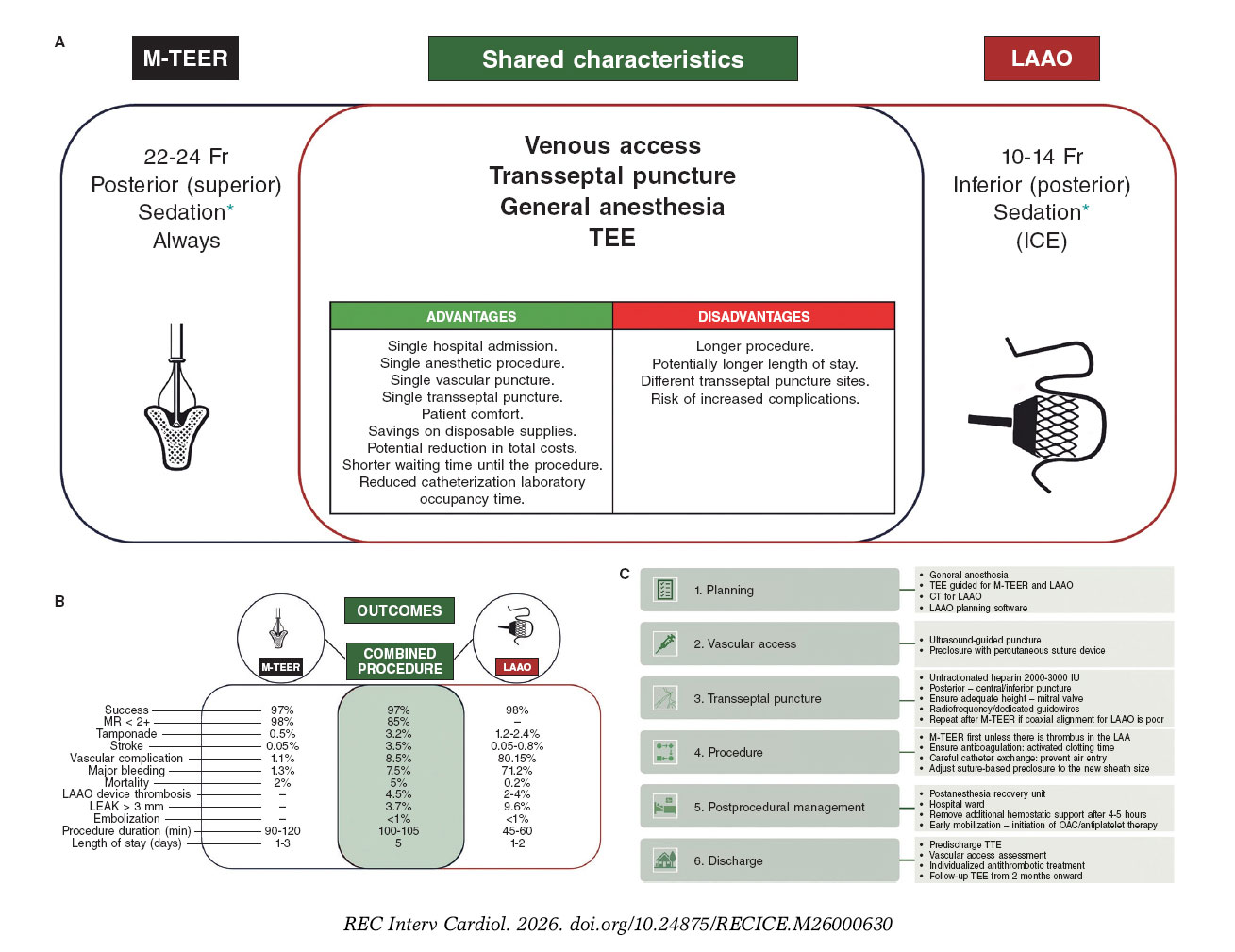
Figure 1. Mitral-tanscatheter edge-to-edge repair (M-TEER) and left atrial appendage occlusion (LAAO) in a single session. A: shared technical aspects and potential advantages and disadvantages of the combined approach. B: safety and efficacy profile of M-TEER and LAAO performed separately vs together (data from large registries of isolated procedures and a meta-analysis of combined TEER and LAAO). C: practical aspects of the combined procedure. CT, computed tomography; ICE, intracardiac echocardiography; LAA, left atrial appendage; MR, mitral regurgitation; OAC, oral anticoagulants; TEE, transesophageal echocardiography; TTE, transthoracic echocardiography.
* The procedure could be considered under sedation.
To review the evidence on this strategy, we systematically searched PubMed, Embase, Google Scholar, Cochrane, Scopus, and BioMedCentral for all English-language articles addressing combined procedures, using the keywords “transcatheter edge to edge repair,” “left atrial appendage occlusion,” “combined procedure,” and “concomitant intervention.”
The combination of LAAO with other transcatheter procedures has been evaluated in 2 randomized clinical trials: one in the setting of AF ablation (OPTION),2 in which 41% of patients underwent both procedures during a single session, and another involving transcatheter aortic valve implantation, which included a total of 349 patients (WATCH-TAVR).3 Both trials showed favorable results. In addition, a large retrospective population-based analysis compared combined LAAO and any transcatheter technique with the corresponding isolated procedures using propensity score matching. Notably, patients undergoing concomitant AF ablation had higher rates of pacemaker implantation, whereas those undergoing transcatheter aortic valve implantation had higher rates of stroke and vascular complications. Only 49 patients underwent M-TEER, with no differences in outcomes compared with patients undergoing M-TEER alone.4
The available evidence specifically addressing combined M-TEER and LAAO is limited and comes mainly from retrospective series and a single prospective registry (table 1); only 5 studies included more than 10 patients. Overall, the procedural success rate was 97%, with LAAO adding 15-22 minutes to M-TEER. Mortality rate was 1.5%, and the rates of cardiac tamponade and vascular complications, 1.8% and 5.9%, respectively (figure 1B).
Table 1. Published studies of combined mitral-transcatheter edge-to-edge repair and left atrial appendage occlusion
| Studya | Study design | n | Endpoint | Results | Complications | Observations |
|---|---|---|---|---|---|---|
| Freixa et al. 2016 | Retrospective | 6 | Feasibility and safety | Success 100% | None | M-TEER first 100% 1 TSP 100% |
| Francisco et al. 2016 | Retrospective | 5 | Feasibility and safety | Success 100% | None | LAAO first 1 TSP 100% |
| Tichelbäcker et al. 2016 | Retrospective | 4 | Feasibility and safety | Success 100% | 1 embolization 1 cardiac death | LAAO first 1 TSP 100% |
| Kuwata et al. 2017 | Retrospective, compared with TEER alone | 25 and 25 | Feasibility and safety | Success 100% | None | M-TEER first 1 TSP 100% MR ≥ II more frequent in combined group |
| D´Amico et al. 2021 | Retrospective | 30 | Feasibility and safety | Success 93.3% | 1 tamponade (death) 1 minor stroke | M-TEER first 90% 1 TSP 97% Follow-up 423 days 41% TEE follow-up; no thrombosis 1 leak > 3 mm |
| Frazzeto et al. 2023 | Retrospective, compared with M-TEER alone | 41 and 51 | Death–stroke–embolism–hospitalization–major bleeding (1 year) | 36% vs 48%; success 93% | 1 major vascular complication | M-TEER first 100% 1 TSP 100% |
| Al-Abcha et al. 2025 | Prospective | 24 | Feasibility, safety, and death–stroke–fatal bleeding at 45 days | Success 100% 21% (45 days) | 1 effusion 1 vascular complication | M-TEER first 100% 1 TSP 100% 96% MR < II |
| Prosperi et al. 2025 | Retrospective | 15 | Feasibility and safety | Success 100% | 1 tamponade | M-TEER first 100% 1 TSP 100% |
|
LAAO, left atrial appendage occlusion; M-TEER, mitral transcatheter edge-to-edge repair; MR, mitral regurgitation; TEE, transesophageal echocardiography; TSP, transseptal puncture. a References for the studies included in this table are available in the supplementary data. |
||||||
The only prospective registry included a total of 24 patients and reported a 100% success rate, with a mean procedure duration of 104 minutes (22 minutes for LAAO) and a single transseptal puncture in most cases.5 At 45 days, 96% of patients had grade ≤ II mitral regurgitation, and no leaks > 3 mm were recorded. The composite endpoint of death, stroke, and bleeding occurred in 21% of patients at 45 days.
A meta-analysis of 7 studies (223 patients) reported a mean procedure duration of 101 minutes, a success rate of 89.5%, and a mean length of stay of 5 days.6 Although compared with M-TEER alone, the combined procedure did not increase acute kidney injury, major bleeding, or all-cause mortality, numerically higher rates of tamponade, stroke, and vascular complications were noted. Periprocedural mortality rate was 5%, exceeding that reported for either procedure performed separately, likely reflecting the greater comorbidity burden and clinical complexity of this patient population.
The reciprocal influence of both procedures on the occurrence of specific complications and their outcomes has not been evaluated in published studies. In this regard, appropriate transseptal puncture is key, because LAAO-specific complications (leak, device embolization, and device thrombosis) and M-TEER outcomes depend on appropriate coaxial alignment and adequate height of the delivery sheath relative to the appendage axis and mitral plane, respectively. Regarding device thrombosis, left atrial stasis after M-TEER is not uncommon and usually manifests as echocardiographic “smoke” whose presence in patients undergoing LAAO alone was associated with a higher incidence of device thrombosis in the Japanese OCEAN-LAAC registry. This finding should probably be considered when determining the antithrombotic strategy at discharge.
Beyond the clinical benefit, the combined approach avoids duplication of resources (anesthesia, cath lab occupancy, and shared disposable supplies) and a second hospital admission, potentially yielding substantial savings per patient. However, this estimate requires confirmation in dedicated cost-effectiveness studies, which have not yet been conducted.
Figure 1C describes the practical aspects in 6 steps, from planning through discharge, based on this review and our own experience, which currently comprises 15 patients treated in a single session. Most importantly, careful planning should be performed with transesophageal echocardiography directed at both procedures and, ideally, computed tomography to evaluate the appendage and plan access. A posterior transseptal puncture site should be prioritized to facilitate M-TEER, with a central or inferior position to achieve proper alignment with the appendage. The use of a suture-based vascular preclosure device facilitates hemostasis after catheter exchange and at the end of the procedure. In our experience, as in most published studies, M-TEER is performed first because it is usually the priority clinical problem and because appendage measurements may change after M-TEER. The stabilizer should be withdrawn after M-TEER to allow catheter exchange as low as possible through the guiding catheter, thus minimizing the possibility of air entry into the left atrium. Using a hemostasis valve introducer, a high-support guidewire is positioned, ideally in the left superior pulmonary vein, for exchange to the LAAO delivery sheath (video S1). Performing LAAO directly through the M-TEER steerable guide catheter has not previously been reported. However, introducer sheath lengths are generally incompatible, and advancing the LAAO device directly through the guide catheter may be traumatic and hazardous because of the risk of air entry. If access to the left atrial appendage proves difficult, repeat transseptal puncture should be considered, although steerable sheaths may facilitate coaxial alignment with the appendage. Patients remain hospitalized for at least 24 hours and undergo follow-up echocardiography before discharge, followed by transesophageal echocardiography at 2 months or later to guide antithrombotic management (figure 1B).
In conclusion, although combined M-TEER and LAAO is feasible and has an acceptable safety profile, complication rates appear to be slightly higher than when the procedures are performed separately, warranting caution before routinely recommending this approach. Current evidence is limited to small, heterogeneous studies, highlighting the need for larger studies, randomized trials, and cost-effectiveness analyses. Careful patient selection and procedural planning, including optimal transseptal puncture site selection and the use of standardized protocols, may be essential to optimizing safety and efficacy outcomes.
FUNDING
None declared.
ETHICAL CONSIDERATIONS
Submission of this review article together with the supplementary data, which includes a video, was approved by our center ethics committee. The SAGER guidelines regarding possible sex/gender bias were followed.
STATEMENT ON THE USE OF ARTIFICIAL INTELLIGENCE
Artificial intelligence was not used in the preparation of this article.
AUTHORS’ CONTRIBUTIONS
J.G. Córdoba-Soriano: manuscript drafting, systematic literature review, and manuscript submission. J. Jiménez-Mazuecos: systematic literature review and manuscript review. J.C. García-López and L. Guerra-Luján: selection of video images and manuscript review. P. Valentín-García and M. López-Vázquez: manuscript and reference review.
CONFLICTS OF INTEREST
None declared.
SUPPLEMENTARY DATA

Vídeo 1. Córdoba-Soriano JG. DOI: 10.24875/RECICE.M26000630
REFERENCES
1. Whitlock R, Belley-Cote E, Paparella D, et al. Left Atrial Appendage Occlusion during Cardiac Surgery to Prevent Stroke.
2. Wazni O, Saliba W, Nair D, et al. Left Atrial Appendage Closure after Ablation for Atrial Fibrillation.
3. Kapadia SR, Krishnaswamy A, Whisenant B, et al. Concomitant Left Atrial Appendage Occlusion and Transcatheter Aortic Valve Replacement Among Patients With Atrial Fibrillation.
4. Ismayl M, Ahmed H, Freeman J, Alkhouli M, Lakkireddy D, Goldsweig A. Safety and Efficacy of Combining Left Atrial Appendage Occlusion With Another Cardiac Procedure.
5. Al-Abcha A, Di-Santo P, Rihal C, Simard T, Hibbert D, Alkhouli M. Outcomes of Combined Left Atrial Appendage Occlusion and Transcatheter Mitral Edge-to-Edge Repair.
6. Pamporis K, Tsiachris D, Grigoriou K, et al. One-Stop Mitral Valve Transcatheter Edge-to-Edge Repair and Left Atrial Appendage Occlusion in Patients with Atrial Fibrillation and Mitral Regurgitation: A Systematic Review and Meta-Analysis.