
To the Editor,
The benefit of dual antiplatelet therapy (DAPT) before primary percutaneous coronary intervention (pPCI) in patients with ST-segment elevation myocardial infarction (STEMI) remains controversial. Although current clinical practice guidelines recommend the early administration of acetylsalicylic acid, they do not provide a strong recommendation for the systematic administration of P2Y12 receptor inhibitors before coronary angiography,1 largely because the available evidence is limited and heterogeneous. Findings from the ATLANTIC trial2-4 and subsequent studies have been inconsistent regarding the effects of antiplatelet pretreatment on initial culprit- artery patency before pPCI, acute stent thrombosis, reinfarction, major bleeding, and 30-day mortality.
Furthermore, the interpretation of these studies may be influenced by the use of heterogeneous concomitant antithrombotic strategies across studies. Recent studies, including a meta-analysis of unfractionated heparin (UFH) pretreatment in patients with STEMI,5,6 suggested that the timing of anticoagulation administration may affect initial culprit-artery patency before pPCI and early clinical outcomes.
We therefore evaluated the available evidence comparing DAPT pretreatment vs single antiplatelet therapy (SAPT) in patients with STEMI undergoing pPCI, while also considering the concomitant UFH strategy reported in the included studies.
We conducted a systematic review and meta-analysis in accordance with PRISMA recommendations. The literature search was conducted through PubMed and the Cochrane Library until October 2025 using terms related to STEMI, pPCI, antiplatelet pretreatment, and antiplatelet therapy. Two investigators independently performed study selection and data extraction.
Additionally, we included randomized clinical trials and observational studies comparing DAPT vs SAPT pretreatment in patients with STEMI undergoing pPCI (see supplementary data). Studies without a comparator group, studies including populations without STEMI, and those providing insufficient information on concomitant antithrombotic strategies were excluded.
Statistical analyses were performed using random-effects models and relative risks (RRs) with 95% confidence intervals (95%Cis). The random-effects model was prioritized because of the anticipated clinical and methodological heterogeneity among studies. Between-study heterogeneity was assessed using the I2 statistic. Stratified analyses were performed according to the concomitant anticoagulation strategy reported in each study, which were categorized into 3 groups: UFH administered as pretreatment, UFH administered in the cath lab, and unspecified timing of UFH administration.
The meta-analysis included a total of 17 studies (3 randomized clinical trials and 14 observational studies), comprising a total of 47 185 patients with STEMI undergoing pPCI (see supplementary data).
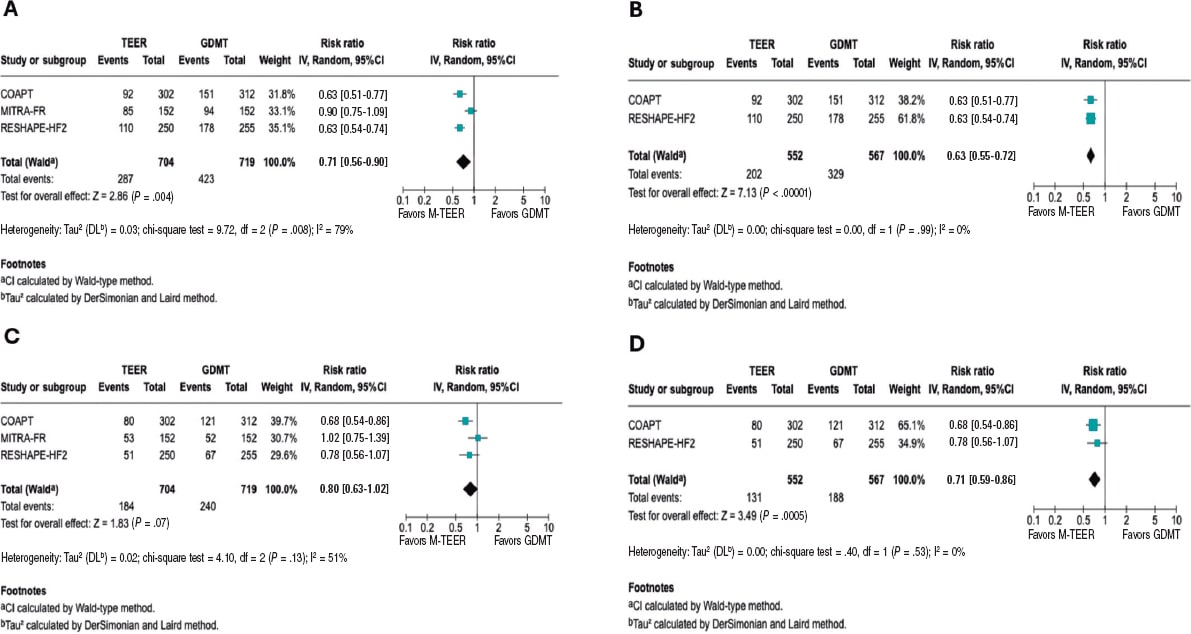
The mean age was 64.1 ± 12.2 years, and 75.8% of the patients were men. The main findings are summarized in table 1 and figure 1. Figure 1 illustrates forest plots of the clinical outcomes analyzed using the random-effects model. These outcomes included initial culprit-artery patency before pPCI, acute stent thrombosis or early reinfarction, depending on the outcome reported in each study; major bleeding; and 30-day mortality, according to the definitions used in the individual studies.
Table 1. Clinical outcomes according to P2Y12 inhibitor pretreatment and the concomitant unfractionated heparin strategy
| Event | Prehospital UFH RR (95%CI) | UFH in the cath lab RR (95%CI) | Timing of UFH administration not specified RR (95%CI) | Overall RR (95%CI) |
|---|---|---|---|---|
| Initial culprit-artery patency | 1.19 (0.70-2.01) | 1.04 (0.95-1.14) | 0.98 (0.82-1.17) | 1.05 (0.96-1.15) |
| Acute stent thrombosis | 0.72 (0.33-1.61) | 0.80 (0.46-1.40) | 0.15 (0.02-1.48) | 0.60 (0.34-1.09) |
| Major bleeding | 1.10 (0.57-2.12) | 0.87 (0.60-1.27) | 0.94 (0.61-1.45) | 0.89 (0.68-1.18) |
| 30-day mortality | 0.61 (0.28-1.33) | 0.75 (0.54-1.04) | 0.61 (0.42-0.89) | 0.73 (0.57-0.94) |
|
95%CI, 95% confidence interval; RR, relative risk; UFH, unfractionated heparin. Values are derived from the random-effects model. For initial culprit-artery patency before primary percutaneous coronary intervention, an RR > 1 favors dual antiplatelet therapy (DAPT). For acute stent thrombosis, major bleeding, and 30-day mortality, an RR < 1 favors DAPT. A difference was considered statistically significant when the 95%CI did not cross 1. |
||||
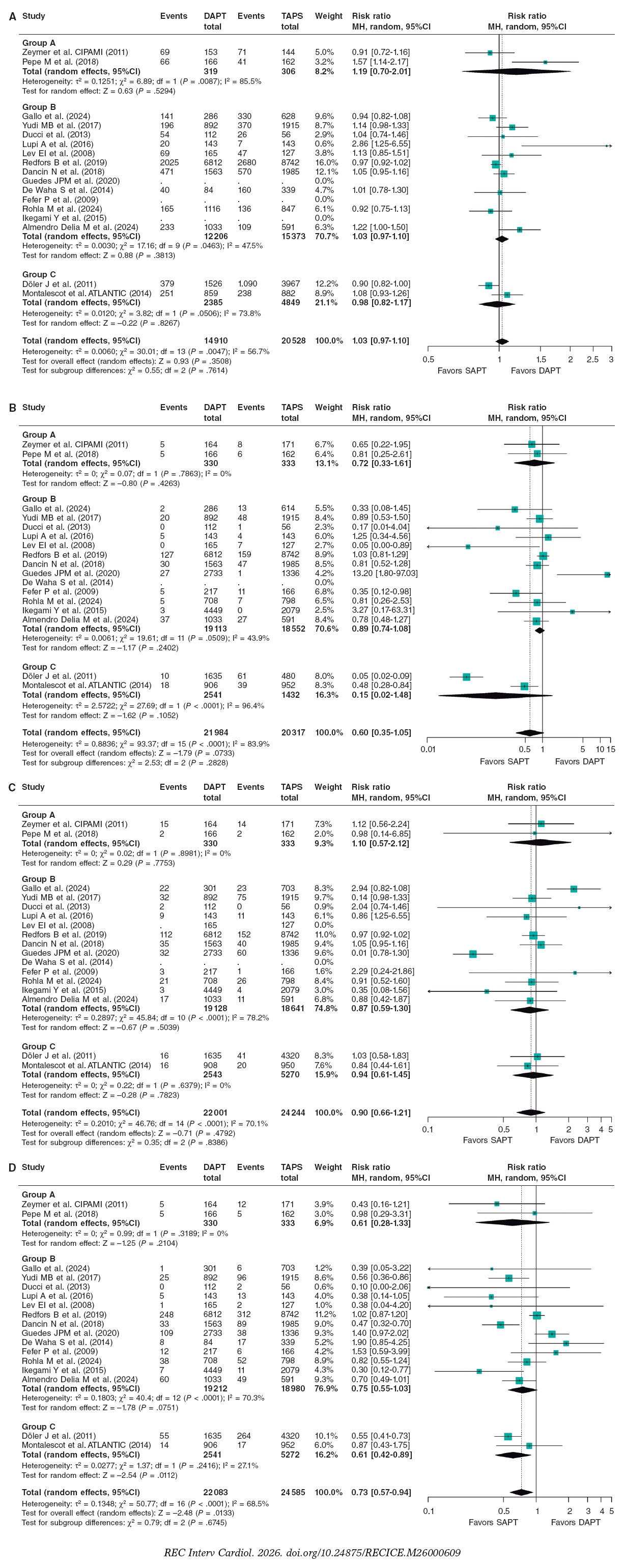
Figure 1. Forest plots of the clinical outcomes analyzed according to the P2Y12 pretreatment strategy. A: initial culprit-artery patency before primary percutaneous coronary intervention. B: acute stent thrombosis. C: major bleeding. D: 30-day mortality. Group A: pretreatment with unfractionated heparin (UFH). Group B: UFH administered in the cath lab. Group C: timing of UFH administration not specified. 95%CI, 95% confidence interval; DAPT, dual antiplatelet therapy; MH, Mantel-Haenszel; SAPT, single antiplatelet therapy. Full references for the studies included in this figure are provided in the supplementary data.
In the overall analysis, no statistically significant differences were found in initial culprit-artery patency before pPCI (RR, 1.05; 95%CI, 0.96-1.15), acute stent thrombosis (RR, 0.60; 95%CI, 0.34-1.09), or major bleeding (RR, 0.89; 95%CI, 0.68-1.18). DAPT pretreatment was associated with lower 30-day mortality compared with SAPT (RR, 0.73; 95%CI, 0.57-0.94), with moderate-to-high heterogeneity across studies (I2 = 68.5%). Heterogeneity was substantial in several analyses, particularly those involving thrombotic and bleeding outcomes.
In analyses stratified according to the concomitant UFH anticoagulation strategy, no consistent statistically significant differences in the main clinical outcomes were observed among studies in which UFH was administered as pretreatment, in the cath lab, or at an unspecified time.
Moreover, there was substantial variability among studies in the definitions of clinical outcomes. Some studies assessed angiographically confirmed definite or probable stent thrombosis, whereas others combined stent thrombosis with early clinical or angiographic reinfarction. The definitions of major bleeding and concomitant antithrombotic strategies used were heterogeneous across studies.
A sensitivity analysis excluding the largest observational study preserved the direction of the effect on 30-day mortality, but the association was no longer statistically significant. Furthermore, this finding was not accompanied by statistically significant differences in initial culprit-artery patency before pPCI, acute stent thrombosis, reinfarction, or major bleeding. The observed reduction in mortality was therefore sensitive to the influence of large observational registries and does not establish a direct causal relationship between antiplatelet pretreatment and the observed reduction in mortality.
The ongoing controversy regarding the benefit of P2Y12 receptor inhibitor pretreatment in patients with STEMI likely reflects, at least in part, the complexity of the antithrombotic strategies used in contemporary clinical practice. The included studies differed in the P2Y12 inhibitor used, the use of glycoprotein IIb/IIIa inhibitors, and other procedural characteristics, thus limiting direct comparisons among studies. This therapeutic heterogeneity limits the interpretation of the isolated incremental effect of DAPT pretreatment.
An important finding of this review is the limited number of studies that describe concomitant antithrombotic strategies in sufficient detail, particularly the timing of UFH administration. This methodological limitation complicates appropriate contextualization of the effect of antiplatelet pretreatment and highlights an important gap in the STEMI literature.
These findings suggest that future studies of antiplatelet pretreatment in patients with STEMI should therefore report in a standardized manner not only the timing of P2Y12 inhibitor administration but also the concomitant anticoagulation strategies and other antithrombotic treatments used before and during pPCI.
Prospective studies specifically designed to evaluate integrated antithrombotic strategies in patients with STEMI undergoing pPCI are needed. Such studies should include detailed information on the timing of each antithrombotic treatment and its potential impact on early clinical outcomes.
FUNDING
This study was funded by CIBERCV CB16/11/00385.
ETHICAL CONSIDERATIONS
Ethical considerations are not applicable to this study because this meta-analysis was based exclusively on previously published aggregate data and did not involve the collection of individual patient information; therefore, approval by an ethics committee was not required. A specific sex-based analysis was not performed because the included studies did not provide sufficient information to assess potential differences according to sex.
STATEMENT ON THE USE OF ARTIFICIAL INTELLIGENCE
During preparation of this manuscript, the authors used ChatGPT to assist with the development of graphical elements. After using this tool, the authors reviewed and edited the content as necessary and take full responsibility for the published work.
AUTHORS’ CONTRIBUTIONS
M. Roldán-Medina: conceptualization and design; data acquisition, analysis, and interpretation; writing of the original draft; and review and editing of the final manuscript. V. Shumbar Samkohvalov: conceptualization and design; data acquisition, analysis, and interpretation; writing of the original draft; and review of the final manuscript. R. López-Palop: data acquisition, analysis, and interpretation; review and editing of the final manuscript. J. García de Lara: manuscript review. J.R. Gimeno-Blanes: conceptualization, methodology, and design; data analysis and interpretation; drafting, review, and editing of the final manuscript; final approval; and project administration. D. Pascual-Figal: conceptualization and design; data analysis and interpretation; review and editing of the final manuscript; final approval; and project administration.
CONFLICTS OF INTEREST
The authors declared no conflicts of interest related to the content of this article.
ACKNOWLEDGMENTS
The authors thank the health professionals of the Cardiology Department of Hospital Clínico Universitario Virgen de la Arrixaca, Instituto Murciano de Investigación Biosanitaria (IMIB), and Universidad de Murcia (Murcia, Spain) for their collaboration.
SUPPLEMENTARY DATA

REFERENCES
1. Byrne RA, Rosello X, Coughlan JJ. 2023 ESC Guidelines for the management of acute coronary syndromes. Eur Heart J. 2023;44:3720-3826.
2. Montalescot G, Van't Hof AW, Lapostolle F, et al. Prehospital ticagrelor in ST-segment elevation myocardial Infarction. N Engl J Med. 2014;371:1016-1027.
3. Bellemain-Appaix A, BéguéC, Bhatt DL, et al. The efficacy of early versus delayed P2Y12 inhibition in percutaneous coronary intervention for ST-elevation myocardial infarction:a systematic review and meta-analysis. EuroIntervention. 2018;14:78-85.
4. Presume J, Gomes DA, Ferreira J, et al. Effectiveness and safety of P2Y12 inhibitor pretreatment for primary PCI in STEMI:systematic review and meta-analysis. J Cardiovasc Pharmacol. 2023;82:298-307.
5. Roldán-Medina M, Riquelme-Pérez A, López-Palop R, et al. Heparin pretreatment for STEMI primary angioplasty:a meta-analysis. REC Interv Cardiol. 2025;7:229-237.
6. Redfors B, Dworeck C, Angeras O, et al. Pretreatment with P2Y12 receptor antagonists in ST-elevation myocardial infarction:a report from the Swedish Coronary Angiography and Angioplasty Registry. Eur Heart J. 2019;40:1202-1210.