
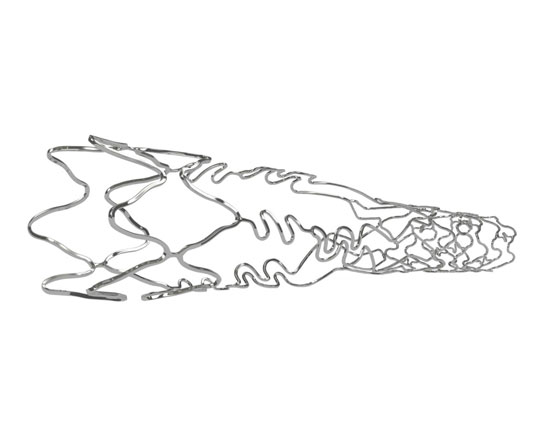
Older devices can be revived with innovative technological improvements. This is the case for the design of a stent specifically for bifurcations, now called Biomime Branch (Meril, India).
This is a chrome-cobalt stent with 65 µm strut thickness. It is covered with a resorbable PLGA-PLLA polymer that elutes sirolimus at a dose of 1.25 µg/mm2. The device’s architecture is interesting because it has a hybrid design, which is very useful for treating 1,1,1 bifurcations in which there is a very high probability of needing more than one stent. It is mounted on a balloon (with four radio-opaque markers) with a tapered design, which allows stent implantation from the main branch into the side branch. The proximal segment (which is positioned in the main branch) has a closed-cell design and the distal segment (for the side branch lesion) has an open-cell design. The distal segment has a variable length, from 6.5 to 13 mm, to ensure coverage of side branch lesions.
Between the two segments there is a transition zone with three panels with highly flexible connectors that leave large open spaces, allowing access to the main branch to implant a further stent without the risk of losing the side branch, and avoiding overexpansion of the stent at post-dilatation. This reduces the risk of losing important branches with severe lesions.
In my opinion, this is a very interesting device, as it simplifies the procedure, reduces the intervention time when it is likely that 2 stents will be implanted, and limits the amount of metal that may be exposed at the carina.
Palabras clave: Intervención coronaria percutánea, bifurcación coronaria, stent coronario para bifurcación, stent coronario liberador de droga. Keywords: Percutaneous coronary intervention, coronary bifurcation, bifurcation dedicated stent, drug eluting stent.