
To the Editor,
Acute pulmonary embolism (PE) remains a major cause of cardiovascular morbidity and mortality, with intermediate-high-risk patients facing a substantial risk of early clinical deterioration despite preserved hemodynamic stability.1 Although anticoagulation remains the standard of care, systemic fibrinolysis is limited by the risk of major bleeding, prompting growing interest in catheter-directed fibrinolysis (CDF) as a targeted, lower-dose reperfusion strategy.1 However, whether CDF translates into meaningful clinical benefit remains uncertain. The recent publication of the HI-PEITHO trial provides contemporary randomized evidence and warrants reassessment of the available data.2 We therefore performed an updated systematic review and meta-analysis of randomized controlled trials (RCTs) comparing CDF with anticoagulation alone in patients with acute intermediate-high-risk PE.
This systematic review and meta-analysis was conducted according to the PRISMA recommendations and prospectively registered in PROSPERO (CRD420261367527). PubMed, Embase, Scopus, and the Cochrane Central Register of Controlled Trials were searched between 1 April and 16 April, 2026, without language or date restrictions, to identify RCTs comparing CDF with anticoagulation alone in adults with acute intermediate-high-risk PE. Furthermore, reference lists of eligible studies were screened.
The primary endpoint was all-cause mortality assessed at the study-specific follow-up time reported by each trial. Secondary endpoints included the postintervention right ventricular-to-left ventricular (RV/LV) diameter ratio, major bleeding, and hemodynamic instability, according to the definitions used in the individual trials.
Two reviewers independently screened records, extracted data, and assessed the risk of bias using the Cochrane Risk of Bias tool, version 2. Data were analyzed according to the intention-to-treat principle. When only medians and interquartile ranges were reported, means and standard deviations were estimated using established methods, with assessment of data skewness when applicable. The Grading of Recommendations Assessment, Development and Evaluation (GRADE) framework was used to assess certainty of evidence.
Outcomes were pooled using random-effects models with restricted maximum likelihood estimation and reported as risk ratios or mean differences with 95% confidence intervals (95%CI). Statistical heterogeneity was quantified using the I2 statistic, and leave-one-out analyses were performed to assess robustness. Statistical analyses were conducted using R version 4.4.1, with a 2-sided significance threshold of P < .05.
Of 2967 records screened, 4 RCTs published between 2013 and 2026, comprising 720 patients (363 assigned to CDF and 357 to anticoagulation alone), met the inclusion criteria.2-5 Three were multicenter trials (ULTIMA, CANARY, and HI-PEITHO), whereas 1 was conducted at a single center (Kroupa et al.3). Trial design, key inclusion and exclusion criteria, treatment strategies, baseline characteristics, and prespecified primary endpoints are summarized in table 1.
Table 1. Characteristics of the included studies and baseline characteristics of the included patients
| Characteristic | ULTIMA 20134 | Kroupa et al. 20223 | CANARY 20225 | HI-PEITHO 20262 | ||||
|---|---|---|---|---|---|---|---|---|
| Control | CDF | Control | CDF | Control | CDF | Control | CDF | |
| Study characteristics | ||||||||
| Design, recruitment period | Open-label RCT (multicentre), 2010-2013 | Open-label RCT (singlecentre, pilot), 2019-2021 | Open-label RCT (multicentre), 2018-2020 | Open-label RCT (multicentre), 2021-2025 | ||||
| Country, sites, follow-up | Germany / Switzerland (8 sites) 3-month follow-up | Czech Republic (1 site) 30-day follow-up | Iran (2 sites) 3-month follow-up | Austria, France, Germany, Ireland, Netherlands, Poland, Switzerland, United Kingdom (59 sites) 30-day follow-up | ||||
| Patients per group, n | 29 | 30 | 11 | 12 | 46 | 48 | 271 | 273 |
| Treatment | UFH | US-assisted CDF: alteplase 0.5 mg/h per catheter ×24 h + UFH | UFH or LMWH | CDF: alteplase 1 mg/h per catheter (total 20 mg) ×10 h + UFH | LMWH | CDF: alteplase 0.5 mg per catheter/h ×24 h + UFH | LMWH or UFH | US-assisted CDF: alteplase 2 mg per catheter, then 1 mg/h per catheter × 7 h + UFH |
| Key inclusion/exclusion criteria | Inclusion: acute proximal PE with RV/LV ratio ≥ 1.0. Exclusion: age < 18 or > 80; symptom duration > 14 days; high bleeding risk; recent thrombolysis; active bleeding; prior intracranial bleeding/lesions; major surgery; hemodynamic instability; right-to-left shunt | Inclusion: proximal intermediate–high-risk PE (sPESI ≥ 1) with RV dysfunction (RV/LV ≥ 0.9) and positive biomarkers. Exclusion: age < 18; active bleeding; prior intracranial bleeding or recent stroke/TIA; recent cranial trauma or intracranial lesions; recent major surgery; low RV/LV ratio (< 0.7); coagulopathy; severe renal dysfunction | Inclusion: acute proximal intermediate-high-risk PE, sPESI ≥ 1, RV/LV > 0.9, positive biomarkers. Exclusion: high-risk PE; CrCl < 30 mL/min; recent surgery; thrombocytopenia; contraindication to thrombolysis | Inclusion: acute proximal intermediate–high-risk PE with ≥ 2 clinical criteria of cardiorespiratory distress, RV/LV ≥ 1.0 and positive biomarkers. Exclusion: age < 18 or > 80; symptom duration > 14 days; hemodynamic instability; fever; active bleeding; prior intracranial bleeding or recent stroke/TIA; recent cranial trauma or intracranial lesions; recent major surgery; recent thrombolysis; dual antiplatelet therapy; chronic anticoagulation or coagulopathy | ||||
| Primary endpoint (individual trial) | Difference in RV/LV ratio from baseline to 24 h (echocardiographic) | Composite efficacy endpoint: improvement in RV function, RV/LV ratio reduction ≥ 25% on coronary computed tomography angiography and systolic PAP decrease ≥ 30% or normotension at 24 h | Proportion of patients with a 3-month echocardiographic RV/LV ratio > 0.9 (core-laboratory assessed) | Composite of PE-related death, cardiorespiratory decompensation or collapse, or symptomatic PE recurrence within 7 days | ||||
| Baseline characteristics | ||||||||
| Age, years | 62 ± 13 | 64 ± 15 | 63.5 ± 15.1 | 60.6 ± 14.3 | 57.5 ± 2.4 | 57.7 ± 2.2 | 58.2 ± 13.4 | 58.2 ± 13.6 |
| Male | 17 (59) | 11 (37) | 5 (45.5) | 8 (66.7) | 28 (72) | 33 (72) | 153 (56.5) | 159 (58.2) |
| Type 2 diabetes mellitus | 4 (14) | 6 (20) | 3 (27.3) | 0 | 9 (23) | 6 (13) | 54 (19.9) | 48 (17.6) |
| Smoking | 7 (24) | 4 (13) | 3 (27.3) | 3 (25) | – | – | 34 (12.5) | 39 (14.3) |
| Hypertension | 15 (52) | 20 (67) | 6 (54.5) | 9 (75) | 14 (36) | 13 (28) | 118 (43.5) | 114 (41.8) |
| Prior PE | 2 (7) | 4 (13) | 3 (27.3) | 1 (8.3) | 1 (2) | 1 (2) | – | – |
| Prior stroke/TIA | 1 (3) | 0 (0) | – | – | 0 | 1 (2) | 11 (4.1) | 7 (2.6) |
| Systolic BP, mmHg | 131 ± 18 | 137 ± 19 | 140.2 ± 22.1 | 141.6 ± 22.4 | 122.9 ± 2.6 | 129.1 ± 3.3 | – | – |
| RV/LV ratio, baseline | 1.20 ± 0.14 | 1.28 ± 0.19 | 1.3 ± 0.1 | 1.1 ± 0.1 | 1.2 ± 0.3 | 1.2 ± 0.1 | 1.5 ± 0.4 | 1.6 ± 0.5 |
| TAPSE, mm | 19.9 ± 5.8 | 15.7 ± 3.8 | 14.6 ± 3.5 | 16.3 ± 1.9 | – | – | – | – |
| Troponin, ng/L | – | – | 365.2 ± 329.6 | 244.5 ± 241 | 168.1 ± 73.3 | 169.9 ± 68.2 | – | – |
|
BP, blood pressure; CDF, catheter-directed fibrinolysis; CrCl, creatinine clearance; LMWH, low-molecular-weight heparin; PAP, pulmonary artery pressure; PE, pulmonary embolism; RCT, randomized controlled trial; RV, right ventricular; RV/LV, right ventricular to left ventricular diameter ratio; SD, standard deviation; sPESI, simplified Pulmonary Embolism Severity Index; TAPSE, tricuspid annular plane systolic excursion; TIA, transient ischemic attack; UFH, unfractionated heparin; US, ultrasound. Data are expressed as No. (%) or mean ± standard deviation. Dashes (–) indicate data not reported. |
||||||||
CDF was not associated with a statistically significant reduction in all-cause mortality (RR, 0.68; 95%CI, 0.11-4.03; I2 = 37.6%) (figure 1). Leave-one-out analyses showed that exclusion of ULTIMA yielded a similar effect estimate (RR, 0.72; 95%CI, 0.06-9.18; I2 = 61.7%), whereas exclusion of HI-PEITHO eliminated heterogeneity and resulted in a numerically greater, although still nonsignificant, reduction in mortality (RR, 0.20; 95%CI, 0.02-1.75; I2 = 0%).
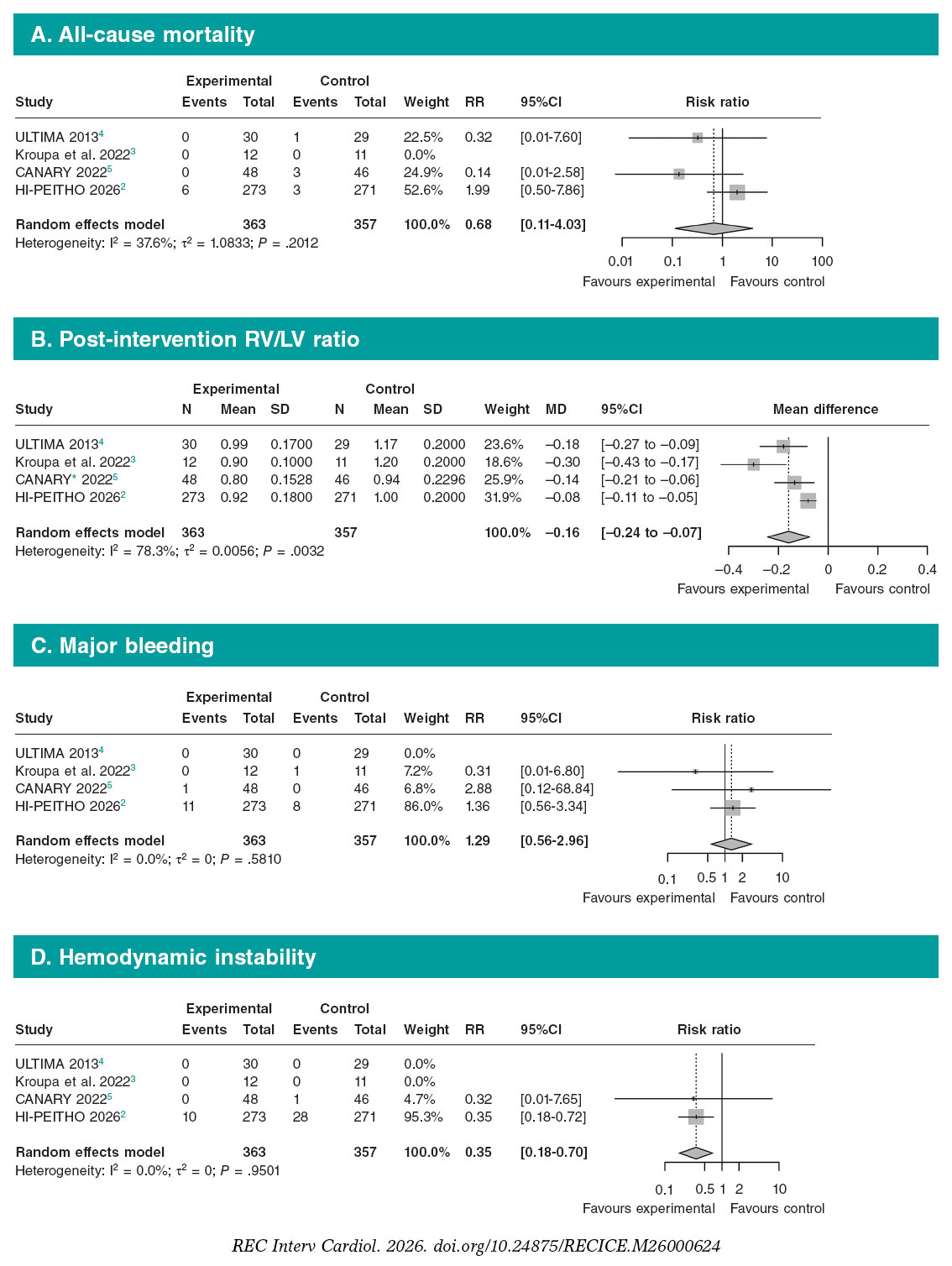
Figure 1. Forest plots comparing catheter-directed fibrinolysis (experimental group) with anticoagulation alone (control group) in patients with intermediate-high-risk pulmonary embolism. Outcomes include (A) all-cause mortality, (B) postintervention RV/LV ratio, (C) major bleeding, and (D) hemodynamic instability. Random-effects models fitted using restricted maximum likelihood estimation were used to estimate pooled RRs for dichotomous outcomes and MDs for continuous outcomes, with corresponding 95%CI.
* Means and SDs were estimated from medians and interquartile ranges. 95%CI, 95% confidence interval; MD, mean difference; RR, risk ratio; RV/LV, right ventricular-to-left ventricular diameter ratio; SD, standard deviation.
CDF was associated with a significantly lower postintervention RV/LV ratio (mean difference, −0.16; 95%CI, −0.24 to −0.07; I2 = 78.3%) and a lower risk of hemodynamic instability (RR, 0.35; 95%CI, 0.18-0.70; I2 = 0%) (figure 1). Leave-one-out analyses confirmed the stability of the findings for the postintervention RV/LV ratio, with statistically significant effect estimates regardless of the study omitted. No statistically significant difference was observed in major bleeding (RR, 1.29; 95%CI, 0.56-2.96; I2 = 0%) (figure 1), and this finding remained unchanged across all leave-one-out analyses.
The risk of bias was low for ULTIMA, CANARY, and HI-PEITHO, whereas the remaining trial raised some concerns, mainly regarding the randomization process. Certainty of evidence was moderate for hemodynamic instability and low for all other outcomes, primarily because of imprecision and risk of bias.
Across 4 RCTs, CDF improved surrogate markers of RV function and reduced hemodynamic instability without a significant increase in major bleeding but did not significantly reduce all-cause mortality. However, the mortality estimate was highly imprecise because of the small number of patients and events, and a clinically meaningful benefit or harm cannot be excluded. Accordingly, the mortality findings should be regarded as inconclusive rather than as evidence of absence of benefit. The observed reduction in RV overload is biologically plausible because CDF enables targeted fibrinolysis and more rapid thrombus resolution, thereby reducing RV afterload and potentially preventing progression to hemodynamic deterioration.
Several sources of heterogeneity should be considered when interpreting these findings. The pooled estimate for the postintervention RV/LV ratio showed substantial heterogeneity (I2 = 78.3%), likely reflecting differences in patient selection, thrombolytic regimens, and the imaging modalities and timing used for RV assessment across trials. Although the RV/LV ratio served as the primary endpoint in several studies, its definition, measurement, and timing were not standardized, limiting its suitability as a primary meta-analytic endpoint. Furthermore, definitions of hemodynamic instability and major bleeding varied across trials, further limiting the comparability of the pooled estimates.
The enrolled populations differed substantially in baseline risk. Kroupa et al.3 and CANARY specifically enrolled patients with intermediate-high-risk PE, requiring RV dysfunction, positive cardiac biomarkers, and a simplified Pulmonary Embolism Severity Index (sPESI) ≥ 1, whereas HI-PEITHO further enriched its study population by including patients at particularly high risk of clinical deterioration based on additional clinical evidence of cardiorespiratory distress. By contrast, ULTIMA predated the current European Society of Cardiology risk-stratification framework and did not distinguish between intermediate-low- and intermediate-high-risk PE. ULTIMA enrolled patients on the basis of an RV/LV ratio ≥ 1.0 without requiring biomarker elevation, thereby including a comparatively lower-risk population. Nevertheless, ULTIMA was retained because its exclusion would have markedly reduced the available randomized evidence. Importantly, leave-one-out analyses excluding ULTIMA did not materially alter the overall direction of the findings, although its inclusion remains an important limitation. Finally, approximately 70% of all included patients were derived from HI-PEITHO, resulting in substantial dominance of this single trial in the pooled estimates.
These findings are consistent with current guidance: the European Society of Cardiology recommends anticoagulation as first-line therapy, and the 2025 European Society of Vascular Medicine clinical practice guidelines on the interventional treatment of venous thromboembolism support catheter-based reperfusion in selected patients treated at experienced centers rather than its routine use.1,6 HI-PEITHO, as the largest and most contemporary randomized trial in this setting, substantially strengthens the evidence base and may inform future recommendations.
Improvements in surrogate markers may not always translate into better clinical outcomes. This distinction is relevant in the present analysis, in which significant improvements in the RV/LV ratio and reductions in hemodynamic instability were not clearly associated with a survival benefit. The absence of a statistically significant mortality benefit should not, however, be regarded as the sole determinant of the clinical value of CDF. The observed reductions in hemodynamic deterioration and RV overload may be clinically meaningful in carefully selected patients at particularly high risk of decompensation. Nevertheless, the available randomized evidence remains insufficient to support routine CDF in intermediate-high-risk PE.
In conclusion, CDF was associated with improvements in surrogate markers of right ventricular function and a reduction in hemodynamic instability, without a statistically significant increase in major bleeding. However, no statistically significant reduction in all-cause mortality was observed, and the available evidence for this endpoint remains inconclusive because of the limited number of trials and events. Moreover, estimates for the RV/LV ratio and hemodynamic instability should be interpreted cautiously because of imprecision and heterogeneity in patient selection, outcome definitions, and assessment thresholds across trials. These findings indicate that the debate remains open and underscore the need for adequately powered randomized trials using standardized definitions to better identify patients most likely to derive a net clinical benefit from CDF and ultimately improve clinical decision-making and patient outcomes.
FUNDING
This research did not receive any specific grant from funding agencies in the public, commercial, or not-for-profit sectors.
ETHICAL CONSIDERATIONS
As this study is a systematic review and meta-analysis, it did not involve direct interaction with human participants or animals; therefore, no ethical approval or informed consent was required. However, the study fully adhered to the ethical conduct policy outlined by the International Committee of Medical Journal Editors (ICMJE). All data generated or analyzed during this study are included in this published article and its supplementary materials.
STATEMENT ON THE USE OF ARTIFICIAL INTELLIGENCE
No generative artificial intelligence or artificial intelligence-assisted technologies were used in the preparation of this manuscript.
AUTHORS’ CONTRIBUTIONS
B. Resende and E. Mata share first authorship and contributed equally. B. Resende and E. Mata: conceptualization and design, data curation, formal analysis, methodology, project administration, and writing—original draft. B. Gonçalves: data curation, formal analysis, and writing—original draft. S. Ribeiro and J. Gameiro: supervision, formal analysis, and methodology. L. Gonçalves: supervision, writing—review and editing, final approval, and responsibility for the overall content as guarantor. All authors read and approved the final manuscript. All authors take responsibility for all aspects of the reliability and freedom from bias of the data presented and their interpretation.
CONFLICTS OF INTEREST
The authors declared no conflicts of interest whatsoever.
REFERENCES
1. Konstantinides SV, Meyer G, Becattini C, et al. 2019 ESC Guidelines for the diagnosis and management of acute pulmonary embolism developed in collaboration with the European Respiratory Society (ERS): The Task Force for the diagnosis and management of acute pulmonary embolism of the European Society of Cardiology (ESC). Eur Heart J. 2020;41:543-603.
2. Rosenfield K, Klok F A, Piazza G, et al. Ultrasound-Facilitated, Catheter-Directed Fibrinolysis for Acute Pulmonary Embolism. N Engl J Med. 2026; 394:1979-1990.
3. Kroupa J, Buk M, Weichet J, et al. A pilot randomised trial of catheter-directed thrombolysis or standard anticoagulation for patients with intermediate-high risk acute pulmonary embolism. EuroIntervention. 2022;18: e639-e646.
4. Kucher N, Boekstegers P, Müller OJ, et al. Randomized, Controlled Trial of Ultrasound-Assisted Catheter-Directed Thrombolysis for Acute Intermediate-Risk Pulmonary Embolism. Circulation. 2014;129:479-486.
5. Sadeghipour P, Jenab Y, Moosavi J, et al. Catheter-Directed Thrombolysis vs Anticoagulation in Patients With Acute Intermediate-High–risk Pulmonary Embolism: The CANARY Randomized Clinical Trial. JAMA Cardiol. 2022;7:1189-1197.
6. Schlager O, Campello E, Madaric J, et al. 2025 ESVM Guidelines on interventional treatment of venous thromboembolism. Vasa. 2025;54:365-381.