

Bruno Scheller, MD, PhD, is Professor of Clinical and Experimental Interventional Cardiology at Saarland University and Deputy Director of the Clinic for Internal Medicine III, University Hospital of Saarland, Homburg, Germany. As Head of Interventional Cardiology, he oversees catheter-based treatment of coronary artery and structural heart disease including transcatheter aortic valve implantation and transcatheter edge-to-edge repair. His research group is at the forefront of preclinical and clinical research on local drug delivery and the development of novel catheter based interventional therapies.
Let’s start from the beginning — what first inspired you to study medicine?
I was born into a working-class family. My father, a coal miner, taught me skills in manual work, from which I still benefit every day in the cath lab. During secondary school, my strongest subjects were mathematics and physics. Toward the end of my schooling, I worked part-time in an industrial plant to co-finance my education. I tried to decide which subject to study by doing internships. In late summer 1988, the region in which I lived was affected by the Ramstein air show disaster. Our university hospital was among the centers responsible for treating civilian casualties. At that time, I was completing a nursing internship in the intensive care unit, which carried much of the clinical burden of the response. The professional attitude of the nursing staff made a deep impression on me and ultimately shaped my decision to study medicine. Nevertheless, during the early years of medical stidues, I continued to question whether this had been the right choice.
Why did you specialize in cardiology? Why did you decide to be an interventional cardiologist?
During an internal medicine lecture in the winter of 1990, our cardiologists proudly demonstrated how they could reopen an occluded right coronary artery in a patient with ST-segment elevation myocardial infarction (STEMI) during the night. At that time, percutaneous coronary intervention (PCI) for STEMI was still regarded as an experimental approach. I realized that interventional cardiology was my destiny.
Describe your initial interest and work with drug-coated balloons. What were the preclinical trials?
I completed my doctoral thesis on the effects of of X-ray contrast media on microcirculation. This work was supported by the head of the R&D department for contrast media of Schering AG in Berlin, Professor Ulrich Speck. In December 1999, he invited me to Berlin (Germany), shortly after I attended the Transcatheter Cardiovascular Therapeutics (TCT) meeting in Washington DC (United States) for the first time in my life. In DC, I was impressed by preclinical data on drug-eluting stents. In Berlin we discussed ideas to use contrast media as carriers for antiproliferative agents.
A few months later, Speck moved to the Radiology Department at Charité hospital, Berlin, for a professorship under the direction of Bernd Hamm. We established a porcine stent restenosis model and conducted the first study of contrast agent-taxane formulations. We showed that a short-term contact of antiproliferative drugs with the vessel wall, such as paclitaxel, led to a dose-dependent, long-lasting biological effect. However, a more lesion-specific technique was required. Remarkably, coating of a conventional angioplasty balloon catheter with the contrast agent and paclitaxel resulted in a significant inhibition of neointimal formation after experimental stent implantation in the porcine model. This observation marked the birth of the drug-coated balloon (DCB) technology.
When we presented the preclinical results of DCB in the early 2000s, the prevailing reaction was that it would not work at all, even if it worked on pigs, it would not work on humans, and even if it worked on humans, nobody would need such technology, let alone use it.
Briefly summarize your clinical research in DCB for in-stent restenosis (ISR) and de novo lesions.
In 2003, we discussed several options for a first-in man study. At that time, it was not possible to predict from animal data whether efficacy could be clinically proven at all, or whether patients would be harmed by an excessive effect. My proposal was to start with a safe indication that also represented an unmet clinical need, namely coronary ISR, where a stent is already in place and surrounded by substantial tissue coverage. Our first clinical trial1 in the ISR indication was successful and paved the way for the indication of DCB for coronary ISR. Meanwhile, our Paccocath ISR trial is seen as one of the milestones in interventional cardiology.2
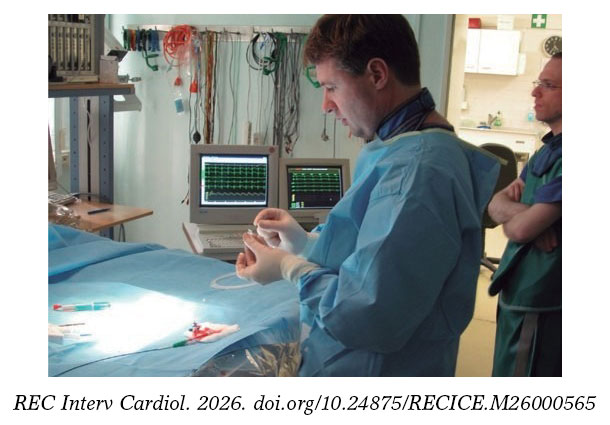
Experimental work in the animal cath lab (2006).
The concept of treating de novo lesions was initially proposed by colleagues performing peripheral vascular interventions. Gunnar Tepe and Thomas Zeller encouraged us to support a trial on the treatment of femoropopliteal lesions, an approach toward which I was initially very skeptical. Fortunately, the THUNDER trial3 demonstrated the utility of DCB in peripheral arteries and fundamentally transformed strategies in peripheral vascular intervention.
One of the early trials on coronary de novo lesions was the PEPCAD I study.4 It was a prospective, non-randomized series of patients with small coronary arteries. At that time, we had no understanding of lesion preparation and only a DCB, with a diameter of 2.5 mm, which we attempted to use for lesions ranging from 2.0 mm to 2.75 mm. The positive result was that approximately 70% of lesions could be successfully treated with DCB alone, with event rate in the mid-single-digit percentage range. Conversely, we learned that combining DCB therapy with stent implantation was detrimental, especially in cases of geographical mismatch.
Based on this, shortly after Eastern 2010, we organized the first meeting of the initially German, later international DCB Consensus Group in the timely context of the annual conference of the German Cardiac Society in Mannheim (Germany). My idea was to predilate the lesions to identify those requiring stent implantation. Along with Franz Kleber, I proposed the now widely accepted concept of ‘DCB only‘, focusing on lesion preparation to decide between drugeluting stents (DES) and DCB as the final treatment.5
Criteria were chosen pragmatically. Achievement of TIMI grade-3 flow was considered essential, and the classification of dissections smaller than type C was based on old data from the pioneering days of Grüntzig. The threshold of 30% residual diameter stenosis arose from the recognition that achieving 10% to 20% with conventional angioplasty was challenging (the advantages of specialty balloons were little known at the time) and, at the same time, 50% percent diameter stenosis would, by definition, mean restenosis. We, therefore, proposed a 30% cutoff, which has remained the standard to this day. These criteria are certainly not the last word on wisdom, and we must work to find better standards. Until then, we will continue to work with it, and for small coronary arteries, this concept has performed well in the Basket Small 2 trial,6,7 and larger studies such as Selution de novo have also successfully implemented these criteria.
Which were, and still are, the technical hurdles in the development and advancement of this technology?
The fundamental goal of DCB technology is to deliver as much drug as possible to the vessel wall for as long as possible, despite the short contact time between the balloon and the vessel wall. Accordingly, improvements include reducing drug loss, improved transfer to the vessel wall, a depot effect in the vessel wall, and reduced loss of the coating to the periphery.
Not all drug-coated balloons are the same. How do paclitaxel-based DCB compare with limus-based DCB in terms of efficacy and clinical outcomes?
The central issue is not so much which drug is better or worse, but rather how good or poor the coating technology actually is. Currently, there are significant and clinically relevant differences in this regard for both paclitaxel and sirolimus.
What is the current role of DCB in routine clinical practice?
At present, this very much depends on each center, the investigator and, most importantly, geographic region. In Asia, DCB have already been adopted by 40% in many countries, while in Europe we are slowly approaching the 20% mark. The United States, on the other hand, is just getting started.
For many years, our center has followed the principle of focusing on lesion preparation, which we do for every lesion. This ultimately results in a mix of DCB and DES, whereby the number of lesions and, above all, the length of the lesions have led to a predominance of DCB. We now encounter ISR almost exclusively in patients who previously received long stents at other centers.
Why are DCB currently in the spotlight?
That’s a question I ask myself every day these days, and I do not really have an answer. We have been following the basic principles of lesion preparation and the decision between DCB and DES for almost 15 years. For me, not much has changed in daily practice. The current hype is certainly mainly psychological. The important aspect is that we use this new dynamic to create reliable clinical evidence.
Where do you see this treatment modality in the next 5 to 10 years?
I am, of course, biased here. Patrick Serruys has just published a forecast in the European Heart Journal predicting an almost equal mix of DES and DCB by 2032.8 Whether this will actually be the case depends on many factors. For me, the most important thing is that we conduct high-quality scientific research.
Before we finish, how do you like to spend your time outside of your professional life?
The most important part of my life is my family. I deliberately reserve my free time exclusively for my wife, my son and our puppy.
FUNDING
None declared.
STATEMENT ON THE USE OF ARTIFICIAL INTELLIGENCE
None used.
CONFLICTS OF INTEREST
None declared.
ABOUT THE AUTHOR
Fernando Alfonso is associate editor of REC: Interventional Cardiology, with research interest is drug-coated balloons.
REFERENCES
1. Scheller B, Hehrlein C, Bocksch W, et al. Treatment of coronary in-stent restenosis with a paclitaxel-coated balloon catheter. N Engl J Med. 2006;355:2113-2124.
2. Byrne RA, Stone GW, Ormiston J, Kastrati A. Coronary balloon angioplasty, stents, and scaffolds. Lancet. 2017;390:781-792.
3. Tepe G, Zeller T, Albrecht T, et al. Local delivery of paclitaxel to inhibit restenosis during angioplasty of the leg. N Engl J Med. 2008;358: 689-99.
4. Unverdorben M, Kleber FX, Heuer H, et al. Treatment of small coronary arteries with a paclitaxel-coated balloon catheter. Clin Res Cardiol. 2010;99:165-174.
5. Kleber FX, Mathey DG, Rittger H, Scheller B, German Drug-eluting Balloon Consensus G. How to use the drug-eluting balloon: recommendations by the German consensus group. EuroIntervention. 2011;7 Suppl K:K125-K128.
6. Jeger RV, Farah A, Ohlow MA, et al. Drug-coated balloons for small coronary artery disease (BASKET-SMALL 2): an open-label randomised non-inferiority trial. Lancet. 2018;392:849-856.
7. Jeger RV, Farah A, Ohlow MA, et al. Long-term efficacy and safety of drug-coated balloons versus drug-eluting stents for small coronary artery disease (BASKET-SMALL 2): 3-year follow-up of a randomised, non-inferiority trial. Lancet. 2020;396:1504-1510.
8. Serruys PW, Oshima A, Ferraz-Costa G, et al. Coronary revascularization: a long-term perspective. Eur Heart J. 2025. https://doi.org/10.1093/ eurheartj/ehaf883.