
Transcatheter tricuspid valve replacement (TTVR) is an emerging alternative for patients at high surgical risk with isolated, severe, and symptomatic tricuspid regurgitation, particularly when anatomy is not amenable to transcatheter repair. This is the first case ever reported in Spain of TTVR using the new VDyne Valve (VDyne, United States), a transcatheter valve designed to preserve the asymmetric morphology of the tricuspid annulus. The device consists of a nitinol dual-frame structure housing a 30-mm trileaflet porcine valve. The asymmetric outer frame accommodates annular diameters ranging from 42 to 56 mm and is secured through anchoring to the right ventricular outflow tract (RVOT), using fixation tabs along the free wall, a posteroseptal tab, and a ventricular tail (figure 1). The device is vertically mounted on a 32-Fr femoral delivery system. Compared with other TTVR systems, its advantages include anchoring that is independent of native leaflet visualization or support, minimal interaction with the right ventricular apex, and the ability to achieve full recapture and repositioning after intracardiac deployment.
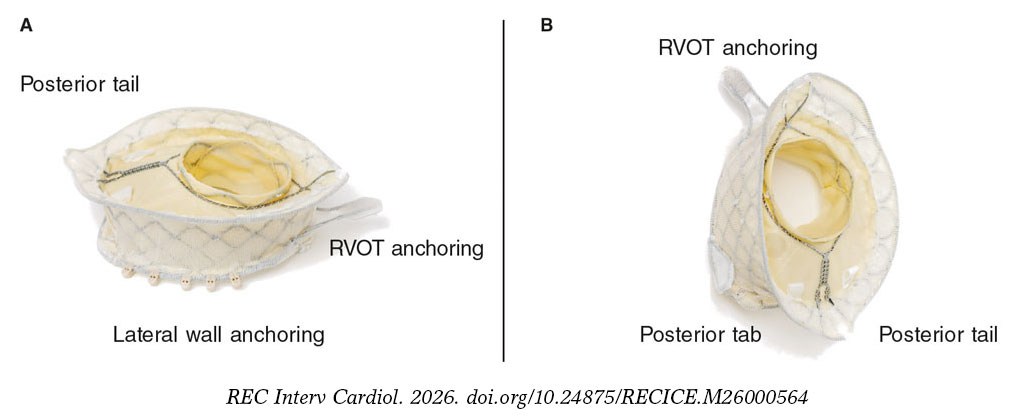
Figure 1.
The procedure was performed in an 81-year-old woman with symptomatic disease (TRI-SCORE, 6) (New York Heart Association functional class IV, ambulatory), massive functional tricuspid regurgitation (effective regurgitant orifice width, 9 mm), and a tricuspid annulus perimeter of 137 mm (figure 2A-B). The VDyne valve (size 1 with 6% oversizing) implanted under fluoroscopic and echocardiographic guidance achieved the complete resolution of tricuspid regurgitation as confirmed by angiographic, echocardiographic, and postoperative computed tomography imaging (figure 2C-D and videos S1-S4). The patient was discharged on postoperative day 5 with marked clinical improvement, corresponding to NYHA functional class II and an increased distance on the 6-minute walk test (+90 m). This case reinforces the potential role of TTVR using dedicated valves in patients with no previous therapeutic alternatives.
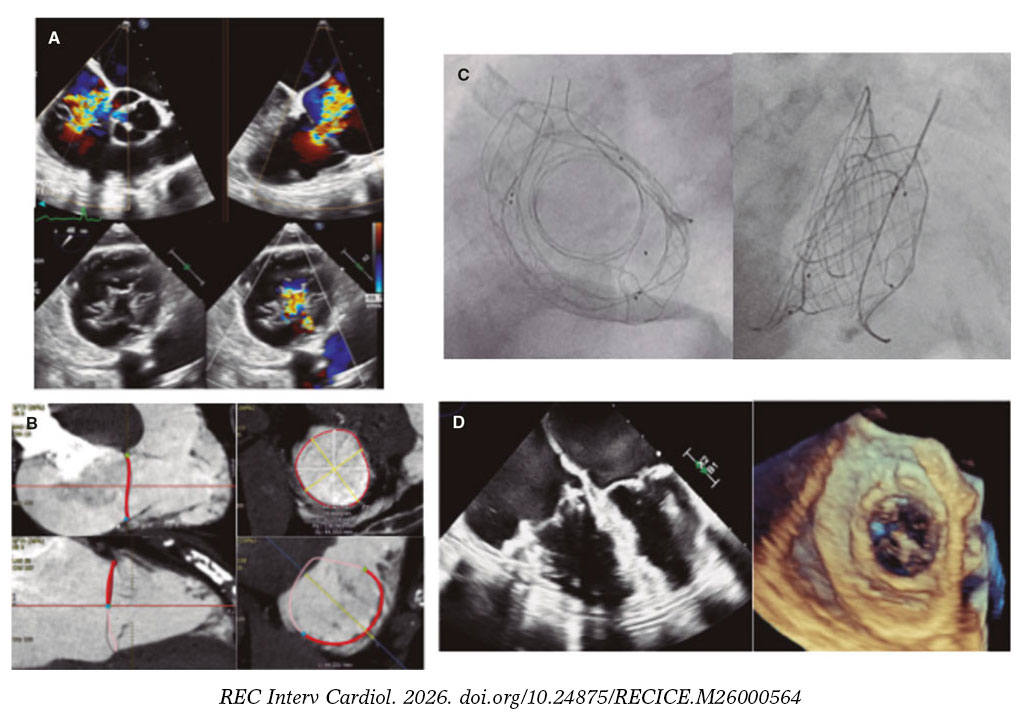
Figure 2.
FUNDING
None declared.
ETHICAL CONSIDERATIONS
It is confirmed that informed consent was obtained for performance of the procedure and for data collection with the purpose of anonymously publishing the results. The SAGER guidelines are not applicable to this article.
STATEMENT ON THE USE OF ARTIFICIAL INTELLIGENCE
The authors declare that no artificial intelligence was used to generate content for this publication.
AUTHORS’ CONTRIBUTIONS
P. Mahía Casado and L. Nombela-Franco: conception and design of the work, manuscript drafting, final approval of the published version, and accountability for all aspects of the work, ensuring that any questions related to accuracy or integrity were appropriately investigated and resolved. All other authors: critical revision of the manuscript with important intellectual contributions and final approval of the published version.
CONFLICTS OF INTEREST
None declared.
SUPPLEMENTARY DATA
Vídeo 1. Mahía Casado P. DOI: 10.24875/RECICE.M26000564
Vídeo 2. Mahía Casado P. DOI: 10.24875/RECICE.M26000564
Vídeo 3. Mahía Casado P. DOI: 10.24875/RECICE.M26000564
Vídeo 4. Mahía Casado P. DOI: 10.24875/RECICE.M26000564